


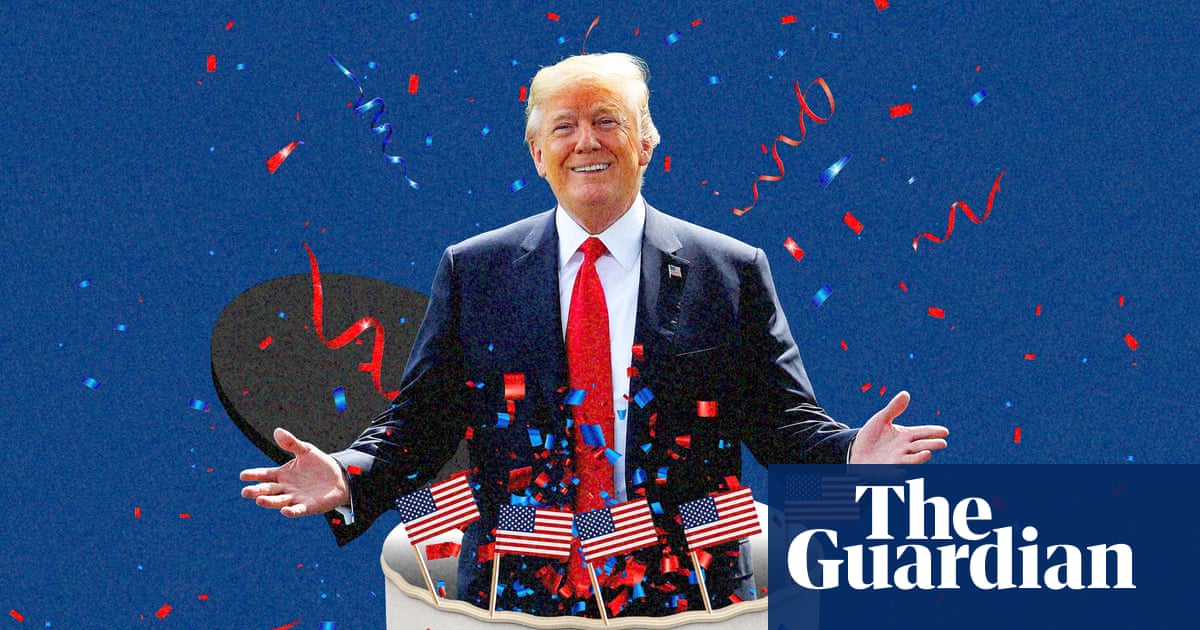
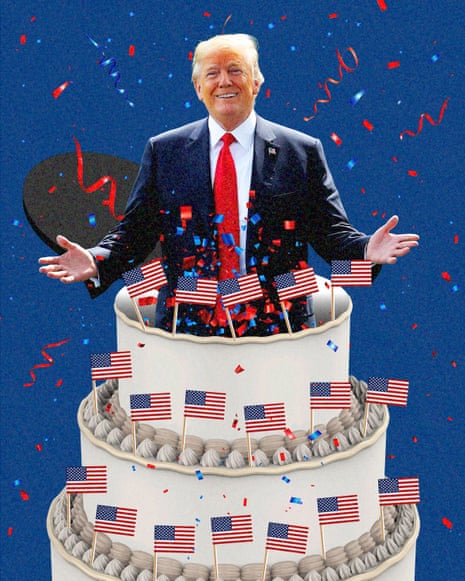
Trump, laying siege to freedoms and truth itself, is twisting America’s milestone birthday into a joyless occasion
This is the room where it happened. The assembly room at Independence Hall in Philadelphia where, 250 years ago this week, a group of sweating, treasonous men broke from the most powerful empire since ancient Rome. Amid a summer of trial and error, delegates including John Adams, Benjamin Franklin and Thomas Jefferson ratified a flawed but aspirational document to declare their independence from the British crown. The date was 4 July 1776 – but it took nearly a month for all 56 delegates of the Second Continental Congress to formally sign on.
“I don’t blame them,” Maggie Burkett, a park ranger, told a group of about 40 tourists as they gazed at green baize tables adorned with books, letters, pipes and candles one recent afternoon. “These words on this page are treason, just as much as burning the king’s coats of arms was. By signing this document, you are literally risking your life. The 56 men who signed this document were brave. In my opinion, they were heroes.”
The anniversary of this date and this document should be cause for a unifying nationwide celebration. Yet two and a half centuries after a bloody revolution that humiliated King George III and installed George Washington as the first US president, the semiquincentennial has become just the latest cue for division, rancour and existential angst.
“There’s a sense of dread,” said Eddie Glaude, the author of America, U.S.A.: How Race Shadows the Nation’s Anniversaries. “It’s as if it’s going to descend below kitsch. It’s going to be a collage of terrible myth-making.”
Two hours south of Philadelphia, in Washington DC, the official epicentre of the nation’s birthday party is, critics say, looking less like a dignified civic jubilee than a gaudy reality TV pageant.
Trump, who has been hyping this anniversary for years and has expressed glee that it falls in his second term, launched a project to beautify the capital, with statues scrubbed clean of graffiti and water flowing from long neglected fountains. He even intends to build a triumphant arch that will dwarf the Arc de Triomphe in Paris.
But in a metaphor that is almost too neat, the president has come unstuck with a $14.7m renovation of the Lincoln Memorial reflecting pool on the National Mall. No-bid contracts for the work were awarded to vendors with past ties to the president. Within days of its completion, an algae bloom turned the pool water bright green while its “American flag blue” coating began to peel off. Trump has blamed the embarrassing debacle on mysterious vandals and threatened the alleged vandals with jail time.
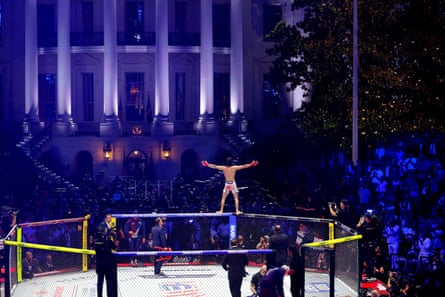
This tone was set over a month ago when, on 14 June, coinciding with his 80th birthday, Trump commandeered the White House South Lawn to host brutal Ultimate Fighting Championship cage matches. He followed up last week on the National Mall with a formal kick off the Great American State Fair, effectively a Trump rally with military jets roaring overhead that was hastily arranged when previously announced performing artists withdrew over the event’s partisan nature.
Addressing the crowd, transportation secretary Sean Duffy railed against “those libtards that cancelled on us” while praising Trump as “the greatest president that’s ever existed in this country since George Washington”. The affair featured no Democrats and culminated with Trump’s familiar battle cry of “Make America great again” and signature dance to the Village People’s YMCA performed by the US Marine Band.
The state fair is running for 16 days, and all 56 states and territories are represented, including some that opted not to send a delegation because of Trump’s hands-on approach. The half-baked tribute to Americana – described by the Washingtonian as “sparsely attended and shockingly boring” – features a ferris wheel that was reportedly plagued by power cuts on opening day.
The mall will host a “Salute to America” celebration on 4 July itself, again starring Trump and an attempt to break the Guinness world record for the biggest firework display ever seen. In August IndyCar descends on the capital for the inaugural Freedom 250 Grand Prix of Washington DC.
All of this has come about after America250, the official bipartisan commission established by Congress more than a decade ago, was elbowed aside in favor of Freedom 250, a Trump-aligned initiative. America 250’s modest ambitions include a time capsule with contributions from all 50 states, an essay contest for students and an America’s Block Party concert on 4 July featuring Queen Latifah, Chris Stapleton and the Smashing Pumpkins.
The upshot is that America’s milestone birthday feels particularly joyless, less a celebration of the world’s most powerful country than a case study in how a demoralised, self-doubting nation has fallen prey to culture wars and the narcissism of its leader. Trump – a uniquely divisive president laying siege to freedoms, institutions and truth itself – has proved to be the ultimate party pooper.
Speaking from a hotel across the street from Independence Hall, David Blight, a professor of American history at Yale University, said: “I don’t feel celebratory at all. I don’t know how to explain [Trump’s] vanity projects any better than anybody else. This is who he is. He’s not unlike Mussolini, who wanted to leave his mark all over Rome. It’s like theatre of the absurd.”
Blight and others draw a contrast with the bicentennial of 1976 when, amid a glut of commemorative merchandise, New York hosted a floating parade of 16 tall ships and more than 100 smaller vessels from around the world, including the Soviet Union. The Smithsonian National Air and Space Museum, boasting an array of planes and rockets, from the Wright brothers’ flyer to the Apollo 11 command module, opened on the National Mall. Gerald Ford, then the president, did not make the celebration about himself.
There are other gestures at semiquincentennial celebration that do not center Trump, but they seem muted, said Jill Lepore, a professor of American history at Harvard University and staff writer at the New Yorker magazine. “To be doing something is somehow to seem as if you’re supporting Trump to some people, which is ridiculous,” she said. “We should be able to have the nation’s birthday without it somehow being an endorsement of this crazy man who happens to be in the White House.”
The gloom is shared by a pessimistic American public. According to a recent Reuters/ Ipsos poll, 38% of respondents – including 40% of Democrats and 26% of Republicans – do not believe the US will even exist as a single country 250 years from now. Nearly two in three Americans agree that their democracy is in danger of failing.
Even among conservatives, there is a sense of mourning for the jamboree that could have been. Bill Whalen, a fellow at the Hoover Institution thinktank in Stanford, California, said: “Ideally, the celebration of the 250th anniversary of the founding of the republic should be the equivalent of the Christmas truce of world war one, where people put down their weapons and got together and exchanged cigars and played soccer and stopped fighting for at least a very brief period of time.”
Whalen suggests that voters in the 2024 election deciding between Trump, a Republican, and Democrat Kamala Harris chose how the anniversary would be marked without knowing it. “With Kamala Harris, 1776 would have turned into a very long conversation about 1619 [when the first enslaved Africans arrived in English North America] and a republic built upon robber barons and inequality and injustice. It would have been a time of reflection, sorrow and shame.
“The good news is you don’t get that with Donald Trump. The bad news is with Donald Trump you get a question of good taste and what is excessive, what is tacky and what is narcissistic.”
The preamble to the declaration of independence has been described by the historian Walter Isaacson as the greatest sentence ever written: “We hold these truths to be self-evident, that all men are created equal, that they are endowed by their Creator with certain unalienable Rights, that among these are Life, Liberty and the pursuit of Happiness.”
Yet Jefferson, its author, enslaved more than 610 people over the course of his life, and some of the other founding fathers did likewise. In 1776 more than 400,000 African Americans lived in slavery. Women could not vote and typically could not own property. The declaration makes reference to “merciless Indian Savages”, and the young republic removed Native Americans from their lands.
America has spent 250 years wrestling with the contradictions of its original sin. The anniversary should have presented an opportunity to contend honestly with these tensions, the zigs and the zags, the giant leaps forward and the jarring backslides. Trump’s mere presence inadvertently proves the point.
“You can easily understand American history from the beginning as a contest between competing ideas of liberalism and illiberalism. We’re frozen in that battle,” said Lepore, author of We the People: A History of the U.S. Constitution.
She continued: “Trumpism is not an aberration; it’s an expression of a very strong and durable strain in American politics and culture. But it’s always in the midst of an ongoing contest. How does one steer back? That is very challenging because of the institutional rot, the constitutional rot, the civic rot, the general decay of trust in institutions, which I associate as much with technological change and the power of Silicon Valley as I do with Trumpism.”
Glaude, a professor of African American studies at Princeton University, views the current moment not as an anomaly but as an echo of 1926, when the white supremacist Ku Klux Klan marched on Washington claiming credit for Calvin Coolidge’s election, and when Coolidge himself rejected the idea that America needed to strive for a “more perfect union”, arguing instead that the nation merely needed to remember and restore its past. Trump, Glaude argues, has echoed that 1926 rhetoric by “yoking the perfection of the country to himself”.
Jefferson’s first draft of the declaration of independence did condemn the transatlantic slave trade but the section was removed, probably to appease slaveholders in the southern colonies. Glaude added: “There’s this contradiction, this doubleness, this divided soul in which America imagines itself as a beacon of freedom and as a white republic. You can’t hold those two commitments together without contradiction, without depositing a kind of madness at the heart of the country. That madness evidences itself in cycles, and we happen to be in one right now.”
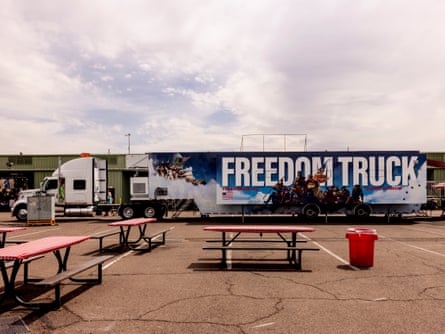
Beneath the Freedom 250 bombast of UFC fighters and IndyCars, some observers perceive a more insidious ideological project: a conscious effort to rewrite the American narrative into an exclusionary myth of white, male Christian triumph. A fleet of six mobile museums, or “Freedom Trucks”, have been travelling the country telling a relentlessly positive and patriotic story that downplays slavery and other dark chapters and culminates with a video of Trump.
Meanwhile, last year, in an executive order entitled “Restoring Truth and Sanity to American History”, Trump directed the removal of “improper, divisive or anti-American ideology” from the Smithsonian Institution, the world’s biggest museum, education and research complex. Lonnie Bunch, the first Black secretary of the Smithsonian, described this as the most challenging period for the institution since the civil war.
A federal court filing alleges that the president also ordered dozens of signs, exhibits, films and other materials be removed from at least 37 National Park Service (NPS) sites in a crusade against objects that “disparage Americans”.
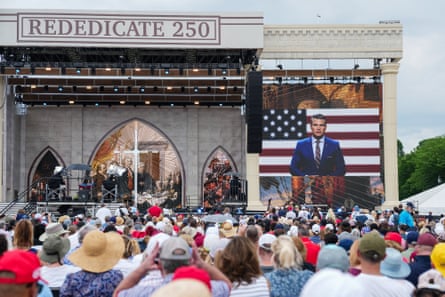
Robert P Jones, the president of Public Religion Research Institute, recently witnessed an event on the National Mall that was billed as a “faith-based jubilee of prayer, praise and thanksgiving” with no pretense of separation between church and state. At the “Rededicate 250” event he saw a sprawling set designed to look like a government building with 40ft faux stone columns, yet the backdrop was a church featuring a colossal stained-glass window and a 30ft cross. Speakers delivered an explicit evangelical Christian message, but there was no one from any historic Black denomination.
This overt Christian nationalism is driven by demographic panic, Jones argues, noting that in 1976, 81% of the country was white and Christian; today, that figure has plummeted to about 40%. This poses the first major test of whether the country truly believes in the first amendment of the constitution guaranteeing the free exercise of religion and non-establishment of any particular religion by the state.
“We’ve always had these conflicting principles in the constitution that have only partially been lived out in practice,” said Jones, “but in particular, this sense of America as a pluralistic nation or a Christian nationalist nation is front and centre, and a real struggle for the future.”
Back in Philadelphia, a simple wooden chair used by Jefferson in 1776 sits mere inches away from a rusting metal bench from a jail cell in Birmingham, Alabama. It was on that bench in 1963 that Martin Luther King Jr penned an open letter about civil disobedience, throwing Jefferson’s words back at a society that had failed to live up to them.
This jarring juxtaposition opens The Declaration’s Journey, an exhibition at the Museum of the American Revolution in Philadelphia that maps the declaration of independence’s influence on freedom movements around the world.
Tyler Putman, its curator and the museum’s manager of gallery interpretation, explained King’s intentions: “Letter from Birmingham Jail is written in response to a critique he’s received from white clergy who are like, ‘Look, we’re all in favor of this equality thing but you’re going too fast, you’re trying too hard.’ He says, ‘Well, if I’m a radical, Thomas Jefferson was a radical,’ and he quotes the declaration.”
Putman is fascinated by how Jefferson’s words spread across the globe to inspire the French revolution, the Haitian rebellion and anti-colonial movements in Chile and India. He points out draft cards from the first world war where Black soldiers were instructed to tear off a corner so the segregated army could identify their race. Across the torn cards, the soldiers had written: “We hold these truths to be self-evident.”
The exhibition is proof that, while the White House stages its partisan spectacles, the nation’s cultural institutions are engaging in a quiet, methodical resistance, wielding primary sources and complex storytelling against the onslaught of the great man theory of history.
In Montgomery, Alabama, the Freedom Monument Sculpture Park commemorates the millions of people who lived and died in slavery, while a memorial at the Legacy Museum is dedicated to the victims of racial terror lynchings. At the Smithsonian Castle in DC, curators point to a component of the Electronic Numerical Integrator and Computer (Eniac), the world’s first general-purpose mainframe computer, whose earliest programmers were women who laid the foundations for modern computer science.
Trump is telling one version of American history on the National Mall, a story that appears to start with Columbus and Washington and end with Elon Musk and Trump himself. Yet even as his tepid state fair and putrid reflecting pool kill the mood, the mall is surrounded by museums that continue to do the work of striving for unvarnished truth.
Away from the official events, there are different songs of the summer: Zohran Mamdani capturing the euphoria of the New York Knicks’ basketball fans; Barack Obama opening his presidential centre in Chicago with a more inclusive vision of America; football fans bringing joy to the World Cup and allowing Americans to see their country anew through others’ eyes. A happy birthday after all.
At Independence Hall, the visitors still come. One recent afternoon Kim Wilson, 52, from Raleigh, North Carolina, had taken the last tour of the day. As the Centennial bell chimed from the hall’s belfry, she mused: “It was so wonderful to be in the room where so many people took such courage to do things that were very difficult.
“I feel like we’ve lost a lot of courage to do very difficult things as a people. We don’t stand for things as much as people used.”
Sitting nearby was Dimitrios Dimoulas, a Brazilian immigrant wearing a blue Brazil football shirt, who became a US citizen in 1976, the year of the bicentennial. He insisted that the current malaise is merely a passing phase. “No matter who you are and what you are, you’ve got to listen and learn,” he said. “That’s all we need. Sooner or later, this is going to pass and then there will be other problems. If you don’t have history, you don’t have a life.”