


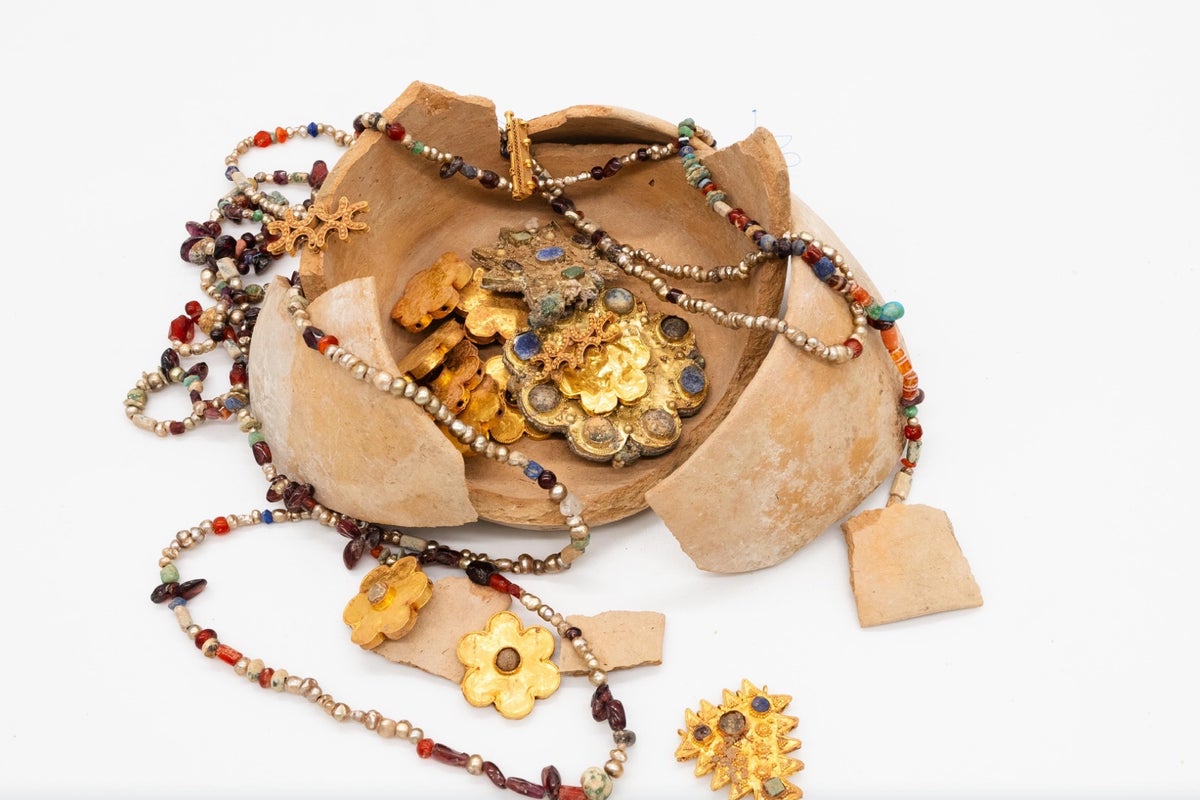
Archaeologists have unearthed an ancient clay pot in Saudi Arabia containing gold, silver, and gemstone-encrusted jewellery that was likely buried over a millennium ago by a pilgrim en route to Mecca.
The trove was found on the outskirts of an archaeological site in Riyadh’s Diriyah, leading experts to dub it the “Diriyah Treasure”.
The site was a key stop for Hajj pilgrims travelling between Basra in Iraq and Mecca in Saudi Arabia, with the main settlements in the region dating between 743 AD and 753 AD.
The Saudi Heritage Commission announced on X the discovery of “100 Abbasid Era gold pieces accompanied by several silver artefacts and precious gemstones, unearthed at the Diriyah site… during the sixth season of the archeological excavations in the Al-Qassim region”.
“The site’s significance lies in its role as a key station on the Basra-Hajj route, with a settlement history extending from the era of the Rashidun Caliphs to the early Abbasid Era,” the commission wrote.
Excavations have been ongoing at the site for over six years, and in recent digs researchers unearthed stone foundations and the walls of several ancient residential buildings.
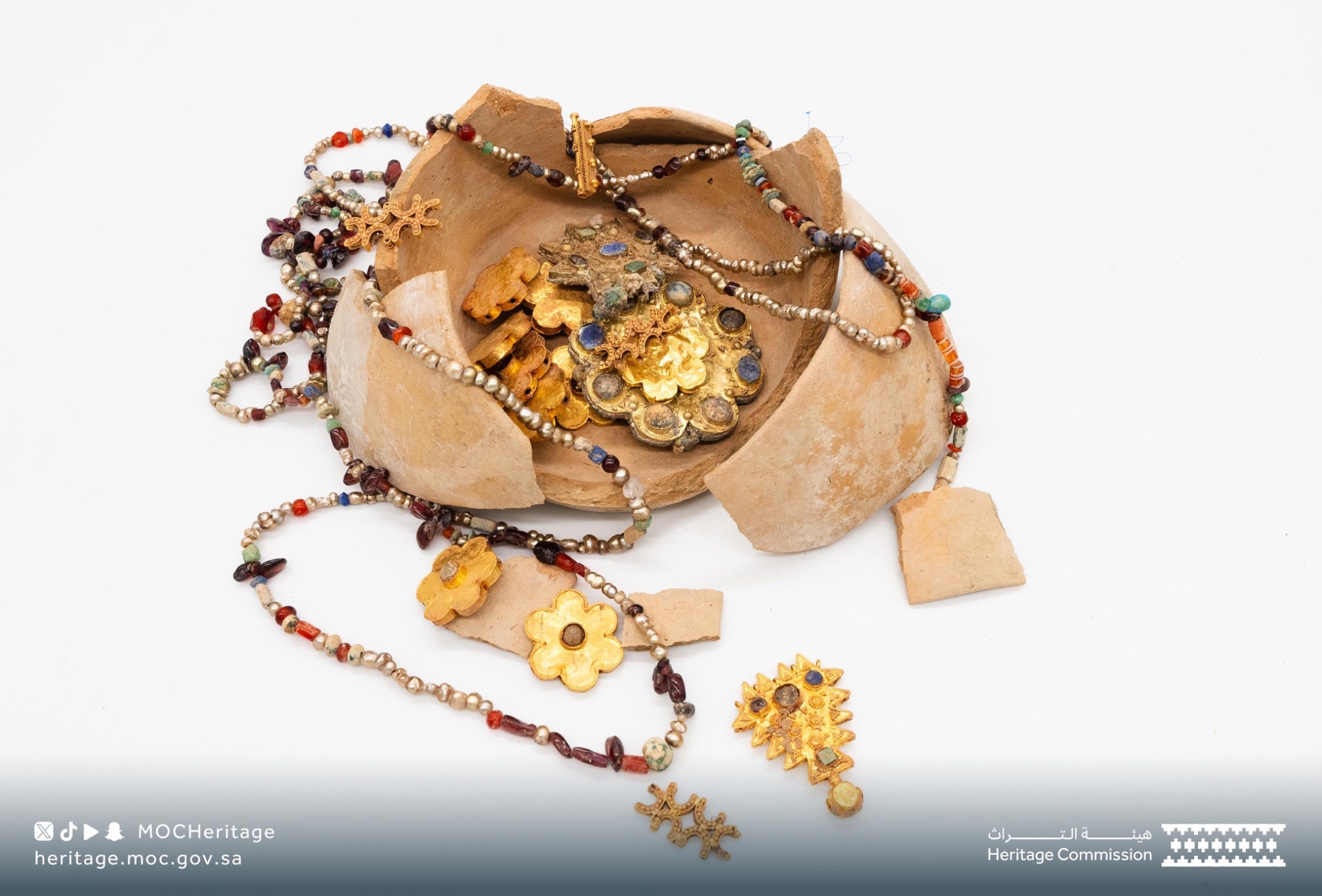
In one of these structures, archaeologists found pottery and glass fragments, including a buried ceramic jar containing more than 100 pieces of jewellery.
“One of the most important discoveries of this sixth season was the uncovering of the ‘Diriyah Treasure,’ which consists of a collection of gold pieces, gemstones and oxidised copper fragments,” a researcher who was part of the excavation team said, in a translated video shared on X by the commission.
The treasure pot was likely buried around 750 AD during the early years of the Abbasid caliphate, which was destroyed in a Mongol invasion in 1258.
Gold pieces found in the pot are adorned with floral and intricate geometric motifs, indicating they were crafted by skilled metalworkers.
The motif was likely made by shaping sheets of gold, embossing them, and inlaying semi-precious gems, Gulf News reported. The exact inspiration behind these patterns remains unknown.
Pot fragments recovered from the Diriyah site are being preserved at restoration laboratories under the Saudi Heritage Commission.
The latest findings expand our knowledge of human settlements in the area dating back to the late third century, and highlight its importance along key pilgrimage and trade routes, researchers say.