


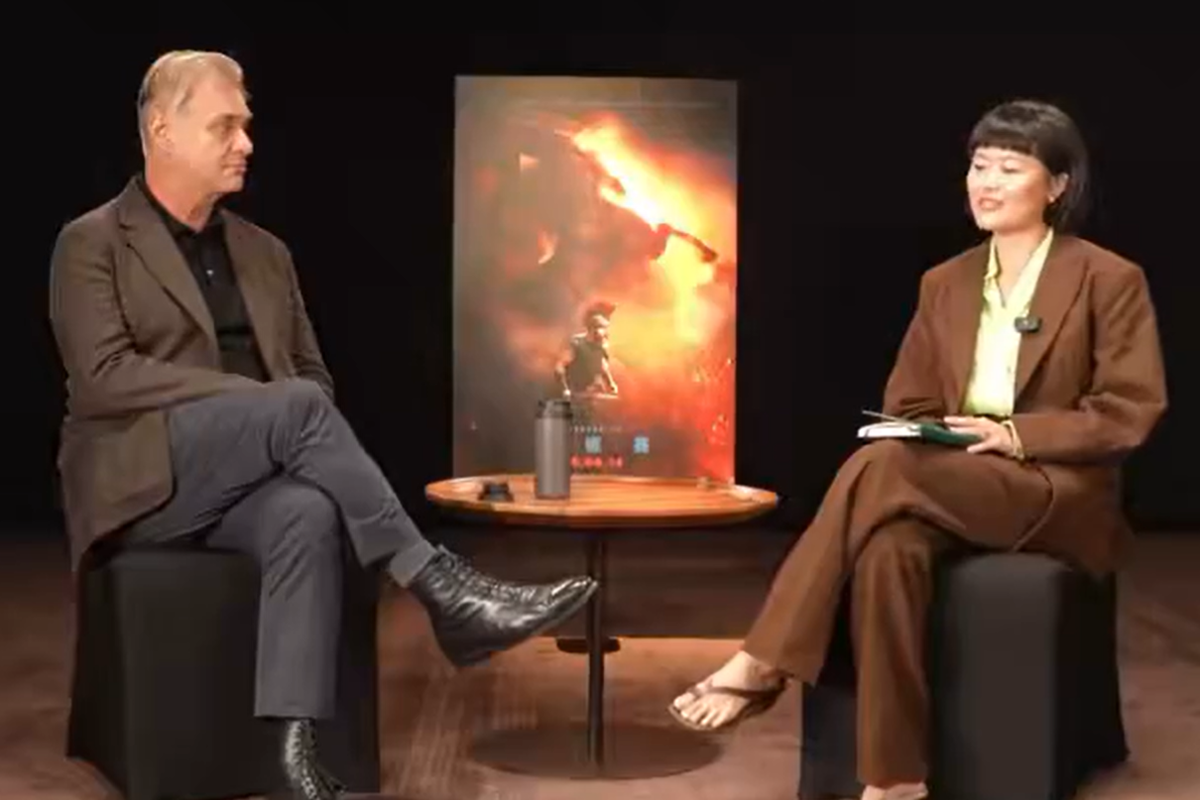
A Chinese podcaster, who became an unlikely international sensation after a philosophical interview with Christopher Nolan, is facing allegations that she translated, paraphrased, or repackaged other people’s work without proper attribution.
Zhongshu, whose real name is Yiyang Zhuge, is a 29-year-old political theory PhD candidate at Boston College.
She has been accused by Chinese social media users of taking material from English-language podcasts and publications for her own Mandarin-language programmes and writing.
The allegations emerged within weeks of her interview with Nolan, which took place when he visited Beijing to promote The Odyssey.
The 17-minute conversation, first posted on the Chinese video platform Bilibili, quickly spread across social media and turned Zhuge into a subject of international fascination.
Instead of the usual press-tour questions, she steered Nolan into territory spanning war, repentance, heroism and the gods, asking whether he saw himself as “a bard at the twilight of Western civilisation”, if Odysseus should feel remorse for his pride, and whether Nolan’s Odyssey had been “Christianised”.
However, shortly after her sudden internet popularity, Chinese users began comparing episodes of her podcast, Du Shu Bu Cheng Lin (A single tree does not make a forest), with English-language programmes, alleging that the similarities extended beyond broad arguments to the sequencing of ideas, details, and even jokes, according to Shanghai-based outlet Shangguan News.
A website created by people investigating the allegations said it had randomly checked 125 episodes and found what it described as clear source-dependence or attribution problems in 75 of them.
One alleged example has become particularly prominent because it appears to reproduce an error in the supposed source.
In Breaking History, an English-language podcast about Iran, a guest referred to the country’s “Health Corps” and “Literacy Corps”, but an AI-generated transcript reportedly misheard and produced the word “corps” as “court”.
Critics who compared the episode with Zhuge’s own podcast found that her Chinese version also referred to the organisations as “health court” and “literacy court”, and argued that the unlikely repetition of the same mistake suggested Zhuge had adapted the automated transcript rather than working from the original audio, according to Lianhe Zaobao.
They also pointed out that the preceding and following sections also very closely resemble the podcast episode in both content and phrasing.
Zhuge has also been accused of lifting material for an article she wrote for Caixin Weekly titled How Universities Combat AI Cheating. Critics compared the piece with Rose Horowitch’s article How AI Killed a 133-Year-Old Princeton Tradition, published by The Atlantic on 12 May, pointing to similarities in both the structure and wording.
Both articles open with the same reference to a 2024 article in Princeton University’s student newspaper, while Zhuge’s piece also describes the university’s honour code as having survived “two world wars, the upheaval of the 1960s, the disillusionment of Watergate, and even the rise of search engines” – a passage that closely follows Horowitch’s article.
Caixin Weekly has since removed Zhuge’s article from its website and replaced it with a notice saying it is “pending review”.
Critics have also alleged that portions of the nearly 10,000-word introduction she wrote for her 2025 translation of Plutarch’s How to Benefit from Enemies was adapted from scholarship in the Companion series on Plutarch without proper attribution.
Zhuge has rejected the plagiarism and “content laundering” accusations and said that she had seen the website compiling comparisons between her work and alleged sources.
“The English and Chinese on that website don’t match, their evidence doesn’t match, and none of it is a word-for-word translation,” she told Shangguan News in Chinese.
At the same time, Zhuge acknowledged that overseas media and podcasts are among the sources she uses.
Discussing her coverage of the Canadian election, she told the outlet: “I would read relevant reports from American and Canadian media, and then compile this information into a podcast episode.”
She added: “I’m not a journalist, nor am I on the scene; many of my sources come from listening to overseas podcasts.”
She said she had been reluctant to respond publicly because she believed it would be futile.
“For example, the scripts for the latest podcast episodes were written by me on a plane without any references,” she said.
“But after they were released, someone quickly provided the full timestamps and said that this and that part were plagiarised. I can’t stand up and say that I haven’t read the books and manuscripts you mentioned.”
Last week, Beijing-based publishing company Zhiyuan Culture’s Yewang imprint announced the cancellation of three events scheduled for 21 to 23 August in Wuhan, Changsha, and Shanghai to promote Zhuge’s translations of works by German-American political theorist Hannah Arendt.
The publisher said Zhuge was “unable to attend as planned due to adjustments to her personal schedule” and that the events had therefore been cancelled by mutual agreement.
“I cancelled it a long time ago; it was just that the bookstore recently announced it,” she said, adding that she had “turned down all the book launch events” because she wanted to spend more time with her family.
“My elders at home aren’t in good health, there’s been some controversy about me online, and I’m feeling a bit emotionally exhausted myself,” she said.