


More than nine in 10 (91%) UK adults were using least one form of online, mobile or telephone banking in 2025, according to a banking and finance industry body.
The proportion increased from 88% of adults who were using remote banking in 2024, UK Finance said.
Mobile banking remains the preferred option, used by three-quarters (75%) of adults, according to UK Finance’s Payment Markets Report for 2025.
The report said: “Looking ahead to 2035, the UK payments market is expected to continue growing while becoming more digital.”
 open image in gallery
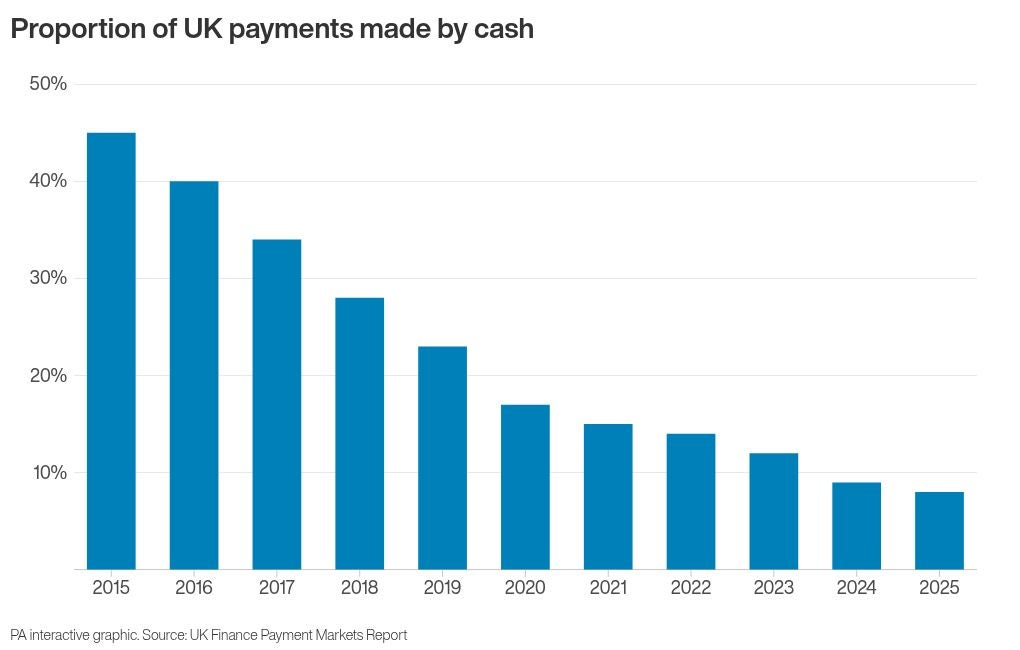
Cash use fell last year and is expected to decrease further over the coming decade “but not disappear”, according to the report.
Around 1.4 million UK adults mainly use cash for their day-to-day spending, but 19 million use cash once a month or less frequently, according to UK Finance’s estimates.
Cash use fell to 3.9 billion payments in 2025, down from 4.3 billion the previous year.
Cash represented 8% of all payments in 2025, falling from 9% in 2024 and 45% in 2015.
By 2035, cash use is expected to account for just 4% of payments made in the UK, with around two billion transactions, the report said.
It added: “While cash payments decline, cash machines continue to play dominant role in access to cash as 49.3 million people used one in 2025.”

Get a free fractional share worth up to £100.
Capital at risk.
Terms and conditions apply.
ADVERTISEMENT
Get a free fractional share worth up to £100.
Capital at risk.
Terms and conditions apply.
ADVERTISEMENT
It also found that nearly two-thirds (65%) of UK adults were registered for at least one mobile payment service in 2025, up from 57% in 2024.
UK Finance said that, while mobile contactless is increasingly replacing physical card contactless, mobile wallet adoption varies by age.
Around nine in 10 (89%) of 25 to 34-year-olds are registered, compared with 29% of over-65s.
Account-to-account payments also continue to grow.
Faster Payments and other remote banking payments reached 6.2 billion in 2025, making them the second most-used payment method, UK Finance said.
Faster Payments and other remote banking is expected to see particularly strong growth over the decade ahead, reaching 8.4 billion payments by 2035 and accounting for 16% of UK transactions.
The report said: “Consumers increasingly use mobile and online banking for bill payments, transfers and person-to-person transfers, while businesses continue to rely heavily on Faster Payments for account-to-account transfers.”
People are using Faster Payments to split bills and send money to friends and family, replacing transactions that would have previously involved cash, UK Finance said.
Debit cards were the most used payment method last year, with 26.6 billion payments, accounting for more than half of all payments in the UK.
UK Finance predicted that debit cards are forecast to reach 29.5 billion payments by 2035.
During 2025, the number of contactless payments made in the UK increased to 19.2 billion, from 18.9 billion payments the previous year.
This was driven by the continued rollout of card acceptance devices, consumer preferences and the continuing growth in popularity of mobile contactless payment services such as Apple Pay and Google Pay, the report said.
Around two-fifths (39%) of payments in the UK were made using contactless methods in 2025.
A decade ago, contactless made up 3% of transactions.
By 2035, contactless is expected to make up 41% of payments.
Meanwhile, an estimated 12.9 million, or 22% of UK adults used buy now pay later (BNPL) services at least once last year, the report said.
In July 2026, the BNPL sector was brought under the regulation of the Financial Conduct Authority (FCA), giving customers stronger protections.
The report used data from various sources, including payment figures provided by members of UK Finance and research among consumers.
Some 49.7 billion payments were recorded in 2025, marking a 2% annual increase.
People accounted for 41.6 billion payments last year and businesses (including commercial organisations, government, and not-for-profit organisations) were responsible for 8.1 billion payments.
Adrian Buckle, head of research at UK Finance, said: “UK Finance’s latest data show that the UK is now a predominantly digital economy when it comes to making and receiving payments.
“Faster Payments continue to grow strongly, while cards remain central to everyday spending.
“The trends of the past decade are becoming increasingly established.
“Cash usage is declining, albeit more gradually, and growth across many payment methods is stabilising as the market matures.
“The industry is now entering a new phase of innovation.
“New payment technologies have the potential to reshape how people and businesses move money, and continued close engagement across government, regulators and industry will be essential to unlock that potential.”
John Howells, chief executive of ATM and cash access network Link said: “The way we pay for things is changing at pace.
“While cash use continues to decline in every part of the UK, it remains vital for millions of people.
“Link will continue working to ensure people can access cash for free on the high street.
“As policymakers work on how payment systems are designed in the future, it’s clear that those systems will still need to work with cash.”
Gareth Oakley, chief executive at Cash Access UK, said: “We know more people are comfortable and choosing to pay with contactless cards or with their smartphones.
“As a result, cash use is falling.
“What’s vital to recognise is that there are millions of people who rely on cash and face-to-face services.
“Technology doesn’t always work for everyone, and for so many there isn’t an alternative to cash.
“For those who rely on cash and for many more, who still need basic banking services, we are pleased to be rolling out banking hubs across the country, with almost 250 open already.”