


AdvertisementC-Suite Content HubBusiness
Building Smarter Human Experiences
Yiyin Zhao, Managing Director of Samsung Electronics Hong Kong, champions a “human-centred” approach to innovation by integrating global technological scale with hyper-local insights.
BySCMP C-Suite5-MIN READ5-MIN Listen
Jolene OtrembaPublished: 5:00am, 29 May 2026
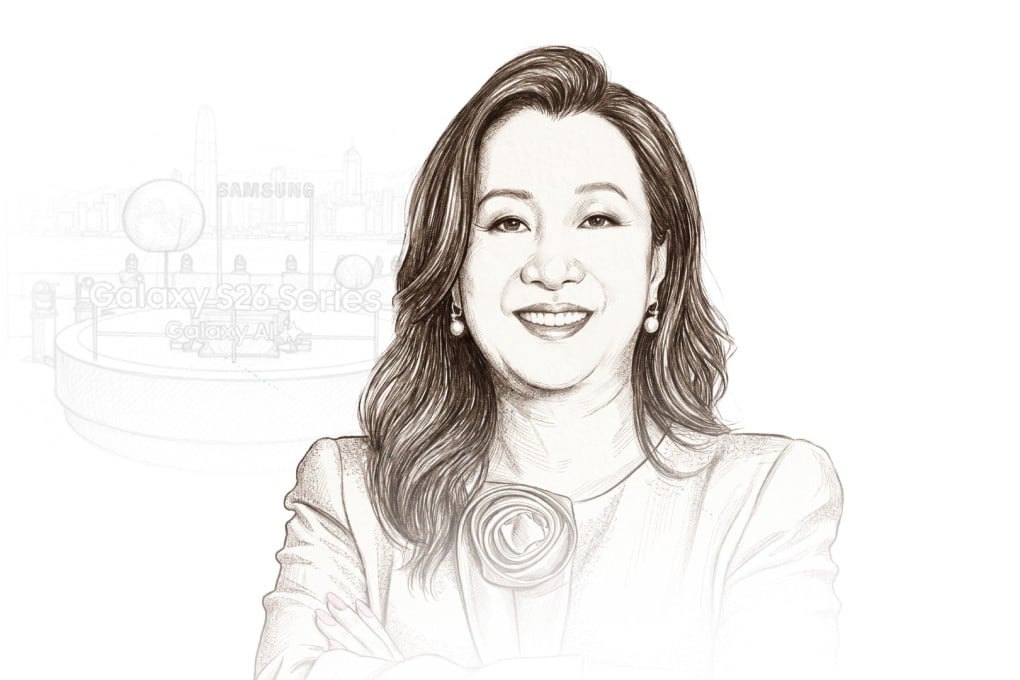
As Managing Director of Samsung Electronics Hong Kong, Yiyin Zhao shows that global scale and local insight can drive meaningful innovation. She is steering Samsung Hong Kong through the AI revolution with human-centred leadership, localisation and accessible innovation.
A preview of Samsung technology does not arrive quietly. A screen renders three-dimensional imagery without glasses, an AI-powered refrigerator suggests recipes and phones shift into privacy mode – handy on the MTR. It is immersive, seamless and almost frictionless.
At the centre of this ecosystem is Yiyin Zhao, Samsung Electronics Hong Kong’s first female managing director. Since her appointment in 2018, the company has become a market leader in foldables, smartphones and TVs across Hong Kong and Macau, while accelerating adoption of wearables, tablets, connected appliances and digital payment services.
Advertisement
Zhao, however, downplays the symbolism of her title. Asked about breaking the glass ceiling in a male-dominated industry, she redirects the focus from identity to impact. “I don’t think it’s really a personal milestone,” she says. “The company’s success is really built on diversified perspectives.”
For her, capability matters more than gender, and leadership is measured by deliverables, curiosity and inclusion.
Advertisement
Her approach mirrors Samsung’s own strategy: integration across cultures, markets, technologies and people.
Changing the Game
But to bring it to the start, she explains the wider ecosystem in which the company has to operate. Hong Kong is one of the world’s most unforgiving consumer electronics markets: compact, hyper-connected and intensely competitive, she explains.
Advertisement
“Consumers are extremely tech savvy, very advanced, very fast-paced,” she adds.
It is also, she notes, “basically a test bed”. In a city where global brands collide and consumers upgrade quickly, survival depends on relevance.
Samsung’s response has been twofold: build a connected ecosystem and localise relentlessly.
Advertisement
“In multiple product categories we are market leaders,” she says. “In the categories that we play, we are a leading player.”
But leadership, for Zhao, is not about product dominance alone. It is about system thinking.
“Consumers nowadays are looking for not just one device, it’s the whole system to make their life better, more seamless. You can connect our phone with PC and monitors, with the TV, with the refrigerator. It’s this whole ecosystem.”
Advertisement
That ecosystem only works if it feels local. In that sense, she rejects the idea that globalisation and localisation are competing forces.
“I don’t consider it a balance,” she says. “Instead, in order for globalisation to be successful, it has to be integrated into the localisation piece.”
Nowhere is that clearer than in Samsung’s AI strategy. When Galaxy AI launched globally, Hong Kong consumers faced an immediate barrier: language.
Advertisement
“We realised there is a gap in Hong Kong because of language. The vast majority of the city’s 7.5 million residents speak Cantonese.” she explains. “Cantonese is very interesting. There is no official language database… nine tones, a lot of slang… they mix Cantonese and English.”
The local team pushed headquarters to invest in a solution. Within three months, Samsung Hong Kong worked with R&D to create its own Cantonese language model, becoming first to market.
“We led this effort together with our R&D. We created our own language model and we brought this to market in three months.”
Advertisement
Adoption surged. “After Cantonese for Galaxy AI introduced, AI usage in Hong Kong surpassed other advanced markets by 40 per cent.”
For Zhao, this was proof that globalisation can be successful if it is anchored in local behaviour.
The same logic drove earlier breakthroughs such as Smart Octopus in Samsung Pay. Launched in 2017, before digital wallets became mainstream in Hong Kong, it required convincing headquarters to invest in a city of 7.5 million.
Advertisement
“We had the technology,” she recalls. “First we went to convince them why you have to invest in Hong Kong.”
The result: Samsung became the first to integrate Octopus into mobile wallets, years ahead of competitors.
In Zhao’s world, global scale gives you tools. Local insight tells you how to use them.
Shaping Tomorrow
For all the futuristic hardware, Zhao insists Samsung’s philosophy is grounded in people.
Advertisement
“At the end of the day it’s not like designing something in your lab. You need to understand your consumers.”
That includes unexpected segments. In Hong Kong, one such group is pet owners.
“We find in Hong Kong there is a very interesting consumer segment: pet owners,” she says. Campaigns spotlighted washing machines with pet-friendly modes, vacuums designed for fur and phones that monitor pets remotely.
Advertisement
“We identify the consumer needs, and then we launch those meaningful campaigns.”
Meaningful innovation is her refrain. “Whatever technology we do, we need to keep the consumers’ benefit in mind. It’s not about hardware features.”
She is focused on the consumer and explains that education is critical in the AI era.
Advertisement
“Everybody’s talking about AI, but when you ask them what that means, even the consumers themselves don’t know.”
Samsung’s response is what Zhao calls “AI for everyone” – anchored in accessibility, affordability and education. From mid-tier to flagship devices, AI is embedded. Experience stores host workshops. Roadshows and digital content demystify new tools.
“People don’t need to buy. We just want them to understand,” she says. “That’s across all ages – even retirees come into our shops.”
Advertisement
Trust, however, underpins everything.
“Because of AI, consumers are very concerned about security,” Zhao notes.
In this context, Samsung’s Knox platform becomes central to the trust equation. Zhao describes it as “defense grade, built at the chipset level”, with enhanced phone security, offering both hardware and software authentication to protect user data from malicious attacks. Additional features, such as a world-first privacy display mode and on-device AI options allowing users to disconnect from the cloud while retaining functionality, add an extra layer of security for dense urban life.
Advertisement
“There is a little conflict about what AI can do versus privacy concerns,” she says. “It comes down to consumer education … ultimately it’s trust building.”
Looking ahead, she sees AI evolving from reactive assistant to proactive partner.
“Originally AI was more like you ask AI, AI gives you an answer. Going forward … AI is going to anticipate what you need and proactively give you solutions.”
Advertisement
It is an exciting inflection point. “We are at a very exciting stage right now,” she reflects. “Personally I feel like we’re really lucky we can go through this.”
Lessons That Last

Zhao’s confidence and leadership is grounded in a life lived across borders.
Advertisement
Born in Shanghai, educated and employed in Japan, she pursued further studies in the United States, moving through Motorola before settling in Hong Kong, building her career by stepping into unfamiliar environments.
“I moved to Japan in my early 20s … I decided to support myself. I had to work after school to support myself. That experience really helped to make me who I am today,” she says.
Her leadership philosophy is shaped by that independence.
Advertisement
“My leadership is not leading from the office and giving orders. You have to be at the front, be part of your team, roll up your sleeves,” she adds.
She defines effective leadership simply: “You have to have a clear vision. You have to empower your people. And you have to have operational excellency.”
In the AI era, she believes leadership itself is evolving.
Advertisement
“Before, leaders were supposed to know everything. But now, sometimes you cannot beat AI.”
But some things remain irreducibly human.
“AI cannot do a lot of things like empathy, how to empower people and how to observe the organisation dynamics. That’s what leaders need to do.”
Advertisement
For young professionals entering this transformed landscape, her advice is pragmatic.
“Exploration is very important. Try it … Talk to as many people as possible and get different perspectives. Be open-minded. Be confident once you decide, and then work hard and go after it,” she says.
It may sound simple, she admits. “It sounds like a cliché, but I think this is how it works.”
Advertisement
In an age dazzled by algorithms, Zhao’s leadership offers a quieter truth: technology can scale, predict and automate but it still requires human architects to give it direction.
And in Hong Kong, one of the world’s most demanding markets, she is proving that the future belongs not to those who choose between global and local, or between AI and humanity, but to those who can integrate them all.
AdvertisementAdvertisementSelect VoiceSelect Speed00:0000:001.00x