



Boogie Nights review – Paul Thomas Anderson’s porn epic is still gaudy, seedy fun
The writer-director’s second movie lacks some of the craft shown in his later work, but remains a stylish and energetic descent into the cocaine-fulled world of the 70s adult film industry
Masculinity was never more fragile than in Paul Thomas Anderson’s picaresque porn comedyfrom 1997, inspired by the life and times of 70s/80s LA adult movie star John Holmes. It’s a film that delivers the era’s jukebox slams on the soundtrack, though oddly not the Heatwave classic that provides the title. But Boogie Nights gives the male-gaze world of porn a taste of its own phallocentric medicine. How does it feel for a guy to be known and valued for just one thing, and then mocked and even hated when that one thing shrivels?
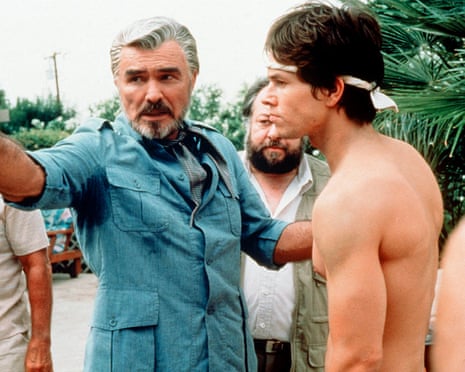
What happens, in fact, is that our detumescent hero symbolically turns to the more reliably priapic world of guns and crime, although not without first embarrassingly trying to make it as a singer. (David Foster Wallace, in his 1998 essay Big Red Son, about the Adult Movie awards in Las Vegas, compares the event’s musical interludes to the ghastly screeching in Boogie Nights.) Twenty-six-year-old Mark Wahlberg plays handsome young teen Eddie, or Dirk Diggler, as he is later professionally to style himself who, while working behind the bar in a nightclub in California’s San Fernando Valley in 1977 (where he supplements his income by jerking off in the kitchens at the bidding of paying voyeur customers) he meets silver-fox porn impresario Jack Horner, played with leathery assurance and style by Burt Reynolds.
With his industry sixth-sense for untutored talent, Jack picks up on what a later generation would call Eddie’s BDE; he offers him a job on his latest dirty movie, where Eddie morphs into “Dirk”, wowing colleagues with his size, stamina and quick turnaround time. Dirk gets to know his supportive new industry family. These include Julianne Moore, who here establishes the sexy-tragic drama queen persona that has surfaced so often in her career. She is Maggie, a divorced mother and elder stateswoman of porn, clenched with the secret anguish of not seeing her child and displacing that maternal longing on to her hardcore scenes with Dirk. Nicole Ari Parker is Becky and Heather Graham is Brandy, known as “Rollergirl”, for never removing her roller skates; her awful destiny is to be forced to play a scene with a guy who once mocked her in high school. John C Reilly is Reed, a porn star who also wants to be a magician; Don Cheadle is country music enthusiast Buck, gifted a financial opportunity to open his own hi-fi store by a chaotic moment of crime; William H Macy is porn producer Bill, who is humiliated by his wife’s exhibitionism; and Philip Seymour Hoffman is set-runner Scotty, a guy with a poignant crush on Dirk.
Behind or above or within all of this is cocaine, a vast omnipresent glittering mountain of white powder, powering the rush behind the success-surge in Dirk’s career montage. Porn and coke merge into a single entity – a compulsive, addictive demon which destroys Dirk’s endowment.
Then there is the industry’s great crisis. Jack is an artist of adult entertainment, a celluloid purist who resents the new world of videotape arriving like the talkies in Singin’ in the Rain; at the end, there’s a premonition of homemade gonzo content, though that was hardly more than a rumour in 1997. Yet Boogie Nights is perhaps sentimental and evasive about some porn realities. Its female leads are clearly not porn stars and don’t have the synthetic body enhancements that would otherwise be sine qua non. The film moreover gives Dirk a lenient kind of redemption that avoids the issues of HIV and how the real John Holmes met his end.
As a film, Boogie Nights is clearly influenced by Scorsese: not just the epic rise-and-fall trajectory of GoodFellas but in Dirk running his lines in front of the mirror like Jake LaMotta. There is also something of Tarantino in the late-night store stick-up that leaves Buck covered with blood and with a brown paper-bag full of cash. Yet at this stage Anderson arguably didn’t have Scorsese’s gift for making his dramas about something more than themselves. The Scorsese films that are about crime or about high finance contain sexiness and irony that is implicit and seductive; this is not really the case in Boogie Nights.
But still, this is a movie of such style and propulsive power, wittily conveying Jack Horner’s sophisticated dilemma as a film-maker and theoretician of adult content. He wants to create a movie that will make the guys in the theatre keep watching even after they have climaxed. As he vulgarly puts it: “… when they spurt out that joy juice, they just gotta sit in it. They can’t move until they find out how the story ends.” His ambition is to transcend porn, to somehow make the unresolved narrative tension stronger than sex. As for Dirk’s manhood itself, it is so dominant, vulnerable and yet unseen until the very end – when it is un-erect. Anderson’s movie is a big living room for this elephant to hide in.
- Film
- Paul Thomas Anderson
- Mark Wahlberg
- Julianne Moore
- Burt Reynolds
- John C Reilly
- Don Cheadle
- reviews