


Beyond the governor: Why Gombe’s 2027 election may hinge on running mates
July 24, 2026 2:17 am

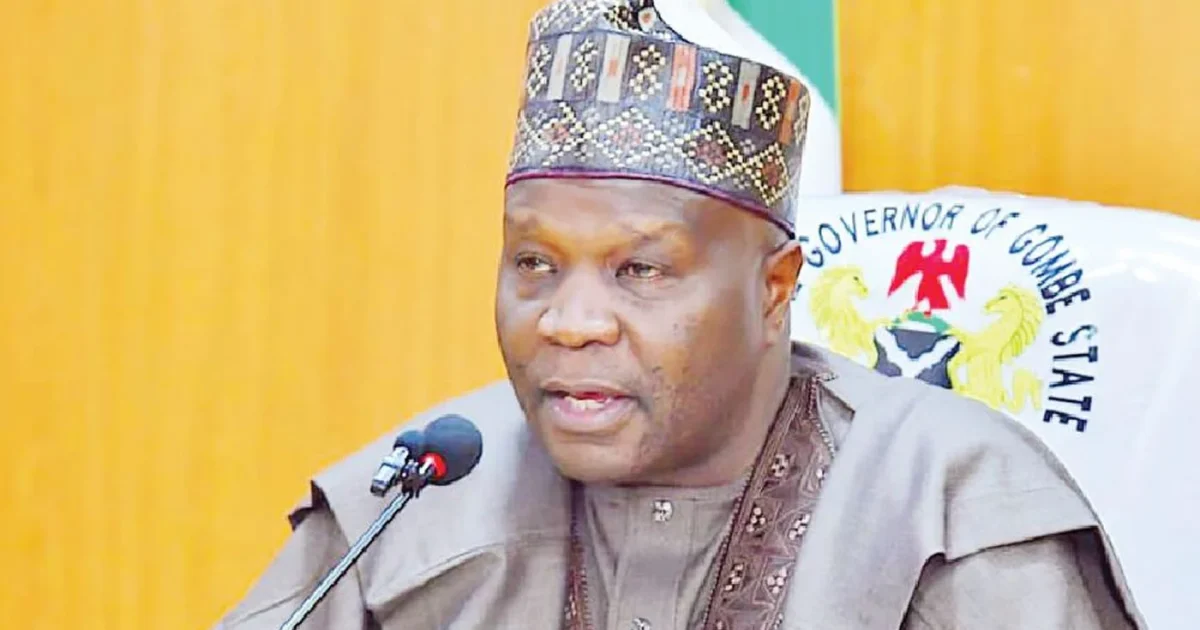
Gombe State Governor, Yahaya
The search for deputy governorship candidates in Gombe has become more than a constitutional requirement — it is a battle over religion, geography, loyalty, electoral arithmetic and the future balance of political power in the state. As the APC, PDP and ADC negotiate competing interests ahead of the deadline for submitting running mates, the choices they make could reveal the strategies they intend to deploy in the contest for Gombe Government House, CHIMA AZUBUIKE reports
With the Independent National Electoral Commission opening the window for political parties to upload the names of their governorship running mates ahead of the 2027 general election, attention in Gombe State has shifted from the governorship candidates to one of the most consequential decisions in the electoral process — the selection of deputy governorship candidates.
For the three major contenders, choosing a running mate goes beyond fulfilling a constitutional requirement. It is a delicate political exercise involving consultations with party leaders, traditional institutions, religious blocs, youth groups, women organisations and other influential stakeholders whose interests often converge around the choice of who occupies the second position on the ticket.
Across the state, conversations have moved from campaign slogans to political calculations. Behind closed doors, party leaders are weighing competence against loyalty, popularity against experience, and electoral arithmetic against longstanding demands for equity and inclusion.
The emerging contest is shaping up as a three-horse race involving the All Progressives Congress candidate, Dr. Jamilu Isyaku Gwamna; the Peoples Democratic Party standard-bearer, Professor Isa Ali Ibrahim Pantami; and the African Democratic Congress candidate, Bala Bello.
Although smaller parties are expected to participate, political analysts believe the battle for Gombe Government House will largely revolve around these three contenders. With the governorship candidates already determined, the focus has now shifted to the personalities who may eventually stand beside them on the ballot.
Political observers note that deputy governorship selections have historically played a strategic role in Gombe politics. While the governor remains the principal candidate, the deputy often serves as a bridge between competing political interests, reassuring different communities that they have a stake in government while expanding the electoral reach of the ticket.
Like many states in Northern Nigeria, Gombe’s political landscape has evolved around an informal balancing arrangement that takes religion, geography and inclusion into account. As a result, the identity of a running mate often reflects broader negotiations within and beyond political parties.
That reality has become even more significant in the current race.
All three leading governorship candidates are Muslims, prompting many analysts to suggest that parties may look towards Gombe South — the predominantly Christian zone comprising Balanga, Billiri, Kaltungo and Shongom Local Government Areas — in selecting their running mates.
Although there is no constitutional requirement for such balancing, political history indicates that parties often consider religious and regional representation when assembling governorship tickets.
For the PDP, many observers believe the calculation appears relatively straightforward.
Professor Pantami, a former Minister of Communications and Digital Economy, and an internationally recognised Islamic scholar, is expected by some analysts to be paired with a Christian running mate from Gombe South to broaden the ticket’s appeal across the state.
The challenge, however, is not whether the deputy should come from the South, but which of the four local government areas within the zone should produce the candidate.
That question has revived longstanding debates about political inclusion, historical representation and zoning.
Among the strongest arguments is the call for Shongom Local Government Area to produce a deputy governor for the first time since the return of democratic rule in 1999.
Political enthusiast Iliya Samuel Laro argues that historical records support the demand.
He said, “In the 27 years since Gombe State returned to democratic rule, one arithmetic has remained stubbornly, almost embarrassingly constant: whenever Gombe South produces the Deputy Governor, that honour has gone to only two of its four local government areas. Kaltungo tasted it once under a different political era. Shongom has never tasted it at all.”
Laro dismissed suggestions that the argument was driven merely by sentiment.
“This is not an accusation. It is a record. And records, unlike sentiment, cannot be argued away,” he added.
Available political records show that Senator Joshua Lidani from Kaltungo served as deputy governor between 1999 and 2003 under the late Governor Abubakar Habu Hashidu. Under Governor Danjuma Goje, Dr. John Lazarus Yoriyo from Balanga became deputy governor before the late David Albashi, also from Balanga, briefly succeeded him in 2011. Following Albashi’s death, Tha’anda Jason Rubainu, again from Balanga, completed the tenure. Governor Ibrahim Hassan Dankwambo later appointed Dr. Charles Iliya from Billiri, while the incumbent administration of Governor Muhammadu Inuwa Yahaya has Dr. Manassah Daniel Jatau from Balanga as deputy governor.
For advocates of the Shongom argument, the pattern of appointments highlights a political imbalance that requires correction.
They argue that while Balanga, Billiri and Kaltungo have all produced deputy governors, Shongom remains the only local government in Gombe South that has not occupied the position despite its political contributions and population.
Not everyone agrees with this approach.
Some politicians argue that elections are won through political strength rather than rotational arrangements, insisting that competence, grassroots acceptance and voting capacity should be the deciding factors.
That tension between equity and electoral pragmatism now shapes much of the debate over the PDP’s eventual choice.
Political analyst Cliff Stanley believes the race for the PDP deputy governorship slot remains open, with several names still being considered.
According to him, “Markus Wina and Dr. Jeremiah Gado are the contenders so far in ADC for the deputy governorship seat.”
His remarks suggest that while advocacy groups continue to promote preferred candidates, the party leadership may still be weighing multiple options before making a final decision.
Beyond individual personalities, Stanley believes political value should remain central to every nomination, arguing that a running mate must strengthen the ticket rather than merely complete it.
The calculations confronting the ruling APC appear even more complex.
Unlike the PDP, where many observers expect a Christian running mate from Gombe South, discussions within the APC have produced competing arguments.
While some stakeholders favour maintaining the traditional Muslim-Christian ticket that has characterised much of Gombe’s democratic history, others argue that changing political realities could make a Muslim-Muslim ticket possible.
Nevertheless, many party actors believe religious inclusiveness remains politically advantageous in a state that has largely maintained peaceful interfaith relations.
Another factor shaping the APC’s decision is geography.
With the party’s state chairman coming from Kaltungo, some observers believe the deputy governorship slot could shift towards Billiri or Shongom to avoid concentrating key political positions within one local government area.
Others, however, continue to make a case for Balanga.
APC chieftain Dr. Abubakar Kumo argues that electoral considerations should outweigh rotational arrangements.
“That’ll be a wrong move politically because we have to consider number of votes. No local government has more votes than Balanga in the South,” he said.
For Kumo, the issue is not simply about fairness but about electoral strategy.
He acknowledged that many stakeholders already understand the prevailing calculations.
“Of course many of us know the permutations. It’s a known fact that the running mate has to come from Gombe South and a Christian. But the question is, what part of the South?” he added.
Explaining his position, Kumo argued that existing party nominations should influence the APC’s decision.
“I was asked, I would suggest Balanga since the APC senatorial and House of Representatives candidates come from Shongom. So Kaltungo is out of the equation because they’re virtually the same with Shongom. Balanga should produce the running mate once again,” he added.
He further disclosed that one of the names being mentioned within party circles is retired Rear Admiral Nuhu Jiddere, a former Deputy Chief of Defence Space Administration at the Defence Headquarters in Abuja.
As consultations intensify within the APC and PDP, the African Democratic Congress (ADC) is also facing a crucial decision that could shape its electoral fortunes in the 2027 governorship race.
For the opposition party seeking to expand its political presence in Gombe State, the choice of a running mate offers an opportunity not only to balance its ticket but also to distinguish itself from the larger parties by projecting a message of inclusion, competence and political renewal.
Whether the parties ultimately prioritise equity, experience, electoral strength or regional balancing remains uncertain.
While the APC and PDP continue their internal consultations, the ADC is navigating a similar political challenge, though from a different position. Seeking to establish itself as a credible alternative to the two dominant parties, the party’s leadership understands that its choice of a running mate could significantly influence public perception of its preparedness to govern.
Political observers believe the ADC has an opportunity to present a ticket that reflects inclusion while tapping into the desire among some voters for a fresh political platform. However, like the APC and PDP, the party must contend with the realities of zoning, religion, grassroots influence and internal party dynamics.
One factor already shaping discussions within the ADC is the position of the party’s state chairman, Keftin Amuga, who is from Billiri Local Government Area. Although there is no formal restriction preventing another key party figure from emerging from the same area, some stakeholders believe the deputy governorship slot could naturally shift towards Balanga, Kaltungo or Shongom in order to broaden the party’s regional appeal.
According to political analyst Cliff Stanley, the ADC could use the opportunity to make a statement on inclusion by considering a female running mate.
“The ADC in Gombe is sincerely lacking viable deputy governorship candidates. I believe the only promising candidate is the woman leader, Naomi Lasara, who is the one that is more visible and she is from Gombe South,” he said.
Stanley’s suggestion has renewed conversations about women’s participation in Gombe politics.
Although women have occupied positions in the National Assembly, state executive councils, local government administration and advisory roles, the office of deputy governor has remained exclusively occupied by men since the creation of the state.
Supporters of Naomi Lasara argue that her emergence would signal the ADC’s willingness to challenge established political patterns while promoting gender inclusion. Others, however, maintain that electoral strength and political viability should remain the overriding considerations.
Beyond the ADC’s calculations, the PDP is also facing intense lobbying over who should accompany Professor Isa Ali Ibrahim Pantami on the governorship ticket.
Among the names generating significant public discussion is Barrister I.Y. Melah, whose supporters have mounted a campaign urging the PDP candidate to consider him as running mate.
A group under the aegis of Concerned Youths of Gombe South described Melah as more than a political ally, arguing that his selection would represent a leadership decision rather than a routine political calculation.
In a memorandum signed by the group’s convener, Thomas Likka, the group stated that a deputy governor should be viewed as a strategic partner rather than a ceremonial figure.
“A running mate is not a footnote. He is a mirror. The Deputy Governor is not a ceremonial ornament. He is the second heartbeat of an administration. He is the first hint of your judgment, the first proof of your courage, the first measure of whether your leadership will be transactional or transformational,” Likka said.
The group further described Melah as “not a name to fill a space” but “a force to fill a gap.”
His supporters argue that his years in legal practice, mentorship and community engagement have earned him recognition across Gombe South.
“He is not loud. He is deep,” Likka said. “When every other voice was shouting, his was building. When others chased titles, he chased truth.”
He argued that a Pantami-Melah ticket would combine national visibility with grassroots credibility, saying both men would complement each other’s strengths.
“You bring the wisdom of years; he brings the urgency of now. Together, you would not just govern, you would connect.”
Although the memorandum reflects the views of its authors and not the official position of the PDP, it highlights the growing intensity of lobbying surrounding the deputy governorship selection.
Another major campaign within the PDP centres on Shongom Local Government Area, where political stakeholders argue that the deputy governorship contest represents an opportunity to address what they describe as a long-standing imbalance in Southern Gombe’s political representation.
Laro again argued that while Balanga, Billiri and Kaltungo have all produced deputy governors since 1999, Shongom remains the only local government area in Gombe South yet to occupy the position.
“It is not a coincidence,” he said. “It is a pattern. And patterns, when left unexamined, harden into entitlement.”
To support his argument, Laro pointed to the distribution of elective offices within Gombe South.
According to him, the PDP senatorial seat is currently occupied by Senator Anthony Siyako Yaro from Balanga. The Kaltungo/Shongom Federal Constituency seat is held by Dr. Obed Paul Shehu from Kaltungo, while the Balanga/Billiri Federal Constituency seat is occupied by Barrister Rambi Ibrahim Ayala from Billiri.
“Balanga sits at the Senate. Kaltungo holds a House seat. Billiri now holds the other House seat. Shongom holds none of them and has never held the executive seat either,” he argued.
“If PDP zoning is meant to reflect fairness across the four LGAs of Gombe South, then the Deputy Governor slot is the one remaining lever left to correct an imbalance.”
Supporters of the Shongom argument reject suggestions that the area lacks the political capacity to produce a deputy governor.
Laro cited the political career of former Deputy Minority Whip of the House of Representatives, Rt. Hon. Fatima Binta Bello, as evidence of the area’s ability to produce leaders capable of occupying high office.
He described her journey from classroom teacher to deputy local government chairman, commissioner and two-term federal lawmaker as proof that Shongom possesses individuals with the experience required for executive leadership.
“If a daughter of Shongom could hold her ground in the leadership of the National Assembly during one of the most difficult political periods in the North-East, then the argument that Shongom lacks the calibre for a state executive seat collapses under its own weight,” he wrote.
Beyond Binta Bello, advocates of the Shongom cause have also promoted Benjamin Sati, Esq., the PDP legal adviser in Gombe State, as another personality capable of strengthening the party’s ticket.
Laro described Sati as a respected legal practitioner, former chairman of the Nigerian Bar Association in Gombe State and a member of the legal team representing Pantami in the legal challenge over his emergence as the PDP governorship candidate.
He argued that Sati’s influence extends beyond Shongom into other parts of Gombe South and neighbouring Akko Local Government Area, making him a potential unifying figure.
“Shongom is not asking PDP for a favour,” Laro said. “It has the numbers, the history and the proof of capacity. The only thing left is for the party to do the fair thing.”
Another name featuring prominently in PDP consultations is Hon. Amos Mela Boh, popularly known as “Teacher” and honoured with the traditional title Danmasanin Shongom.
Supporters describe him as one of the most experienced grassroots politicians from the area.
A retired educationist and former principal, Amos Mela represented Shongom State Constituency in the Gombe State House of Assembly between 2011 and 2019, where he rose to become Majority Leader during the administration of former Governor Ibrahim Hassan Dankwambo.
An advocacy document promoting his candidature credits him with expanding access to education during his time as principal of Government Science Secondary School, Kaltungo, where he reportedly broadened the school’s curriculum and encouraged students from Shongom, Billiri, Balanga and Kaltungo to pursue secondary education.
The document also claims that he supported indigent students, assisted a law graduate with law school fees, helped young people secure employment and facilitated the establishment of the first boarding secondary school in Shongom.
Supporters further point to his experience as Majority Leader, member of the PDP reconciliation committee and former campaign coordinator for presidential aspirant Nyesom Wike as evidence of his administrative experience and loyalty to the party.
By all indications, campaigns for preferred running mates are unlikely to slow down until the political parties formally submit their nominees to the Independent National Electoral Commission. Seasoned political observers describe the period before the announcement of deputy governorship candidates as one of the most delicate phases of an election cycle, as it exposes competing interests within parties and the difficult balancing act required to keep those interests aligned.
Unlike governorship primaries, where delegates openly vote to determine candidates, the selection of a running mate is usually the prerogative of the governorship candidate, often in consultation with party leaders. The process typically takes place behind closed doors, making speculation, endorsements and lobbying almost inevitable.
In Gombe, that lobbying has become increasingly visible. Community associations, youth groups, political stakeholders and supporters of various aspirants have continued to issue statements, circulate memoranda and mobilise support for their preferred choices. Although such campaigns do not necessarily determine the final decision, they offer insight into the expectations of different constituencies and the competing interests governorship candidates must reconcile.
Political analysts believe the eventual choices of the APC, PDP and ADC will be measured against four key considerations: electoral value, political experience, religious and regional balance, and the ability of the running mate to work effectively with the governorship candidate.
“There is no perfect formula,” a political observer in Gombe, who requested anonymity because of his relationship with several political actors, told The PUNCH.
“Sometimes parties choose the most popular politician with a large financial capacity to contribute to the campaign. Sometimes they choose the most experienced administrator. In other cases, they choose someone who can unite divided blocs within the party. Every election presents a different calculation.”
That assessment reflects the unique political challenges confronting the three major parties ahead of the 2027 governorship election.
For the APC, retaining power after two terms under Governor Muhammadu Inuwa Yahaya will require maintaining its existing support base while attracting new voters in an increasingly competitive environment. The party must balance calls for continuity with demands for fresh political direction, while also responding to arguments over equity and representation within Gombe South.
For the PDP, Professor Isa Ali Ibrahim Pantami’s emergence has altered the political landscape. His national profile as a former Minister of Communications and Digital Economy, combined with his influence as an Islamic scholar, has increased expectations that the party will carefully select a deputy capable of complementing his strengths with grassroots mobilisation, particularly in Christian-majority communities in Gombe South.
The ADC faces a different but equally significant challenge. Although the party lacks the extensive political structures of the APC and PDP, it has an opportunity to present itself as a credible alternative by assembling a ticket built around competence, inclusion and political renewal. Analysts argue that because newer parties often have fewer established interests to manage, their decisions may attract even greater scrutiny.
At the centre of the consultations is a recurring debate between equity and electoral pragmatism.
Supporters of zoning argue that communities excluded from major political offices deserve opportunities to participate in executive leadership. They maintain that inclusion strengthens a sense of belonging and contributes to political stability.
Those advancing this argument frequently point to Shongom’s inability to produce a deputy governor since 1999 as evidence that political balancing within Gombe South remains incomplete.
Critics, however, caution against reducing the contest solely to rotational politics. They argue that while fairness is important, political parties ultimately exist to win elections and must therefore prioritise candidates capable of expanding their support base, attracting undecided voters and strengthening campaign structures.
This explains why stakeholders often arrive at different conclusions despite analysing the same political environment. While some view historical exclusion as the dominant factor, others place greater emphasis on voting strength, public acceptance, administrative experience or political influence.
Another issue gaining attention is gender representation.
Stanley’s suggestion that the ADC should consider its National Women Leader, Naomi Lasara, has opened fresh conversations about the place of women in Gombe politics.
“The ADC in Gombe is sincerely lacking viable deputy governorship candidates. I believe the only promising candidate is the woman leader, Naomi Lasara, who is more visible and she is from Gombe South,” he said.
Although women have occupied important political positions in Gombe, including seats in the National Assembly, commissioner roles, local government leadership and advisory positions, the deputy governorship office has remained exclusively male since the beginning of the Fourth Republic.
Whether any party is willing to change that pattern remains uncertain.
The prominence of retired military officers, lawyers, educationists, grassroots politicians and technocrats among the names being considered also reflects a broader feature of Gombe politics: the search for candidates who can provide complementary strengths to the governorship ticket.
For some parties, that may mean choosing an experienced administrator. For others, it may require a grassroots politician with strong networks, professional credibility or cross-community appeal.
Ultimately, the decision rests with the governorship candidates and their party leadership.
Until the final announcements are made, every endorsement, political memorandum and consultation will remain part of a wider contest for influence.
What is already clear, however, is that the battle for deputy governorship slots has become almost as competitive as the governorship race itself.
The intense advocacy surrounding personalities such as Barrister I.Y. Melah, Benjamin Sati, Hon. Amos Mela Boh, Naomi Lasara, Markus Wina, Dr. Jeremiah Gado, Rear Admiral Nuhu Jiddere (retd.), Yakubu Sarma, Aliyu Kombat and others underscores the strategic importance now attached to the office.
For the aspirants and their supporters, the position represents an opportunity to shape governance and deepen representation. For the parties, it is a chance to present balanced tickets capable of inspiring confidence among diverse segments of the electorate. For voters, the eventual choices will provide an early indication of the values, priorities and political calculations that will define each campaign.
As the submission deadline approaches, consultations are expected to intensify. More endorsements will emerge, more interest groups will make their positions known, and more political permutations will dominate conversations across party secretariats, community meetings and government circles.
Until the final names are unveiled, speculation will continue to shape public discourse. But once the candidates are announced, attention will shift from who was selected to whether the parties made the right choices.
Although the deputy governorship decisions may not independently determine the outcome of the 2027 election, they will influence alliances, campaign narratives and each party’s ability to balance ambition with inclusion, strategy with equity, and political calculation with public expectation.
In a contest already shaped by shifting alliances, legal battles, defections and renewed political engagement, the race for Gombe’s next deputy governor has evolved from a supporting role into one of the defining storylines of the 2027 electoral season. The eventual choices may reveal as much about each party’s electoral strategy as the manifestos they present to voters.
All rights reserved. This material, and other digital content on this website, may not be reproduced, published, broadcast, rewritten or redistributed in whole or in part without prior express written permission from PUNCH.
Contact: [email protected]