


Astronomers have found an entirely new kind of object in space.
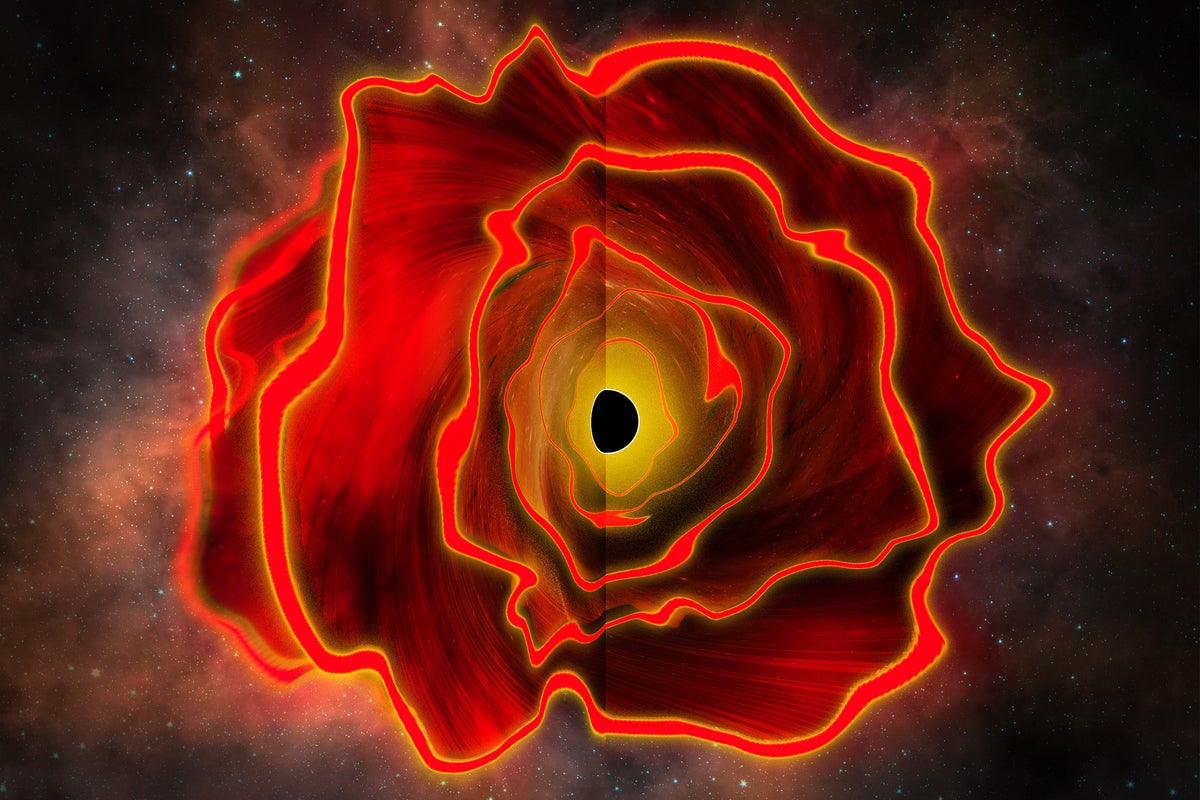
The “black hole star” looks like an enormous Sun, the size of our solar system. But it is emitting 100 billion times more energy than any known star can produce – more like a black hole.
Researchers believe that it is a new kind of object that is a combination of the two. And it could help solve one of the universe’s most enigmatic mysteries.
In nearly every picture of space taken since Nasa’s James Webb Space Telescope was launched, scientists have spotted “little red dots”. They are prevalent throughout space – but nobody knows for sure what they are.
Now scientists believe that the most likely explanation for those little red dots is this kind of object: a combination of a black hole and a star. Nobody has ever seen such an object before.
It could also help explain another cosmic mystery: how so many black holes, with a mass of a billion suns, were able to form so soon after the Big Bang. Researchers have plenty of theories about how black holes could become so massive so quickly, but nobody has ever known the true reason.
Astronomers think that the object is probably a hugely dense cloud of gas. It is not powered by nuclear fusion, like a normal star, but a black hole at its centre.
“Our picture of this object is evolving very rapidly,” says lead author Rohan Naidu, a Nasa hubble fellow and Pappalardo fellow at MIT’s Kavli Institute for Astrophysics and Space Research. “We think there is a central black hole that is 100,000 times as massive as the sun.
And around this black hole, there would be this very extended envelope of gas that looks like a star the size of the solar system. It’s huge.”
The object found in the study has been called MoM-BH*-1 and is so far away that the light reaching us is from near the beginning of the universe – 13 billion years ago, just 660 million years after the Big Bang. The same study also found the most distant galaxy ever discovered, known as MoM-z14.
The names of both objects are a nod to the name of the study, ‘Mirage or Miracle’. It uses the James Webb Space Telescope to study distant galaxies that appear to be remarkably bright, despite being so far away and from so early in the universe, which gave the study its name.
Researchers have also given the object the name “black hole star – one”, in the hope and belief that it will be the first of many to be found. If it is, then it could help explain all of those so-called little red dots.
“Every little red dot is consistent with being a black hole star, embedded in a generic early galaxy,” said Professor Naidu. “But what is special about MoM-BH*-1 is, the black hole star is essentially completely outshining its surrounding host galaxy, such that we’re seeing pure black hole star light.”
The team behind the new study didn’t intend to find a black hole star. The ‘Mirage or Miracle’ research aims to look for those distant, early galaxies to discover whether they actually formed during the early part of the universe.
But as they looked through images from the telescope to try and find those galaxies, they found one feature that stood out: a very red and very bright dot.
“When we see something very red in the universe, we often assume that it is surrounded by dust, like soot or ash,” said Robert Simcoe, a co-author on the study. “The same way that the wildfire smoke from Canada recently made the sky in Boston look bright red, astronomical objects can also appear redder than their intrinsic colour when you see them through a veil of dust.”
But the light didn’t seem to line up with the dust theory. And the object was behaving in other, strange ways: though it was incredibly bright, the light completely disappeared below certain wavelengths, and it did not include any of the signature of metals or other elements.
The researchers then ran simulations to work out what other scenarios could produce the red dot’s unusual colour. That suggested that the red dot was an energy source, surrounded by a cocoon of hydrogen – but that did not explain why it was so bright.
“You have something that looks a bit like a star but is 100 billion times brighter,” Professor Naidu said. “That means you can’t be powering this by nuclear fusion, which is the energy source that sits at the heart of all the stars we have.”
A black hole would explain exactly that intense energy, however. And so the researchers included that in their simulation – and found that the expected brightness of the simulated “black hole star” matched up with the real results from the telescope.
The work is reported in a new paper, ‘A Gas Enshrouded and Gas Reddened Black Hole at Cosmic Dawn’, published in the journal Nature.