


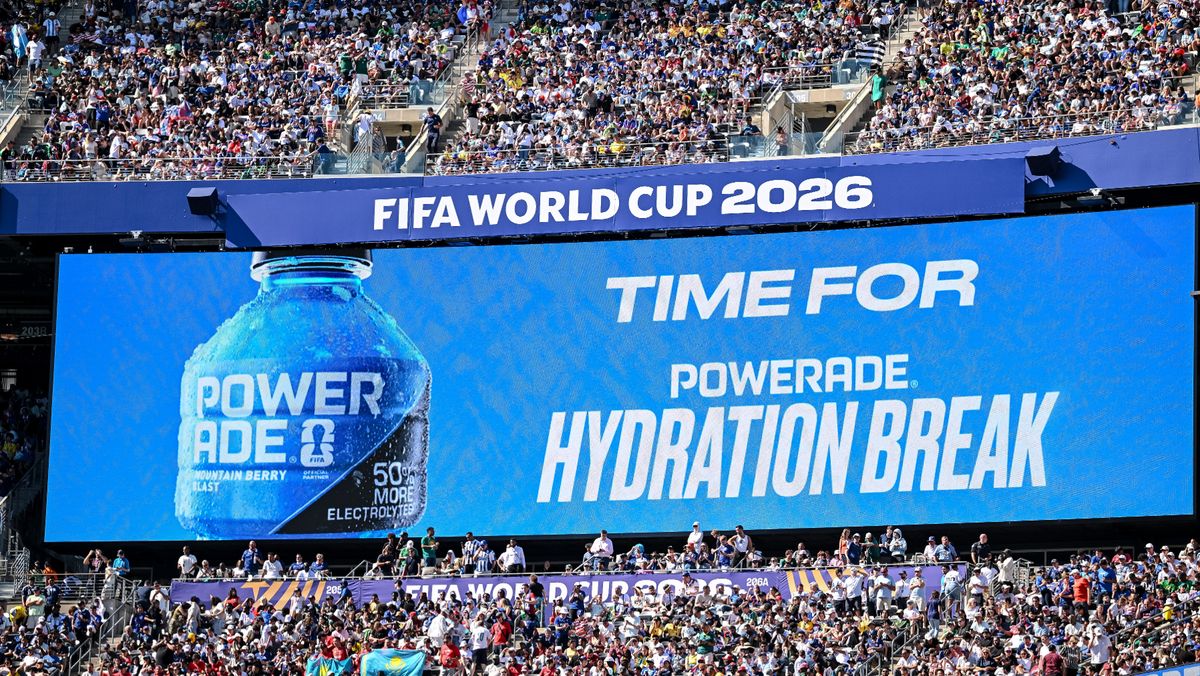
Hydration breaks have become the pantomime villain of this World Cup.
England fans actually loudly booed the intervals against Croatia, while players and managers have called out the three-minute pauses 22 minutes into each half.
The mandatory rule, which has prompted a growing backlash, has been accused of being a contrived way of turning football into four quarters to benefit US broadcasters who can make more money off additional commercials.
It was rolled out by FIFA across the board to “prioritise player welfare” in an identical way across a tournament when humidity is an issue and temperatures often reach the high 20s (°C) and often higher. However, the practice appears farcical in games featuring less intense conditions and in air-conditioned stadiums.
 View 6 Images
England players take on fluids during the hydration break in the game vs Croatia(Image: Javier Garcia/Shutterstock)
England manager Thomas Tuchel insisted they were unnecessary in indoor conditions, but admitted they would give him a chance to have a more direct impact as a coach – to “regroup, change and reset”.
And some pundits have suggested that they ruin the flow of the game, disrupting momentum built up through the course of a ‘normal’ 45 minutes. We looked into the data…
- Get the latest World Cup news straight to your inbox by signing up to our Make Football Great Again newsletter now!
1. One of the earliest indications that such breaks may be having a tangible impact on momentum was when United States beat Paraguay 4-1.
Though the outcome of this game was already a foregone conclusion with the US 3-0 up, Paraguay – who had offered very little in the second half up until that point – were able to get on top immediately following the second-half hydration break and score through Mauricio within mere seconds of the restart.
It was a lapse in concentration from the Americans, with a simple long ball to the unmarked Palmeiras forward.
 View 6 Images
Paraguay were able to take advantage of the second-half hydration break to gain some momentum and score against a coasting United States(Image: Machine Football)


2. Haiti, meanwhile, could feel aggrieved by the impact of the first-half hydration break in their game against Scotland the following day, after the little-fancied Caribbean side had enjoyed a reasonably good start to their opening game.
The following momentum chart shows how the threat difference swung significantly towards Haiti’s favour prior to the stoppage.
After play was resumed, Scotland were quickly able to get back on top and score the only goal of the game through John McGinn in the 29th minute.
 View 6 Images
Haiti’s early momentum against Scotland was reversed after the first-half hydration break(Image: Machine Football)
3. The game between Group G outsiders Iran and New Zealand also produced a noticeable momentum swing after the first half hydration break.
New Zealand had dominated the opening stages of the tie before the break arrived, and made their superior play count through Elijah Just’s goal seven minutes into the game.
The higher-ranked Iranians (FIFA #20) were able to assert their quality after the restart, though, seeing momentum swing their way and equalising through Ramin Rezaeian in the 32nd minute.
 View 6 Images
New Zealand exceeded expectations at the start of their game against Iran but a reversal of momentum after the first-half hydration break dampened their hopes of an upset(Image: Machine Football)
The end-to-end game finished 2-2, with both remaining goals scored between half time and the second-half hydration break.
It is too early to say whether hydration breaks benefit stronger sides or underdogs to a greater extent, but their capacity to disrupt the momentum of a game is inevitable.
Highly-positional attacking teams that use possession to create chances often rely on maintaining concentration longer than their opponents to breach an organised defence.
It should therefore come as no surprise, then, if more matches go on to show that teams building momentum before hydration breaks struggle to maintain that trajectory after play is restarted.
 View 6 Images
England fans loudly booed the break which has happened in every World Cup game(Image: Martin Rickett/PA Wire)
Slower, possession-focused sides such as the Netherlands could struggle particularly at this World Cup, finding it more difficult to win games without full halves in which to build momentum through dominance of the pitch.
Football is a unique sport because its low-scoring nature makes momentum a central part of its appeal and an important ingredient in the success of its winners.
This is what makes the sport flow, and what makes emotion and the impact of atmosphere a more tangible factor in the outcome of its games than in other sports.
By implementing this measure without a proper trial or feedback process, FIFA are gambling with the very formula that makes football the most popular sport in the world.
Join our new WhatsApp community and receive your daily dose of Mirror Football content. We also treat our community members to special offers, promotions, and adverts from us and our partners. If you don’t like our community, you can check out any time you like. If you’re curious, you can read our Privacy Notice.
Upgrade your World Cup TV setup with the Sky Glass ‘designed for football’This article contains affiliate links, we will receive a commission on any sales we generate from it. Learn more from £4.50SkyGet the deal here
Sky is knocking 20% off its entire range of Glass TVs to mark the start of the 2026 FIFA World Cup. Until June 17, shoppers can upgrade to the Sky smart TV that’s ‘designed for football’ from £4.50 per month when taken alongside a Sky TV and Netflix package.