


From Alabama to Yosemite: 50 places with Native American origins
![Members of the Lumbee Tribe in North Carolina, wait for a tribal dance on the National Mall after the grand opening of the Smithsonian's National Museum of the American Indian 21 September, 2004 in Washington, DC. [Brendan Smialowski/AFP]](/wp-content/uploads/2026/07/AFP__20040921__WAS2004092219895__v1__HighRes__UsAmericanIndianMuseum-1782980894.jpg?resize=1920%2C1080&quality=80)
![Members of the Lumbee Tribe in North Carolina, wait for a tribal dance on the National Mall after the grand opening of the Smithsonian's National Museum of the American Indian 21 September, 2004 in Washington, DC. [Brendan Smialowski/AFP]](/wp-content/uploads/2026/07/AFP__20040921__WAS2004092219895__v1__HighRes__UsAmericanIndianMuseum-1782980894.jpg?resize=820%2C1365&quality=80)
By Alia Chughtai2 Jul 2026

Alabama, Chicago, Michigan, Wyoming, Yosemite.
Say them out loud and you are already speaking variations of the languages of this land’s first peoples, often without knowing what the words mean or who first spoke them.
Alabama, also spelled Alibamu, comes from the Alibamu people. It is thought to derive from Choctaw for “plant-cutters,” a nod to farming the land, while Yosemite, famous today for the national park, is pronounced Yohhe’meti in Miwok.
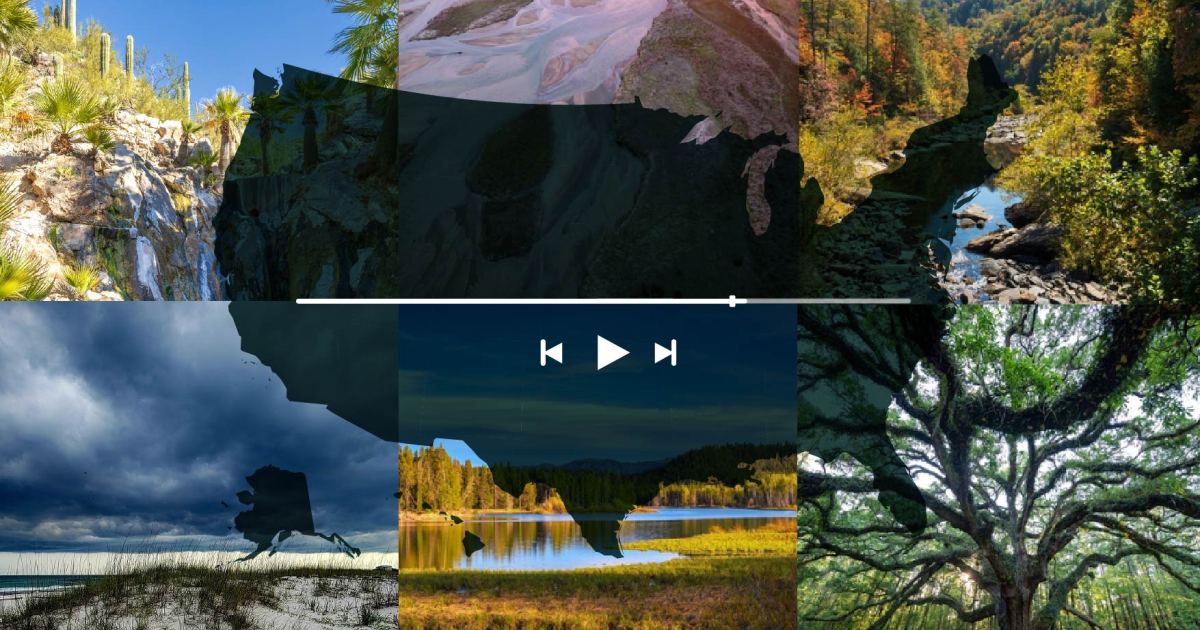
As the United States marks 250 years since the July 4 Declaration of Independence, thousands of US cities, states, rivers and lakes still carry Indigenous names. Al Jazeera traces 50 of those surviving names, exploring their original languages, meanings and pronunciations.
Listen to the first languages
Tap any card to hear the place name spoken by a Native American, and discover its meaning and origin. Swipe through all 50.
‘The land remembers’
![Beautiful morning nature of North Carolina Appalachian mountains, USA. Great Smokey Mountains in summer season [Shutterstock]](/wp-content/uploads/2026/07/shutterstock_2760848871-1782981514.jpg?resize=1920%2C1080&quality=80)
![Beautiful morning nature of North Carolina Appalachian mountains, USA. Great Smokey Mountains in summer season [Shutterstock]](/wp-content/uploads/2026/07/shutterstock_2760848871-1782981514.jpg?resize=820%2C1460&quality=80)
In the 2020 United States census, some 3.7 million people – about 1 percent of the population- identified as American Indian or Alaska Native alone. Including those who also reported another race, the figure reaches 9.7 million, or nearly 3 percent.
Dr Crystal Cavalier-Keck, a member of the Occaneechi Band tribe of the Saponi Nation in North Carolina, traces her ancestry to one of the first Indigenous communities to encounter English colonisers arriving to settle the land as their own.

She says the landscape around her still speaks Indigenous languages. The Haw River is named after the Sissipahaw people, and Hyco Creek means “turkey” in her tribe’s language. Yet while those names endure on maps, Cavalier-Keck says her people are still fighting for federal recognition, despite centuries of documented history and acknowledgement by the state of North Carolina.
“The Trail of Tears that happened on the East Coast that sent tribes west … we [her tribe] escaped that by moving to swamps and living in different areas where most of the colonists didn’t live,” Cavalier-Keck told Al Jazeera.
The Indian Removal Act of 1830 forced tens of thousands of Native people from their homelands to territory west of the Mississippi, in present-day Oklahoma, where many were confined to reservations.
Her tribe currently has about 2,000 enrolled members, and according to Cavalier-Keck, many more have left the area.

“We have so many more people in the community who migrated away, who just left North Carolina because it was so racial and so hostile. It’s just the fact that assimilation and acculturation was a lot easier than claiming your Indigenous heritage. They chose to go that route,” she says.
Through forced assimilation, the breaking up of communities, forced conversions and the imposition of English, the impact on Indigenous languages has spanned generations.
“It’s only in the last 10 years that I’ve truly understood what losing our language means,” she says. “I’m always trying to learn about our people, but so little has been passed down.”
She says elders from other tribes encouraged her to reclaim what remains of her ancestral language.
“The land remembers. The trees and the rocks are witnesses to the violence that happened here,” she says. “But we’ve lost the language that helped us reconnect with the land, the trees and the water.”
The Occaneechi Band of the Saponi Nation share a struggle faced by many Indigenous communities across the US. Over the past 250 years, languages have steadily eroded, with some disappearing altogether. An estimated 300 Indigenous languages were once spoken across 50 to 60 language families. Today, according to the US Census Bureau’s 2017-2021 American Community Survey, only five are spoken by more than a few thousand people. These include:
- Navajo (Diné Bizaad): more than 161,000 speakers
- Cherokee (Tsalagi): about 10,440 speakers
- Zuni (Shiwi’ma): about 8,100 speakers
- Choctaw (Chahta’): about 7,260 speakers
- Hopi (Hopílavayi): roughly 7,100 speakers
When one word holds a sentence
![Native American rain dance [Shutterstock]](/wp-content/uploads/2026/07/shutterstock_1165322200-1782982320.jpg?resize=1920%2C1080&quality=80)
![Native American rain dance [Shutterstock]](/wp-content/uploads/2026/07/shutterstock_1165322200-1782982320.jpg?resize=820%2C1460&quality=80)
Rene Locklear White is a member of the Lumbee Tribe, which won full federal recognition in December 2025 after a struggle of more than a century.

Locklear White says there are so many Indigenous languages in the United States that it is virtually impossible for a handful of people to verify the original meanings and sounds of every Indigenous-influenced word, since many have been altered by English over time.
She says language is the essence of Indigenous cultures in what is now the United States.
“A richer linguistic diversity existed prior to the colonised boat people arriving that influenced the naming of our spaces and places in this country,” Locklear White says.
In her view, Indigenous words belong to complex language families, and many Native American languages can express a whole sentence in a single word, conveying mood, tense and object roles through suffixes, prefixes, doubled syllables and inflection.
“Sometimes the full translation is impossible due to the limitations of English to convey the fullness of the Indigenous meaning. I believe the remnants of these Indigenous words can be part of an awakening that’s happening among our Indigenous peoples that influences our self-determination,” she says.

According to UNESCO, dozens of Indigenous languages in the United States now have only a handful of elderly speakers left.
Aaron Carapella, a member of the Cherokee community, lives in eastern Oklahoma, in the tribal territory where his ancestors were forcibly relocated under the Indian Removal Act. He runs Tribal Nations Maps, charting the homelands, movements and languages of Indigenous peoples through US history.

Across the country, a quieter effort is under way to bring these languages back, through immersion schools, digital dictionaries, recordings and cultural programmes. It is painstaking work, and for some languages it comes too late.