


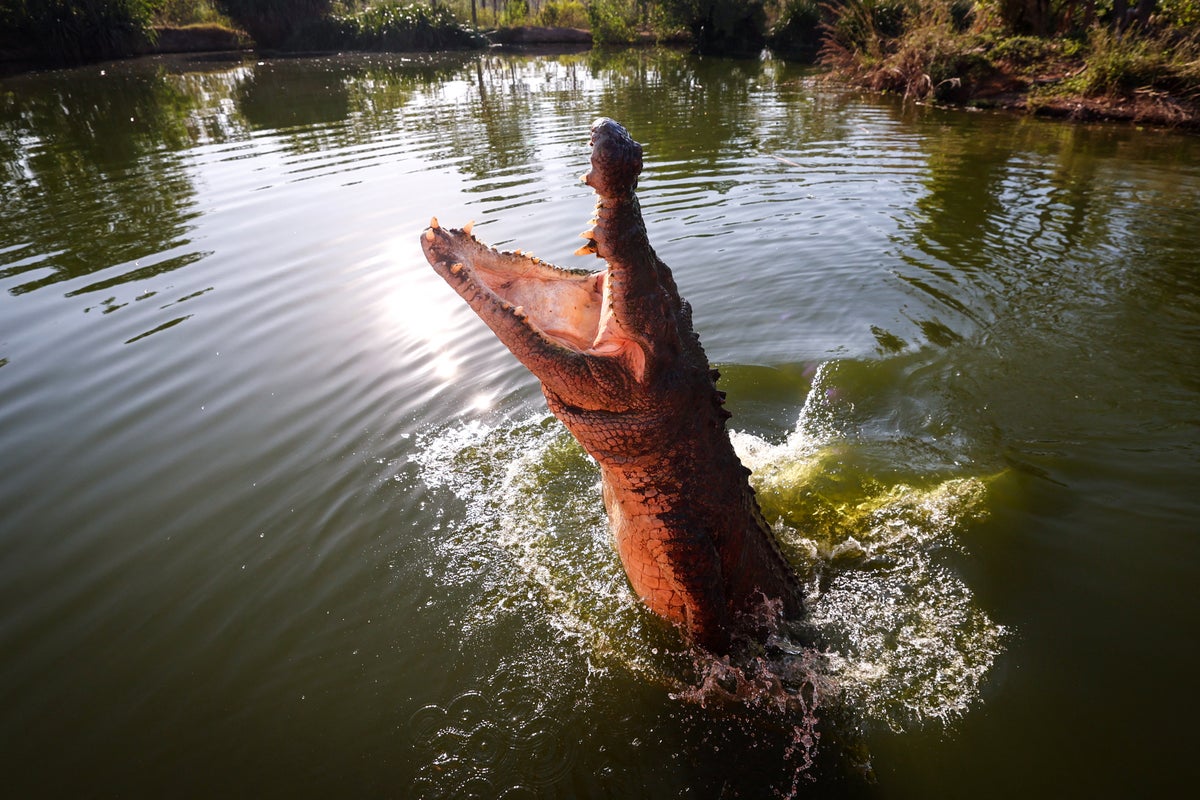
A Queensland town has warned residents to stay away from the local river after a dog was taken by what is believed to be a saltwater crocodile, in the first sighting of the animal in an area hundreds of kilometres from where it is normally found.
The attack happened on Monday night at the Bottom Crossing on the Flinders River near Richmond. The town is about 660km from Karumba on the Gulf of Carpentaria, where saltwater crocodiles are more commonly found.
Richmond Shire mayor John Wharton said a young woman had been chasing pigs with her dog when the animal entered the water.
“The dog’s got the pig in the water, and suddenly, there was a huge noise and splash, and the dog was screaming, and it was all over,” he told ABC North West Breakfast.
“The dog went instead of a child, and it’s really, really important we let them know what’s going on.”
“No one has spotted a saltwater crocodile around Richmond before, although we have had a couple of sharks and sawfish caught here before,” council CEO Peter Bennett told Yahoo News.
“The river is very popular with kids and families. Many set yabby pots in the river or go fishing for barramundi,” he said.
He said a prolonged wet season had kept the river running constantly for more than 20 weeks, which could have carried the crocodile down from the Gulf of Carpentaria.
“People have been known to float down the river on inner tubes between the top crossing and bottom crossing at Richmond. This is about a two-kilometre stretch of river and the croc attack happened within this zone.”
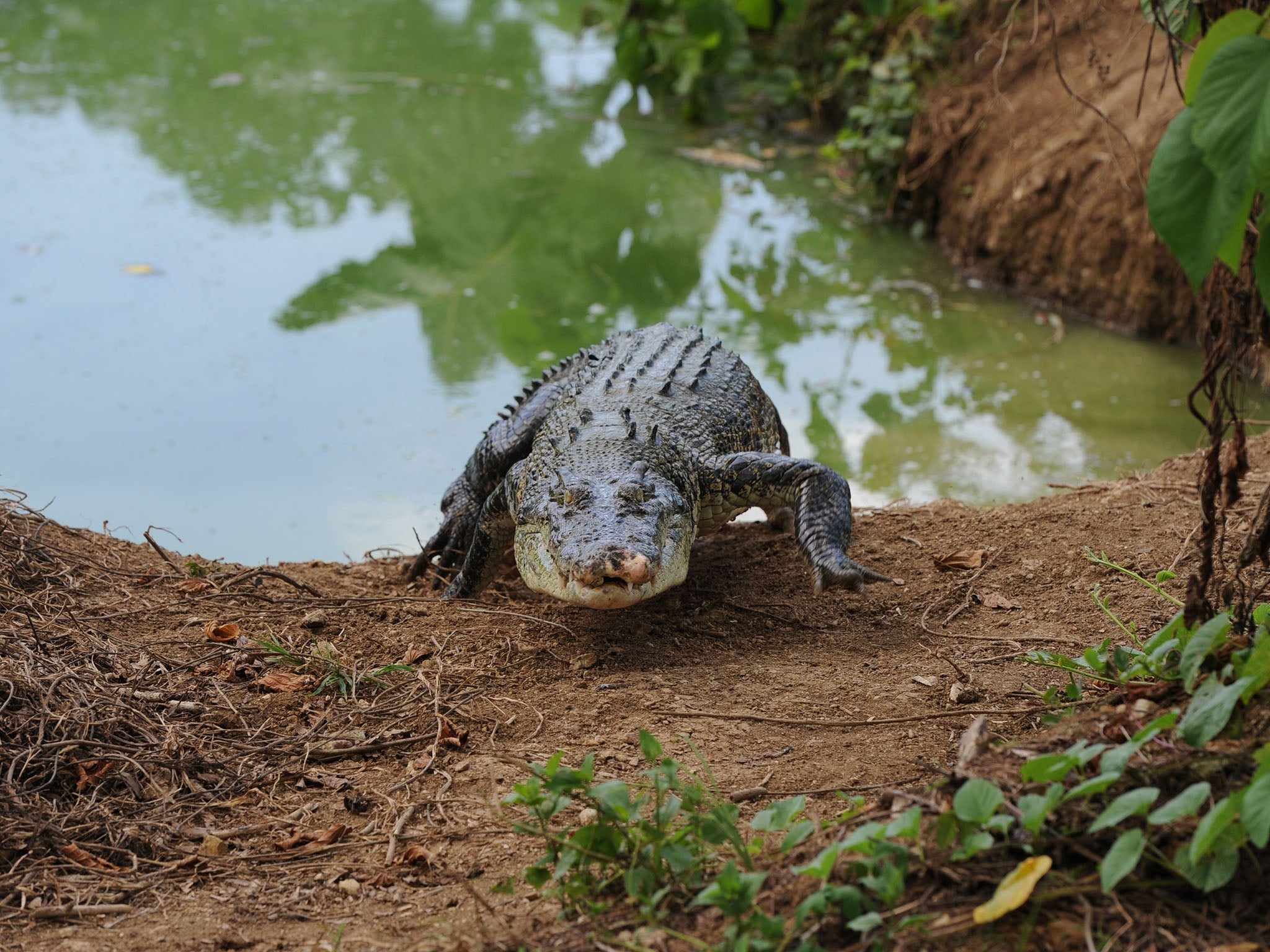
The area is regularly used by freshwater crocodiles, which usually coexist with humans without incident. Saltwater crocodiles typically inhabit coastal river systems, estuaries and oceans, and the Flinders River is considered well outside their normal range.
However, Queensland’s Department of the Environment, Tourism, Science and Innovation said the species can travel hundreds of kilometres inland during wet weather events.
The department said it had launched an investigation into the report and would install warning signs at the site as a precaution.
Mr Wharton said the dog’s behaviour was consistent with a saltwater crocodile attack rather than a freshwater one.
“Freshwater crocs don’t do that, and there’s plenty of freshies in the river, and no-one’s ever concerned about the freshies,” he said. “So, it’s got to be a salty.”
Zoologist professor Grahame Webb, from Darwin’s Crocodylus Park, told the ABC a saltwater crocodile travelling that far upstream would be uncommon but not impossible.
“That would seem unusual, especially if there’s no history of them ever seeing a croc up there, but it doesn’t mean it’s not possible,” he said, adding that several details still needed to be confirmed, including whether the animal was in fact a saltwater crocodile and whether it was responsible for taking the dog.
If the animal was confirmed to be a saltwater crocodile, he said recent floodwater could explain how it reached Richmond.
“The upstream movement of saltwater crocodiles is really unpredictable. There are long-distance movements upstream, but it’s usually just the odd animal,” he told the ABC.
Richmond Shire Council urged visitors to the river to exercise caution and remain vigilant at all times in a statement on Tuesday morning.
“Please ensure children and pets are closely supervised and avoid approaching the water’s edge unnecessarily,” the council said, asking residents to report any further sightings.
The incident follows a similar attack last year in which drone footage captured a large crocodile swimming down the Fitzroy River in Rockhampton with a Rottweiler in its mouth, with the dog’s owners only discovering their pet had been taken after seeing the footage on Facebook.