



Buckle up: a “pollen bomb” has just hit the UK, according to the Met Office.
This dramatic-sounding term describes the process of millions of grains of pollen being released into the air in a short space of time – a nightmarish prospect for hay fever sufferers.
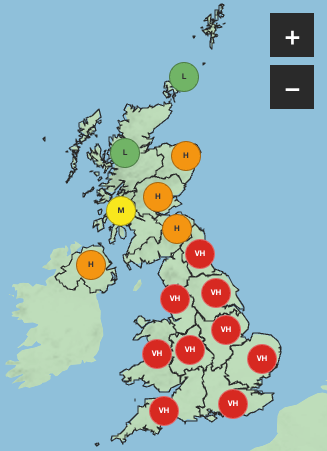
Pollen levels are set to increase across many parts of the UK over the coming days. Every region of England and Wales will hit “very high” levels on Tuesday and Wednesday, according to the Met Office’s five-day pollen forecast, while Northern Ireland and much of Scotland will be classified as “high”.
The nation’s recent spring and summer weather combo has created an almost-perfect storm for pollen. First came a warm, dry spring, which brought on grass pollen early. Next came the rain, allowing grasses to shoot up again. Now the weather has heated up once more, the grasses are flowering and drying out, and a breezy week ahead is set to spread that pollen far and wide.
“As soon as you have these periods of dry weather and you have any amount of wind in the air, then the pollen’s going to become much more mobile,” says Simon Creer, a professor of molecular ecology at the University of Bangor who has studied pollen monitoring and forecasting.
There are three distinct pollen seasons: tree pollen, from late March to mid-May; grass pollen, from mid-May to July; and weed pollen, from the end of June to September.
Right now, we’re in grass pollen season – the worst and most common trigger for hay fever, causing about 95 per cent of allergic reactions in the UK. “Grass is the most harmful airborne allergen out there compared to trees and weeds,” says Creer. “Everyone’s affected differently, but grass is the major culprit, and we’re entering the peak period now.”
 open image in gallery
While the Met Office has said that it has no data to support the claim that pollen is “worse” this year in the UK, general trends related to climate change are elongating the pollen season.
“Obviously the weather’s getting more stochastic, and the grass flowering season is starting earlier for definite,” says Creer, who has also suffered from hay fever for 40 years. “Historically you would take your medication at particular times in the year, but now you can feel the pollen emerging and see the grass flowering weeks before it has done in the past. So the season is starting earlier and it seems to be hanging on for longer because of these weather conditions.”
Earlier this year, a major study from the Lancet Countdown found that the pollen season was one to two weeks longer on average in 2015-2024 compared with 1991-2000, increasing exposure for hay fever sufferers.
The findings reflected what many allergy sufferers had already been experiencing, according to the charity Allergy UK, which said in a statement: “Over recent years, people living with hay fever have reported that their symptoms are becoming more severe and longer lasting, a trend now supported by the data.”
Because of climate change, we’re finding that the pollen seasons are longer. The geographical spread of pollens is also wider than it was, and the peaks tend to be higher
Professor Simon Creer
In the UK, about 20 per cent of adults have grass pollen allergies. It has, unequivocally, become more common over the last couple of centuries, according to Dr Adam Fox, chair of the National Allergy Strategy Group. “If you go back to the very origins of hay fever, there was a paediatrician in Manchester called John Bostock in the early 19th century who identified that he had hay fever – he noticed he had these symptoms every year that coincided with the pollen season. It took him nine years to find the next 28 patients that he put in The Lancet publication that he came out with. This is something that was very rare 200 years ago and is now super common.”
There’s no good evidence to suggest this rise is on a continued curve; in fact, the data suggests that rates have plateaued. However, people who already have hay fever may well find themselves suffering more. “Because of climate change, we’re finding that the pollen seasons are longer,” says Fox. “The geographical spread of pollens is also wider than it was, and the peaks tend to be higher. Essentially, if you’re unlucky enough to be in the 20 per cent that have got hay fever, it’s more likely to be bad now than it was a few years ago.”
Hay fever symptoms will directly correlate to how much exposure to pollen an individual has, and this will be affected by a whole raft of factors. If it’s a warm and breezy day, there’s going to be more pollen wafting around, while a day when it’s rainy or very windy will offer more protection.
“It’s not just about what’s at the bottom of the garden,” explains Fox. “There can be a tendency to believe that my hay fever’s bad because that birch tree is releasing its pollen – but most of the birch that causes problems in the UK currently comes over in clouds from the Scandinavian birch forests. There’s a geological component to this on a much wider scale; it’s not as simple as what’s going on in your local area.”
 open image in gallery
Time of day also plays a major part: pollen counts tend to be higher first thing in the morning and in the evening. The little pollen grains are very light, and tend to rise up during the course of the day and then come back down as temperatures cool.
“If you go out for a run at 6.30 or 7am on a day where it’s nice weather and there’s a gentle breeze, you’re going to run into a lot more trouble than if you go out for lunchtime on a rainy day,” advises Fox.
Hay fever symptoms include a runny nose, itchy eyes and sneezing. Unmanaged symptoms can also give rise to the development of asthma or cause asthma to worsen, cautions Allergy UK. “It is very important to control hay fever symptoms,” says Amena Warner, head of clinical services at Allergy UK. “If you experience asthma symptoms of tight chest, wheeziness and difficulty breathing, urgent medical help should be sought.”
There is also a knock-on effect, she says: “Hay fever symptoms can affect sleep quality and, in turn, sustained periods of poor sleep can also increase risks of other illnesses too.”
 open image in gallery
So how can you cope during a pollen bomb?
Fox highlights the efficacy of non-medical interventions, such as pollen balms around the nose, wearing wrap-around sunglasses, and using saltwater nasal sprays. He also recommends not drying your clothes outside as they will inevitably collect pollen, and washing your hair before you go to sleep for the same reason.
Allergy UK advises monitoring pollen forecasts and limiting outdoor activities on high pollen days, wearing a face mask and wide-brimmed hat, and keeping windows shut at home and in the car at times of high pollen counts, especially in the morning and evening.
If you’re unlucky enough to be in the 20 per cent that have got hay fever, it’s more likely to be bad now
Dr Adam Fox
Creer gives the tip of avoiding red wine during pollen season, as it has significantly more histamines than white wine and can exacerbate symptoms.
Then there are over-the-counter medications, which can be very effective: antihistamines, steroid nasal sprays and eye drops. Be sure to get the right kind of antihistamines, warns Fox: “It’s important to get the long-acting, non-sedating ones – they’re much better than the short-acting, sedating ones that you can buy.”
Finally, for the unlucky 15 per cent for whom hay fever symptoms are extremely severe, Fox recommends asking your doctor about a treatment called desensitisation. This consists of injections or tablets containing high doses of pollen that can treat severe hay fever.
“Not many people know about it, even though it’s clinically proven, fully licensed and NICE-approved – it’s absolutely legit,” he says. “It’s really important for the minority of people where hay fever really impacts their daily life.”