


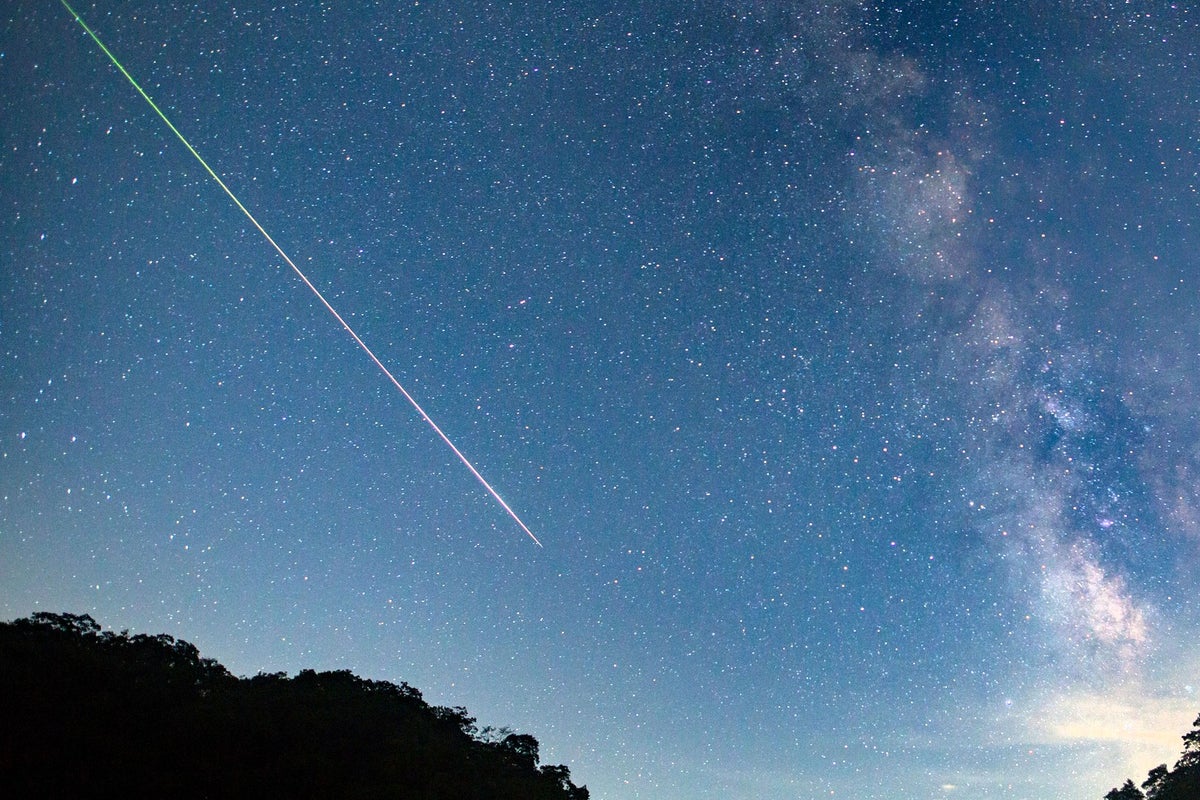
The most unpredictable meteor shower of the year is set to peak this week, bringing up to 100 shooting stars per hour.
The uncertain nature of the June Bootids, which arrive on 22 June, mean the number of visible meteors could be far lower.
Any that do arrive will be easy to spot, as they enter the Earth’s atmosphere at just 12 to 18 kilometres per second. By contrast, the Leonid meteor shower that appears in November features meteors burning up at around 70 kilometres per hour.
This means the June Bootids produce slow streaks across the sky, rather than rapid flashes.
The June Bootids have produced spectacular displays in recent decades, most notably in 1998 when the shower peaked at 100 meteors per hour and sustained this level for over seven hours.
The meteors result from the Earth passing through debris left behind by comet 7P/ Pons-Winnecke, which orbits the Sun every six years.
“The radiant is best placed in the evening sky just as the sky becomes dark,” the American Meteor Society (AMS) noted.
“Observers in the Northern Hemisphere have a distinct advantage over those located south of the equator as the radiant lies much higher in the evening sky.”
The AMS warned that current forecasts suggest there will be little activity for the June Bootids in 2026, however there were also no big predictions for peaks in previous years where activity was high.
The short summer nights around the time of the solstice mean that opportunities to spot any shooting stars will also be narrower.
The latest weather forecasts from the UK Met Office show clear skies across large parts of the country for most of the week, meaning any shooting stars that do appear should be easy to spot.
“If you’re feeling lucky, go outside, lie on a blanket, face the constellation Bootes in the west-southwest, keep the Moon out of your direct line of sight, and wait,” the Royal Museum Greenwich advised.
“You might see almost nothing. You might see a storm. We cannot tell you which. That makes the June Bootids, in their own chaotic way, one of the most exciting meteor showers of the summer.”