


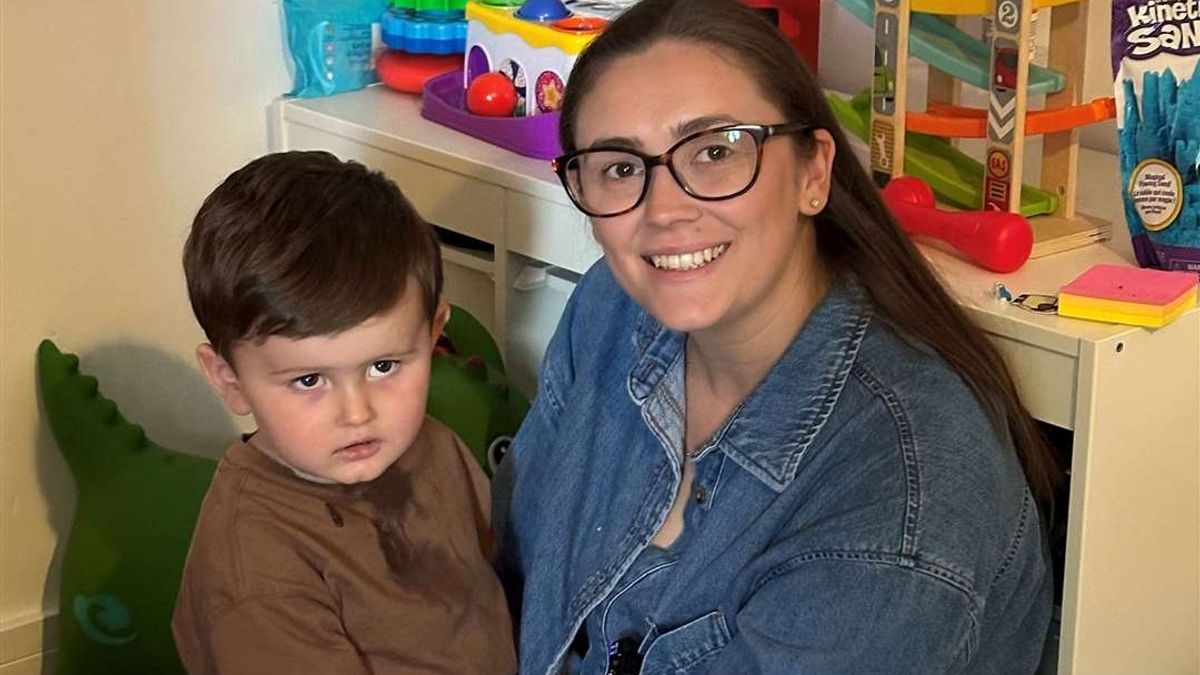
A toddler who can’t walk, move or feed himself has been denied a Blue Badge because he’s not considered disabled enough, according to his mother.
Charlotte Jenner and Charlie Sears from Paddock Wood, Kent have applied for the scheme, which would give them access to certain parking spaces, to help with transporting their son Ronnie.
The two-year-old has Phelan-McDermid syndrome, a genetic disorder caused by a microdeletion in one of his chromosomes, and hypertonia, which is a medical condition where muscles remain tight, stiff and resistant to movement. As a result, he is disabled, immobile, and cannot walk, crawl, roll or go from lying to sitting because his brain doesn’t communicate well with his limbs.
 View 3 Images
Ronie’s brain doesn’t communicate well with his limbs(Image: Charlotte Jenner/Cover Images)
Ronnie can eat but not move so at 18kg he is heavy for his age, which means his parents must lift him or use bulky equipment to mobilise him. After struggling to safely park and extract Ronnie from the car for months, in June last year Charlotte applied for a Blue Badge from Kent County Council (KCC). To her disappointment, it was declined. The project manager said: “It feels like a battle to get equal accessibility for my child.”
Undeterred, Charlotte refused to take no for an answer and lodged an appeal, including evidence from Ronnie’s GP and physiotherapist regarding his condition and immobility. Again, it was refused.
A spokesperson for KCC said they understood the decision was “disappointing” but said it must assess eligibility against the Department for Transport guidance and legislation.
Charlotte says a member of KCC’s Blue Badge team explained that for under 3s to be eligible, the child needs to be on palliative care or require life-saving equipment such as breathing equipment or feeding tubes.
After arguing Ronnie’s case, the authority agreed to organise an in-person assessment by an occupational therapist. Charlotte brought her son and an entire folder of medical letters detailing over 100 scheduled appointments about his condition and mobility. In-person, Charlotte says the assessor was sympathetic to her situation, but the final decision was made by a panel, who refused to issue a badge.
The 27-year-old says she was “absolutely fuming” and in disbelief that the refusal would come against the backdrop of Ronnie’s medical professionals advocating for him to have one.
She said: “It basically said, we recognise Ronnie’s disabled, but he’s not disabled enough. That is the long and short of what they said. I’m having to fight my local council for basic accessibility for my disabled son. If all of Ronnie’s medical professionals in his life say he needs a Blue Badge, what position does my council have to say no?
“Ronnie has a medical condition that isn’t going to disappear. He will have the same diagnosis today as to when he’s seven, to when he’s 40. His entire life, it is not going to change. So that is why I argued you can’t apply a blanket policy when I am telling you my scenario is different.”
 View 3 Images
Ronnie’s mum and dad are doing their best to provide as normal life as possible for their boy(Image: Charlotte Jenner/Cover Images)
Without a badge, every day is a battle for the family to attend medical appointments, park safely and even utilise his walker weighing 14 kilograms, as it can’t be transported and used in other settings outside the home without access to a widened parking space.
“There are times I haven’t been able to attend appointments because I can’t find a safe space to park and get Ronnie out of the car. His nursery can’t leverage any of the equipment like the walking frame because I can’t get it there, so that actually hinders him being able to progress walking. How can I be expected to park my car, get this stuff out of my car and Ronnie safely? He is disabled. I need better accessibility to get him in and out.”
It was only when she submitted a subject access request to obtain Ronnie’s application paperwork that she learned how restrictive the assessment had been. The parents want the council to recognise that her family needs a Blue Badge and for her son to be assessed “as an individual, not as part of a tick-box exercise”.
Charlotte and Charlie work full-time while juggling the multiple medical appointments for their son, and have accessed every level of support available to the youngster.
The two-year-old, who doesn’t turn three until February, has a paediatrician, community paediatrician, hearing specialist, development specialist, occupational therapist and physiotherapist, but none of them can provide an accessible parking permit, only KCC’s Blue Badge department can.
“Ronnie cannot choose whether he is disabled or not, that choice was made for him,” said Charlotte. “Right now my council is preventing me from including him in everyday society, from giving him the same opportunities and from making him feel included. I should just be able to include him in society as every other child should: dropping him off at nursery, popping to the shops, taking him to an appointment, going out for the day. I shouldn’t have to worry and plan ahead about how safe I’m going to be or whether I can take part in that.”
The family is determined to fight for Ronnie and other disabled children’s access to a Blue Badge. The council advised the family to use parent and child bays, but the couple say they are not always an option, are often occupied, and do not offer the same accessibility, such as parking on double yellows, that a Blue Badge could.
The family have been in contact with their MP, Mike Martin (Lib), who described the situation as “deeply concerning”. He said: “Families with disabled children shouldn’t have to go through such prolonged battles simply to secure basic access and dignity for their children. I have been pressing the council for months to review this case and to implement a fairer, more compassionate Blue Badge system.
“However, Kent County Council, under the leadership of Reform’s Linden Kemkaren have repeatedly rejected my calls for change. This is another example of Reform’s chaos and utter incompetence.”
A KCC spokesperson said: “We understand the council’s decision is disappointing. However, KCC must assess Blue Badge eligibility against the national Department for Transport guidance and legislation. This provides a very clear set of eligibility criteria for children under three which were not met at initial assessment, or appeal, in this case.
“KCC considers all Blue Badge applications for children under three as special cases, but also has a responsibility to be fair and consistent when issuing Blue Badges. The presence or absence of any condition does not in itself determine badge eligibility at any age. In this case, the applicant was offered multiple assessments, including a face-to-face assessment, to ensure that all relevant information was considered, including observing how the family get about. The outcome of assessments are always communicated in writing with applicants.
Article continues below
“When children reach three, the eligibility guidance allows for a greater scope in assessing how children mobilise independently, and we have advised that KCC is always happy to reassess children at this time. If the Department for Transport changes the eligibility criteria KCC will follow this guidance.”