


David Lammy has defended the Government’s plans for the UK’s defence, saying the pledge for spending to reach 3 percent of national income is “absolutely sacrosanct “.
Amid delays to an investment plan for the future, the deputy prime minister said “the money will be found” to set out how new equipment and infrastructure will be procured, as he faced questions about which departments may face cuts to fund the armed forces. The Defence Investment Plan (DIP) was expected last year but may not be published until July amid reported wrangling within Government over how to pay for the plans.
Ministers have said the plan will be released before the NATO summit in Turkey begins on July 7.
 View 9 Images
Vladimir Putin’s Russia could attack NATO territory, experts have warned(Image: POOL/AFP via Getty Images)
Asked whether he would be happy to give up some of the justice budget to shore up cash for defence, Mr Lammy, who is also Lord Chancellor, said he would not comment on discussions with the Treasury but that defence of the nation is “the first purpose of any Government”. He told the BBC’s Sunday With Laura Kuenssberg programme: “The money will be found, our commitment to 2.6 percent and then to three (is) absolutely sacrosanct under this Government.”
The Sunday Times reported Sir Keir would target net zero and transport as he looks for cuts to fund the DIP. Capital spending, which is used for long-term investment on infrastructure, will also be reduced by 1% across all departments to raise around £6 billion by the end of the Parliament, according to the paper.
 View 9 Images
Taiwanese military drills last year(Image: Anadolu, Anadolu via Getty Images)
And a Ministry of Defence (MoD) spokesman said the Government is providing a “generational increase” in defence spending, with an extra £270 billion across this Parliament. The UK has committed to reach a defence spending target of 3 percent of gross domestic product when economic conditions allow, and 2.6 percent – which includes spending on the military as well as on security and intelligence – by 2027.
Asked about criticsim over the DIP spokesperson told The Mirror: “The Defence Investment Plan will deliver the best equipment and technology into the hands of our frontline forces, while investing in and growing the UK economy.
“We are working across government to finalise the plan and as the Defence Secretary said earlier this week, it will be published before the NATO summit.”
But reports have suggested there is a funding gap of around £28 billion in the existing plans, and war could come sooner than that, experts warn. NATO chief Mark Rutte has suggested Russia could be ready to use military force against the alliance within five years.
Experts have repeatedly warned that Britain is underprepared for war, and some have suggested a larger increase in spending will be needed to successfully address the problems it faces.
Last year, the Government-commissioned UK Strategic Defence Review warned that in a world with nukes, drones, pathogens, the changing nature of warfare and rogue countries, a “hollowing out” of its armed forces must be addressed. It warned that the regular force of the British Army should not drop below 73,000. It is currently around 73,790.
“This is the most dangerous period that I have known,” Chief of the Defence Staff Sir Richard Knighton told the BBC’s Today programme on Friday. He said the first five months of this year have seen as many incursions by Russian strategic aircraft into UK airspace as were recorded in the whole of 2025.
 View 9 Images
Lord George Robertson, who co-authored the Strategic Defence Review(Image: PA)
Dr Rob Johnson, director of the Changing Character of Conflict Centre at Oxford University, said in April that there is a “breathtaking” lack of preparation. Speaking to Sky News he said: “I would expect to see a rapid expansion of the Royal Navy, a rapid improvement in munitions production in the UK, co-production with Europe.”
He went on to say that he felt there were numerous signs war is possible in the future. He added: “Crucially, I also would like to see the public being informed properly about what the threat is.”
 View 9 Images
A rescue worker battles blaze after Russian attack on Kharkiv earlier this month(Image: Ukrainian Emergency Service via)
Dr Johnson argued that China was preparing for war in Taiwan. He said: “Perhaps most worrying of all, they’ve made a declaration they’re going to have a thousand nuclear warheads by 2030.” He also said there is evidence of a plan for a potential attack by Russia against NATO.
Defence spending fell significantly from the end of the Cold War. Where previously it was around five percent of GDP, it fell to around 2.4 percent in the following decades and there were further damaging cuts under the austerity brought in by the Coalition and Tory governments. It means that today, the UK has a limited capacity to respond to external threats and the changing nature of warfare.
Drones and missiles
Drones, for instance, have become tactically essential on the battlefield since the outbreak of the war in Ukraine. The UK has little it can throw at an incoming drone attack, which are known to get through defences because of their sheer numbers, an advantage of them being relatively cheap to produce.
Defending with missile reserves, which are already very limited, would be costly and would deplete quickly. Smaller drones hovering around key parts of UK energy infrastructure, such as electricity pylons, are also a concern, with calls for drone nets and other protections around key sites growing, Sky News reports.
 View 9 Images
Two young people cry as they look at stand outside a destroyed residential building, in Kyiv, that was destroyed by a missile(Image: AP Photo/Efrem Lukatsky)
The Department of Energy Security and Net Zero (DESNZ) has said energy security is a “top priority”. Land-based missile defence are also limited, with most stationed on aircraft and ships. Andrew Neal, the Personal Chair of International Security, University of Edinburgh, wrote in The Conversation that this “has the advantage of mobility”, but is “spread thin”.
In February, the Government announced a £500 million air defence package. It included £150 million for NATO’s Prioritised Ukraine Requirements List (PURL) initiative, enabling the rapid delivery of air defence interceptors, alongside the provision of more than 1,000 Lightweight Multirole Missiles manufactured in Belfast.
It also supported a £390 million deal to boost collaboration between UK and Ukrainian industry, including the transfer of production and support for air defence systems to Ukraine.
Fleet
Following repeated cuts since 1990, the surface combatant fleet is around a quarter of its size at the fall of the Soviet Union. Currently, it includes six destroyers and 11 frigates, below what is reported to be a “bare minimum” of 22, according to internal MoD thinking cited by The Telegraph.
 View 9 Images
UK warship HMS Dragon(Image: LPhot Helayna Birkett/Royal Navy / SWNS)
And there are further questions over how many could actually be put to sea at once. Sir Richard recently rejected criticism that the military was ill prepared for conflict in Iran, following criticism the UK was too slow to deploy its HMS Dragon warship to the region.
Nukes and NATO
The UK is heavily dependent on the US for its nuclear deterrent. Trident missiles can be fired independently of the US, but they have US-built components and must be serviced across the pond.
The US under Donald Trump has been increasingly antagonistic towards its allies and there are more general concerns that this spells a long-term shift away from NATO allies through the supplying of troops to cooperation on nuclear issues. That, for now, could be a long way off, but the US is clearly frustrated by defence spending, or what it sees as a lack of, among NATO partners and Trump has repeatedly hinted at leaving the alliance.
 View 9 Images
Trump has been critical of NATO allies(Image: NBC)
Submarines
The MoD is developing a submarine maintenance recovery plan amid reports the Royal Navy’s entire available fleet of hunter-killer submarines is docked. The Mail on Sunday reported all five Astute class submarines – which are used to protect the Vanguard submarines which carry nuclear Trident missiles – are out of service while they undergo maintenance and repair work.
The First Sea Lord ordered the plan to be developed which would prevent maintenance overruns and increase capacity to achieve war readiness. An MoD spokesperson said: “Strengthening and sustaining our submarine capability is a top priority, and we are taking decisive action to ensure its long-term resilience.
“The Strategic Defence Review has underscored the critical importance of sustained and targeted investment across the Defence Nuclear Enterprise, and we are unwavering in our efforts to deliver the resources, infrastructure, and support necessary to meet current and future operational demands. We do not routinely comment about specific submarine operations and availability, but British waters are always protected with a range of assets including warships, patrol aircraft and submarines.”
 View 9 Images
British defence secretary John Healey(Image: Getty Images)
The Mail quoted a naval source as claiming that “a lack of investment for decades in providing the back-up infrastructure to keep them (submarines) safe” had contributed to the current problem. It is the second time in as many days the state of the Royal Navy’s vessels has been called into question.
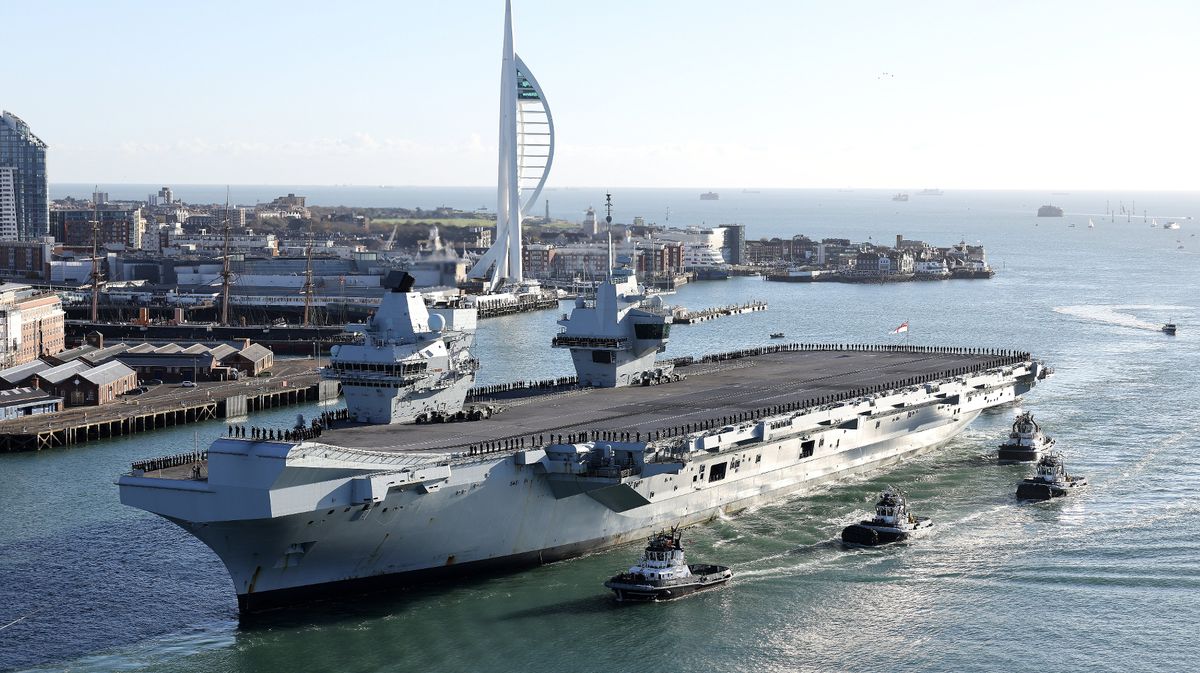
On Saturday, the MoD said a technical issue had been detected on the UK’s largest warship as it was docked at a port in Norway. Earlier this month, HMS Prince of Wales set sail from Loch Long, Argyll and Bute, Scotland, for Nordic waters to provide security in the Atlantic and High North regions.
“A minor technical issue” was identified on the Royal Navy’s most powerful vessel during its latest stop in Stavanger, a port city in south-western Norway, the MoD said. The aircraft carrier is expected to sail in the coming days, the ministry added.
Article continues below
An MoD spokesperson said: “HMS Prince of Wales is currently conducting a port visit to Stavanger as part of the Carrier Strike Group’s deployment across the North Atlantic and Arctic, we expect her to set sail in the coming days.”
Earlier this year, former chief of the service Lord West of Spithead said the Royal Navy is in the most “parlous state” it has been in for 60 years and does not “deliver what the nation needs”.