


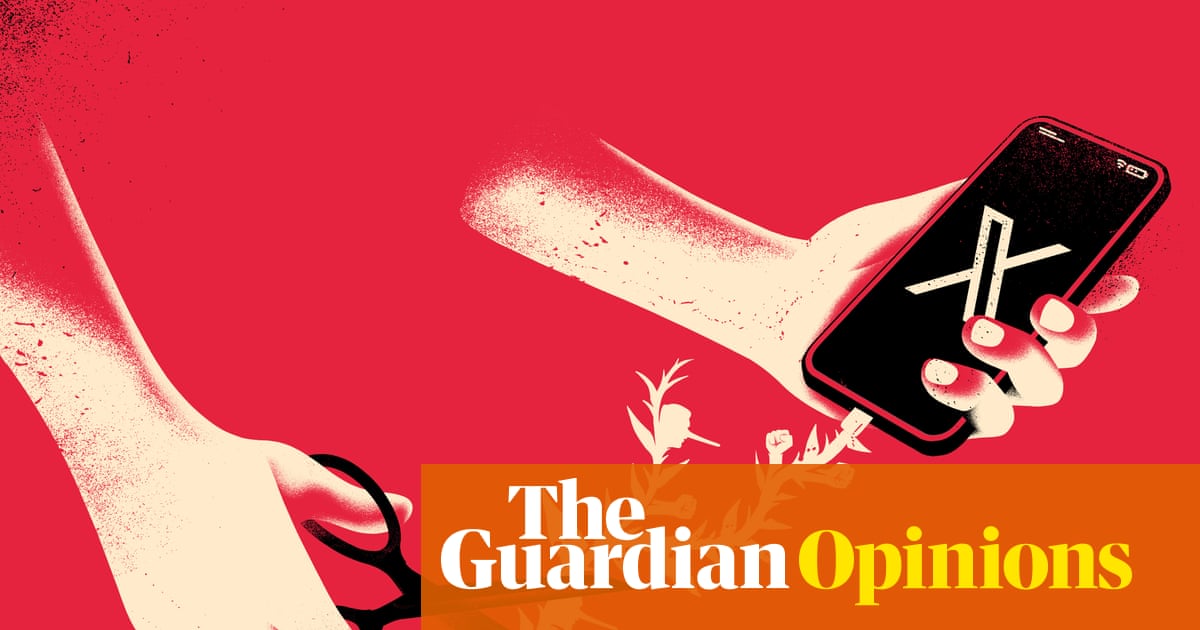
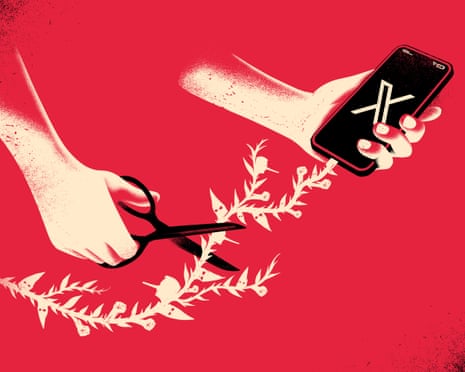
If you’re still on Elon Musk’s X, ask yourself this: why?

Some argue that quitting the platform formerly known as Twitter cedes the space to malign actors. But it’s an open sewer, beyond redemeption
You can read the Tottenham striker Richarlison launching a defiant broadside at the newly crowned champions. “Next season, we will compete for the title,” he says. “Arsenal won’t be winning it again for the next 22 years.” You can read the outgoing Manchester City manager, Pep Guardiola, throwing shade at his Arsenal counterpart, Mikel Arteta. You can see the Liverpool full-back Andy Robertson warning his coach, Arne Slot, that “things have got to change if he wants to stay”. You can see the television pundit and former Manchester United player Gary Neville deriding the club’s playmaker Bruno Fernandes as a “stat-padding talisman” who pales in comparison with the City legend Kevin De Bruyne.
Incendiary stuff, and huge if true. Also, as it turns out, huge if not true. On a regular Monday morning on the world’s 15th-most-popular social media platform, these were just a few of the football-related tweets doing big numbers, getting shared and discussed and punted up the X algorithm to be discussed even more. That none of them were actually real quotes was the most minor of inconveniences. After all, when the whole point of the site is simply to argue over things, to relitigate existing beefs and reinforce existing prejudices, does it even matter if they were real or not?
I should confess that since deleting my account completely in 2024, I no longer visit Elon Musk’s free-speech Disneyland with any great regularity, and so we should admit the possibility that what I happened to see this week was an unrepresentative sample. Perhaps on a typical day the factchecking processes are robust, the fake content minimal, the community largely wary and self-policing. In which case: deepest apologies.
All the same, and mainly for unpleasant and unavoidable work reasons, I do occasionally have to set up a burner account and wade back in, and leave a little more appalled every time. The levels of fake content are out of control. The user interface seems specifically designed to push content you did not ask for. And deepest sympathies if you ever decide to watch a video and find yourself finessed down a wormhole of street brawls, arcane arguments, talkshow interviewers “owning” interviewees or vice versa.
Partly, of course, this is simply the nature of the algorithm, updated and published by Musk at regular intervals. Whenever a post is published on X, a formula instantly assesses it according to 15 possible metrics. Did you like or share it? Did you reply? If your reply prompts a response from the original author, a bot marks it as a “debate” and shoves it to the front of the queue. And because people are far more likely to respond to a post they object to than a post they admire, what gets promoted is often the most contentious or controversial material: trans rights, Israel, Restore Britain, VAR.
We do not need to explore the many ways in which this apparatus stymies meaningful public discourse, amplifies the false and the provocative. There is a plethora of existing research on how X shifts its users in a more rightwing direction. A study published in February this year randomly assigned 5,000 active X users into one of two groups: one served the algorithmic “for you” feed, one using the classic chronological model. Users seeing the “for you” feed were measured as significantly more likely to “prioritise policy issues considered important by Republicans, such as inflation, immigration and crime”, more likely to take a pro-Russia stance over the war in Ukraine.
The enduring curiosity is why so many self-professed progressives remain wedded to a platform with an algorithm that results in misrepresentation and suppression, drowning out their creativity in an open sewer of disinformation, scams, bots and falsehoods. And to be clear about this: many of these people are voices that I admire and respect, people I consider allies and friends. Although the Guardian stopped posting on X in 2024, a good number of you probably remain on there, still lurking, still browsing, still using. Why? What do you think you are trying to achieve?
One possible explanation is sunk-cost fallacy, a kind of nostalgia for what Twitter once was. Many X users have spent more than a decade building up their followings, building networks and trust. My own account had about 120,000 followers at the time of deletion, and naturally there was a short period of mourning for the years of work consigned to the digital bin: the jokes, the memes, the illuminating conversations with total strangers, the fleeting moments of genuine art that could exist in an age before bad-faith actors were able to use quote tweets and screenshots to take your thoughts and strip them of context for money.
We also hear the tired but tenacious trope that to retreat from X is somehow to cocoon yourself, to run from scrutiny, to cede the space to the malign. Perhaps this was truer a decade ago. But to be remotely leftwing on X in 2026 is simply to exist in a bubble of a different kind: an echo chamber in which everyone is forced to ingest a regular stream of ill-informed racist garbage as the price of admission, where progressives are essentially a sort of second-class citizenship. An echo chamber in which you are regularly urged to kill yourself, deport the foreigners, argue about Donald Trump with a string of alphanumeric code. And yes, occasionally you get served a funny video of a fight outside a pub. Is it worth it?
The remedies here are obvious enough. Already it is clear that alternative platforms such as Bluesky and TikTok and Threads will not save us. The utopian idea of the digital town square is dead for ever. The only reliable disinfectant for a surfeit of lies and white supremacism is a balanced, informed media diet, actual engagement with actual real-life people. And the only real antidote to X-brain is X-shaming: an admission that the continuing presence of progressives on X helps prop up the entire enterprise, offers the illusion of balance and multipolarity that allows mainstream media and politicians to continue mining it as a proxy for public opinion.
Above all, we should start to stigmatise X usage for what it really is: a small and selfish part in making the world measurably worse. You are not special. You are not immune to fake news, delusion, anti-reality. You do not have a unique ability to maintain your critical faculties in an ecosystem where everyone else is losing theirs. Every minute you spend in the hot water boils you a little more. Ultimately, only by conscientiously refusing the lure of the algorithm can we start to fix all the ways in which it has broken us.
-
Jonathan Liew is a Guardian columnist