


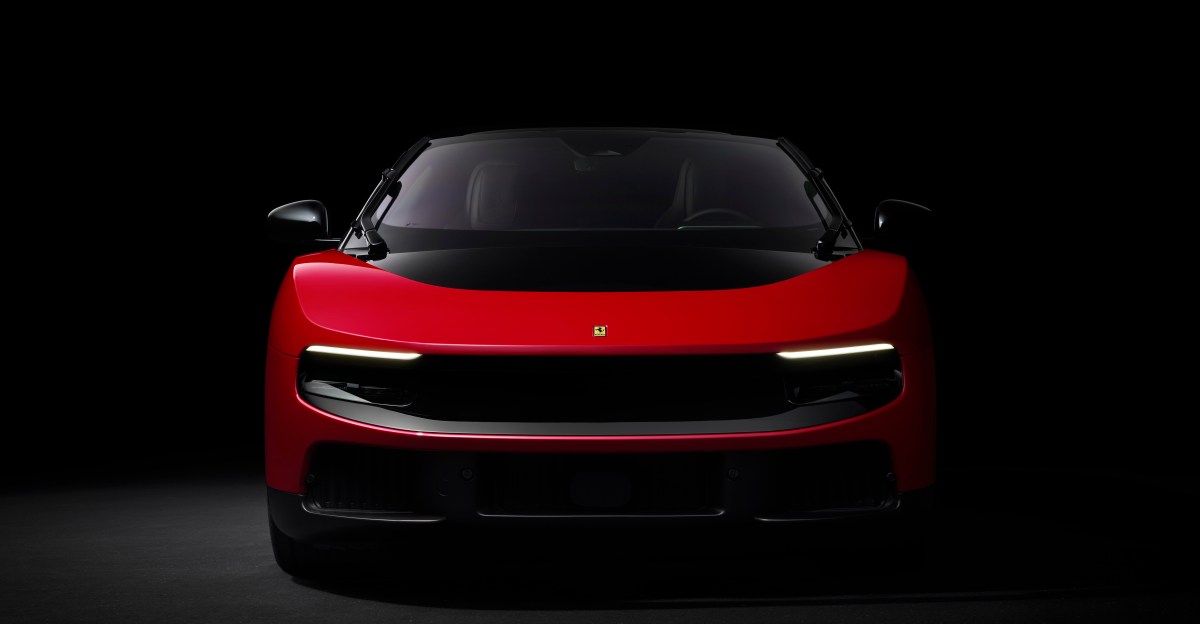
This Ferrari should have been a Volkswagen
Jony Ive’s vision will be enjoyed by an elite few, but it could be extended to everyone
Jony Ive’s vision will be enjoyed by an elite few, but it could be extended to everyone
by May 27, 2026, 1:55 PM UTC TC Sottek is a senior editor who has obsessed over headlines and internet speeds since 2011. He previously worked as an advocate for the National Park System.
It may be the NBA playoffs but right now Ferrari is getting dunked on more than anyone. Whether they own a Ferrari or just have a poster of a Testarossa on their wall, fans in the Ferrari-verse are frothy about the Luce, the company’s first all-electric vehicle. According to one highly rated Verge commenter: “looks like a Polestar had a one-night stand with a Prius.”
Whatever. The competition should steal this design.
The Luce looks weird because Ferrari isn’t asking to have its edges sanded off. Its most iconic models, like 1987’s F40, are defined by hard angles. That makes the contrast between Luce and legacy even sharper. But look beyond the Luce’s cover to find a compelling design story on the inside.
There are lots of arguments for and against the everything-is-a-touchscreen modern car. Ferrari’s new design, built with Jony Ive and Marc Newson’s design agency, LoveFrom, is more proof that there can be a happy middle ground — perhaps a Goldilocks zone of car interiors that successfully blends sensory experiences. I can picture Jeff Bridges in Tron: Legacy looking at this thing and once again uttering: “it’s biodigital jazz, man.”
I’m a huge fan of physical switches over touchscreens because when done right, they’re graceful, efficient, and fun as hell to use. Reducing every tactile input to the same kind of press on a giant touchscreen that dominates the interior of a vehicle feels both tacky and unwieldy. I recently got to see the gigantic 56-inch Mercedes EQS EV “Hyperscreen” and thought I was inside a clown version of the Las Vegas Sphere. There’s something alienating about the Hyperscreen and other offspring in Tesla’s design lineage, as if Grok went back in time to imagine “the perfect future car” and then made that slop real. A screen can be suitable, but a switch has soul.
The Luce is awash in soulful physicality. Just look at this stuff:


Every single physical switch on this thing is begging to be touched. It’s a tactile wonderland, with a mix of rotating knobs, buttons, and toggle switches. There are even variations within each type. And they’re all wrapped in the embrace of an unfussy interior that lets these little details shine.
Humble elegance abounds. The Luce’s rear passenger console has physical inputs and outputs that appear to blend seamlessly with a digital display. And just look at that center-dashboard display with the handlebar. Chef’s kiss.


Elsewhere, the project is dripping with craft. LoveFrom’s custom typeface for the vehicle, “LF Maranello,” is pleasing in its clarity and familiarity, feeling functional instead of fancy. (Not that fancy is always a bad thing; I’m looking at you, classic Porsche Carrera lettering.)
And, yes, of course this isn’t all entirely new territory. There have been lots of great designs and doodads in various cars over the years, including my personal favorite: the toggle switches in my old Mini Cooper. I’d always want to flip them for that satisfying tactile feedback even if I didn’t have a reason to. I can’t even remember what they actually did, but I still remember how they felt.
But there are also a lot of switches that suck. The all-purpose knob in my Mazda CX-5 never felt comfortable or intuitive and actually felt more distracting than if the car’s display had been touchable. Its clunky, unopinionated “click” felt so awkward — like it was stuck in a squeakysquicky space between the dueling identities of wheel and button.
Nonstandard buttons, like the ones that open doors in Teslas, are so cursed that they inspired a sketch on Saturday Night Live:
(To be fair, the Luce also has similar buttons for door opening.)
There are also buttons out there that aren’t really buttons — basically blank placeholders in a bunch of cars that forever haunt you, whispering “you didn’t pay for sport mode.” That would seem to make the case for screens over switches: say, for the iPhone’s movable type over the iPod’s clickwheel.
And then there are buttons in purgatory. The now-familiar push-button ignition has waffled between feeling premium and mundane, which is all to say that there’s no perfect formula for a car’s control scheme.
But the Luce makes a good case for its take — enough to convince veteran reviewer Tim Stevens that “it’s among the greatest interiors in the world.” It doesn’t give into excess in either direction. There aren’t too many screens, and there aren’t too many switches. It looks mature and yet playful — an inviting combination. (Caveat emptor: I haven’t actually touched these things, so I’d still need to sit down for a thorough verdict.)
A car that starts at $640,000 is, practically speaking, for almost nobody. And that might be one of the reasons why the overall project looks like a fumble after Ive spent nearly 30 years at Apple making iconic products used by billions of people.
It’s not that Ive should be forever beholden to making things for a mass market (or for making things at all — what a run of a career already!). But it’s a shame that the good ideas in this largely unattainable machine seem like they could have lived in a widely available car. I keep wondering what might have happened if Ive’s firm had helped reboot something like the Volkswagen Beetle, or blessed an entry-level EV with the Luce’s design language. In the meantime, there’s still plenty of eyebrow-raising design work out there, like these concepts from VW Group’s Scout Motors.
Then again, maybe all this attention will work in Ive’s favor. LoveFrom already got a ton of money from Ferrari to put something bold out there that’ll be licensed or copied by others. Everyone’s talking about it. And now I’m eager to see if this rare Ferrari design will be pounced on by competing carmakers — something that would turn a fleeting controversy into a lasting legend.
Follow topics and authors from this story to see more like this in your personalized homepage feed and to receive email updates.