


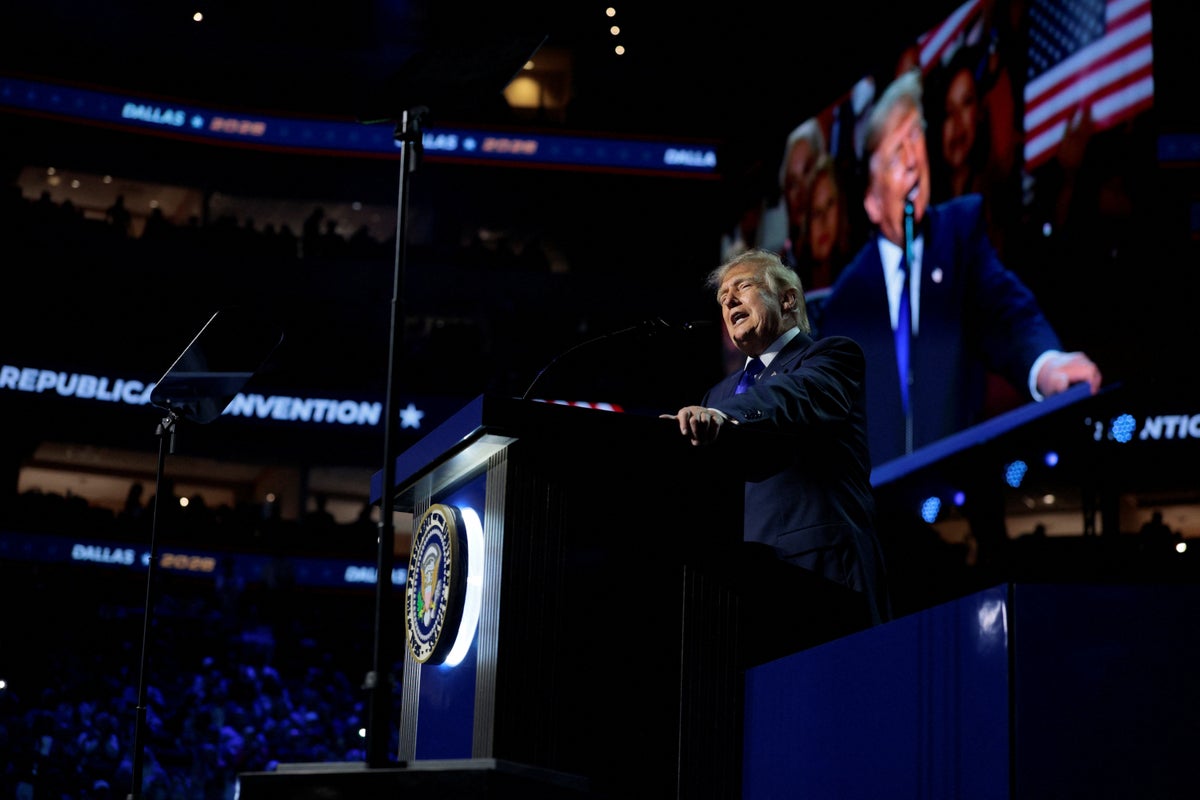
Forty-three minutes into a speech that would run past an hour and a half, the President of the United States begged an arena full of his own supporters to avoid using the bathroom for the benefit of television cameras that were there to document his remarks.
“The fake news will go around and see that man up there. He’s leaving for the bathroom. He’ll be back in two minutes,” Trump said. “They’ll take a picture of his seat while he’s gone, and they’ll say Trump did not fill up the arena. The arena was not filled. Look at the seat. So please, if you don’t mind, don’t anybody go to the bathroom.”
It was the third — but not the last — time he’d remarked on the crowd size at the American Airlines Center in Dallas, where he’d assembled Republicans for a fake “convention” where no party business would be done save for speeches in support of GOP candidates running in midterm elections the party is expected to fare poorly in this November.
By the end he had returned to the size and fullness of the room on at least six separate occasions, and closed on it. “We looked around. The place is packed. Nobody left,” he said in his final minutes. “Let’s keep it that way, because I’m almost finished.”
Nobody had asked. That is the tell, and it ran through the whole night.
 open image in gallery
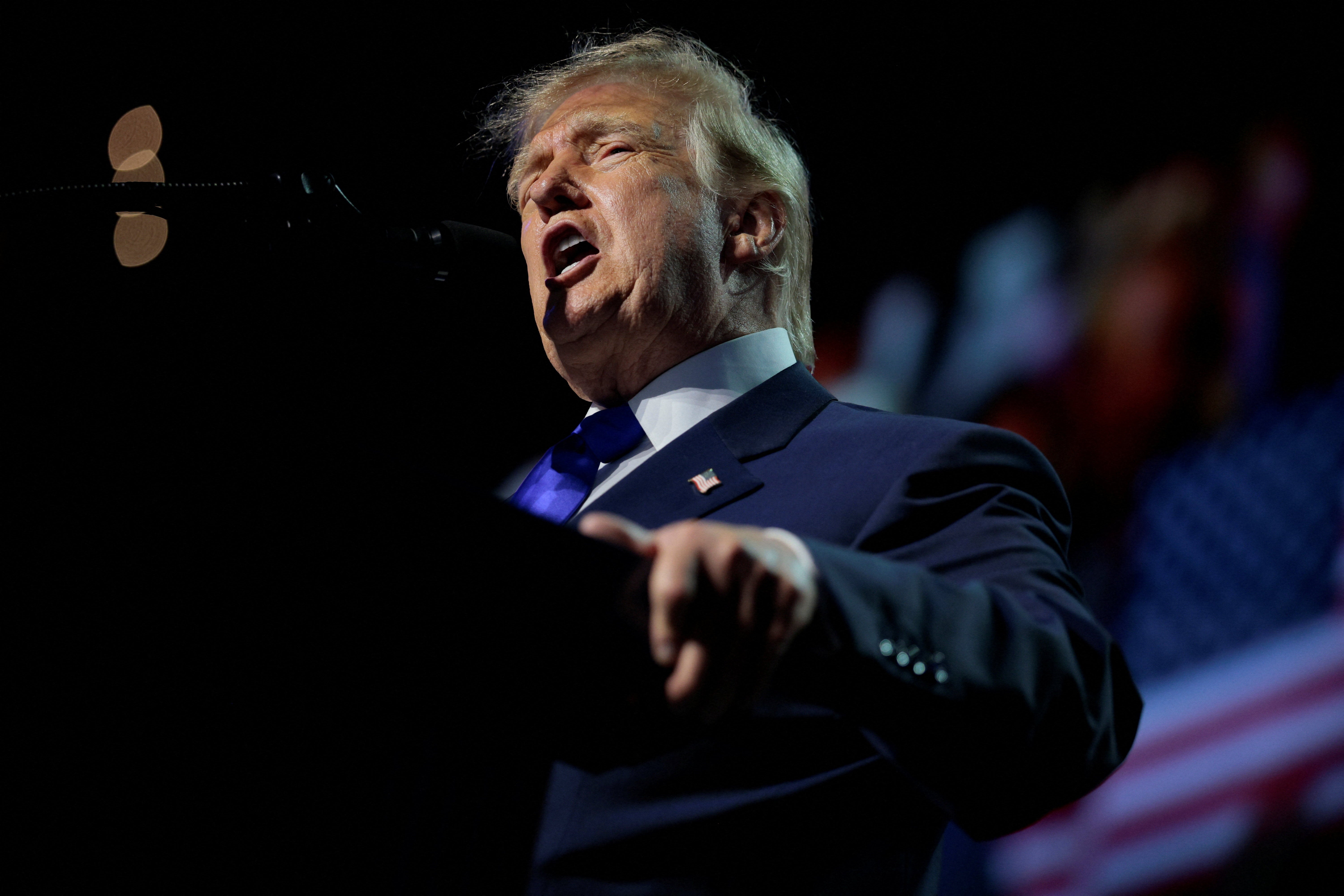
The event that opened at the American Airlines Center on Wednesday was, by the president’s own description, something he made up. “Welcome to the first ever midterm convention of any party,” he said in his second sentence. “A little imagination to think of it, but we thought of it. I’m sure it’ll become a staple in the years to come.”
Political parties hold conventions to nominate presidential candidates, and the next presidential election — one he cannot run in — is two years away.
What he and his allies dubbed a “convention” was instead was a two-night arena rally, in a state the president carried by 14 points, announced eight weeks ago, in a building the Republican National Committee had spent the preceding days filling by public lottery.
It was a desperation move, borne out of Trump’s conviction — and polling supporting it — that he, like most of his predecessors, will see voters render a negative verdict on his first two years in office when they go to the polls two months from now.
“For some reason, when a president wins, even if he’s really a good president or a great president — there aren’t too many of them — they don’t win the midterms, and nobody quite knows why,” he said. “It’s two out of — think of it — two out of 25 races,” he said.
“It’s something deep down and psychological. You’re going to have to explain it, but I’ve asked people what is the reason for it.”
Presidents do not usually stand on a stage 55 days from an election and describe, at length, the historical pattern that is about to happen to them, but for months now he has been preoccupied with that historical pattern — one that held in his first term, when Democrats took back the House by a wide margin.
With that in mind, he begged his supporters to “pretend that I’m on the ballot … just one more time.”
But after an hour of touting his administration’s meager accomplishments, he stopped asking for votes based on results and started offering what amounts to a bribe.
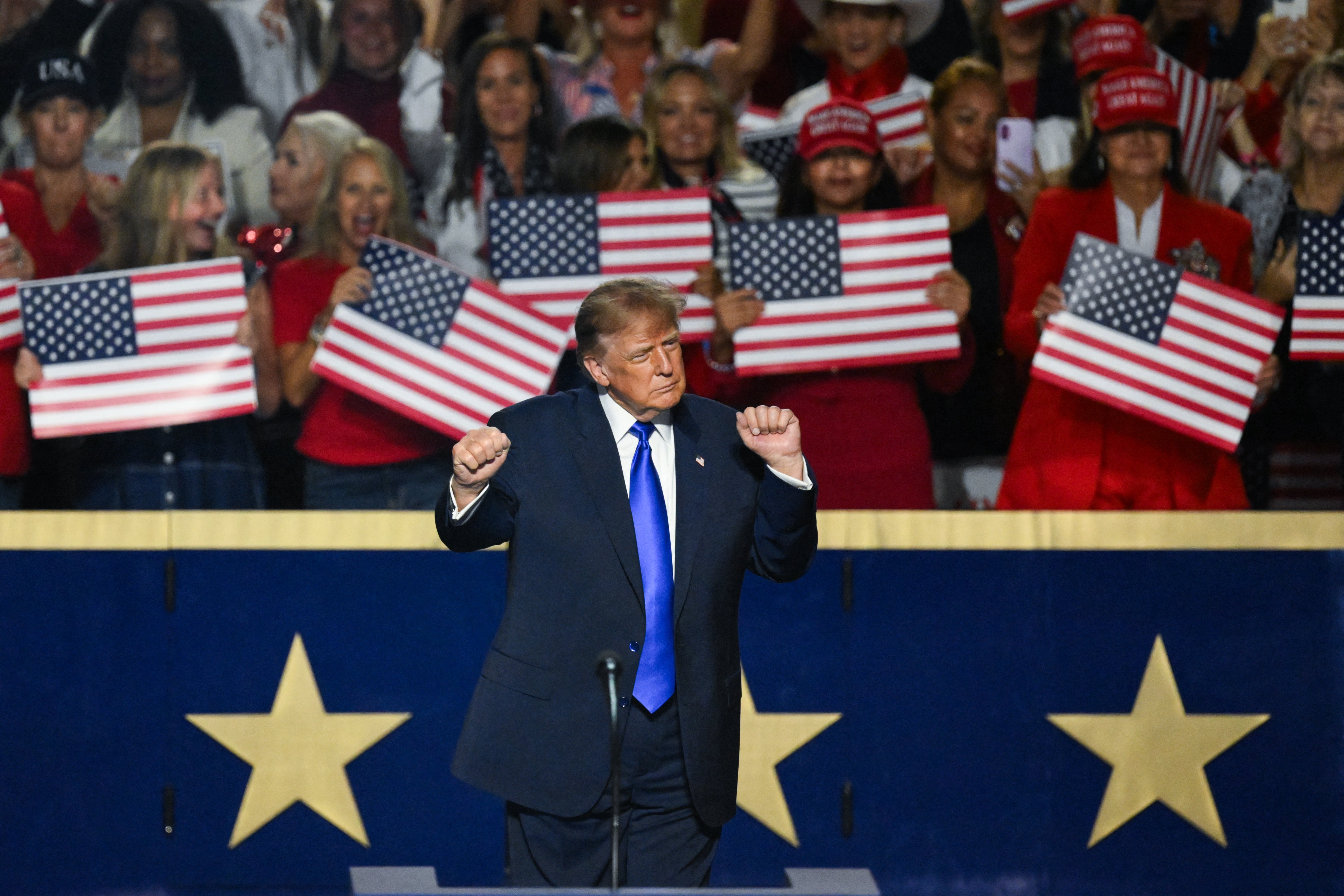
“Because of our tremendous strength and success economically, I will issue a dividend to every adult citizen in the United States of America for $5,000,” he said.
 open image in gallery
“So if the Republicans win, you win with us, and you get $5,000. It will be called the Trump dividend.”
Set aside what it means for a president to offer the electorate a five-thousand-dollar payment contingent on an election result. The more immediate problem is that he has made this promise before, for less, and it did not arrive.
In November, Trump promised $2,000 tariff-funded checks to low- and middle-income Americans, to begin around the middle of this year. It is September. Treasury Secretary Scott Bessent — who was in the arena on Wednesday, and whom Trump called on by name from the stage — said at the time: “We need legislation for that.” White House economic adviser Kevin Hassett said the same. The Committee for a Responsible Federal Budget concluded that tariff revenue would not cover it.
Since then the revenue base has been removed. On February 20, the Supreme Court held 6-3 that the International Emergency Economic Powers Act does not authorise the president to impose tariffs, striking down the levies that were generating most of the money and leaving the government facing refund claims projected at up to $175 billion.
The arithmetic on the new figure is not close. There are roughly 258 million adult citizens in the United States. At $5,000 each, the Trump dividend would cost about $1.3 trillion — more than half of what the federal government collects in individual income tax in a year, and several times the estimated cost of the $2,000 version he could not deliver when it was capped by income.
Congress appropriates money. The president does not. A promise conditioned on Republicans winning both chambers is, on its own terms, an acknowledgement of that.
He seemed to know the number was doing something odd. Attacking Democrats over reparations later in the speech, he said: “They have the money for $5,000, but they don’t have that kind of money.”
The final half-hour was given over to the candidates he needs, and it was the ugliest stretch of the night.
In North Carolina, where former governor Roy Cooper is running for the Senate against Michael Whatley, Trump spent five minutes on the murder of Iryna Zarutska, the 23-year-old Ukrainian refugee stabbed to death on a Charlotte light rail train, describing the video in detail and saying he had been “forced to look.”
He then falsely accused the ex-governor of playing a role in the chain events that led to the brutal killing — something Cooper had nothing to do with.
“Roy Cooper was the governor,” he said. “Released this animal into North Carolina society.”
 open image in gallery
Zarutska was killed on August 22, 2025, nearly eight months after Cooper’s term as governor ended.
And according to PolitiFact, Trump’s suggestion that a 2021 prison settlement under Cooper released her killer, DeCarlos Brown Jr., was completely baseless.
Trump then alluded to a similar case from his heyday as a New York tabloid figure — the late 1980s — when another Republican candidate used specter of Black criminality to derail another Democratic candidate’s hopes for higher office.
“This happened up in Massachusetts a long time ago, when they released a violent criminal … and as you know, that governor from Massachusetts was running for president, and he was leading. And as soon as that happened, he took a 10-point drop, and then another 10 point, and then he got beat in a slaughter.”
He did not say the names of Willie Horton or Michael Dukakis. He did say what he wanted: “That should happen to Roy Cooper.”
In Texas, he turned to Ken Paxton’s opponent, state Representative James Talarico, and called him “a weird-looking dude” who in his estimation resembles the Mad Magazine mascot Alfred E. Neuman. Among the claims that followed was that Talarico “described himself as a person who hates Christianity” and “says that God is transgender.”
Talarico earned a Master of Arts in theological studies from Austin Presbyterian Theological Seminary in May of last year, is a member of the Presbyterian Church (USA), has said he intends to seek ordination whether he wins or loses, and has run a campaign built explicitly on his Christian faith — to the point that Texas Republicans have accused him of overdoing it.
In Michigan, Trump attacked the Democratic Senate nominee by way of his sister and his mother, making allegations about both that he offered no evidence for and that concern private citizens who are not on any ballot.
He had already, earlier, spent close to three minutes praising Paxton by insulting him. “Some may not like the way he dresses. I don’t,” Trump said. “They may not like the way he talks. I can see that.” Then: “You may not like the way he looks, but here’s the news. In the history of Texas, he is the single greatest attorney general you’ve ever had.” He said his own advisers had begged him not to and had kept it off the teleprompter.
And in the last minutes, he came back to the room.
He told a long story about a rally he held in South Carolina for Darline Graham, the sister of the late Senator Lindsey Graham, who died in July and whose seat she is now defending in November. A New York Times reporter, Trump said, had claimed on television that the room was half empty and that the back had nobody in it.
“Let me tell you, the back of the room made this one look empty,” he said — a sentence that does not mean what he wanted it to mean. Then: “Because of that speech, she won.”
Then the pre-emptive strike. “I’ll read in the New York Times tomorrow that Trump lost his audience,” he said. “They’ll say the arena started emptying out, or they’ll say the arena, which was only 25 percent full.”
“I’ve been speaking for an hour and 20 minutes. Nobody’s left.”
He was counting.