


Tesla Cybercab doesn’t have any manual controls — but it does have a virtual joystick
The virtual controls seemingly appeared accidentally to several riders in the first couple weeks of the Cybercab’s public launch.
The virtual controls seemingly appeared accidentally to several riders in the first couple weeks of the Cybercab’s public launch.
by Sep 8, 2026, 4:06 PM UTC AFP via Getty ImagesPart OfTesla’s Cybercab robotaxi rollout: the biggest news and announcementssee all updates
  Andrew J. Hawkins is transportation editor with 10+ years of experience who covers EVs, public transportation, and aviation. His work has appeared in The New York Daily News and City & State.
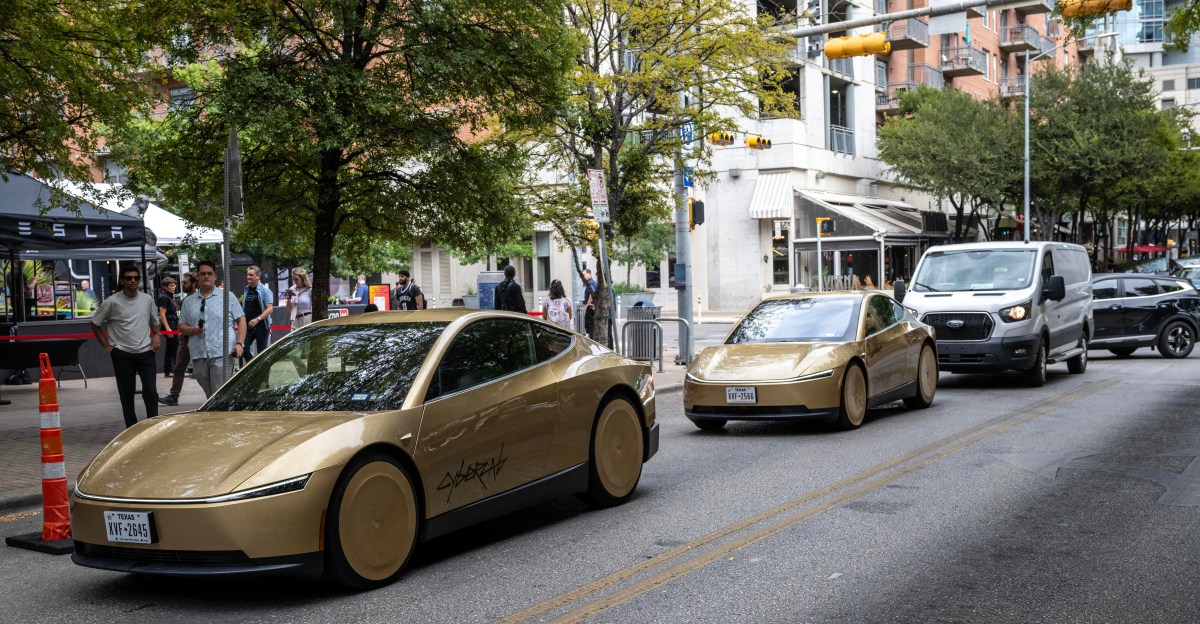
The Tesla Cybercab is notable for what it lacks, namely a steering wheel and pedal. By design, there is no way for this vehicle to be manually controlled — or so we thought. Less than a week after the Cybercab was officially launched in Austin, Texas, some riders have discovered the Cybercab’s secret manual controls that appears to be intended only for Tesla employees.
In at least two videos posted on X, Cybercab riders are encountering a virtual joystick that appears intended to control the vehicle’s movements. A square-shaped screen appears in the lower left corner of the central display, with a toggle in the middle for manual driving. It says “forward” at the top and “reverse” on the bottom. There are also buttons to “stop” the vehicle, sound the horn, and manually open the doors. To the right are views of the live camera displays, though in one rider’s video the image appears to be frozen on a Tesla Supercharger from a previous location.
Clearly these controls are intended for Tesla employees and depot workers who may need to nudge the Cybercab into a tight space at low speeds. Since the Cybercab lacks traditional controls, Tesla needed a work-around for fleet workers who may need to rearrange the vehicles in a parking lot, for example. This display would allow them to do that without having to call in a request to Tesla’s Cybercab control center or use a remote operator.
Theoretically these could also be used by law enforcement or emergency responders who may need to move a Cybercab off the road. Tesla has briefed Austin’s police department on the Cybercab service, though its unclear whether these manual controls were part of the conversation.
The customers who noticed the virtual joysticks tried unsuccessfully to use them to control the vehicle. Thankfully, they didn’t seem to work — or perhaps they weren’t using the controls accurately. Why these controls were on the display during customer rides is anyone’s guess. Chalk it up to an early bug that Tesla can hopefully fix before the Cybercabs gets any wider release.
Tesla built the Cybercab as a fully autonomous vehicle without manual controls. The purpose was to send the message that these controls are relics of the past, and the Cybercab is the vehicle of the future. But even the vehicle of the future may need some manual help every now and then.
Follow topics and authors from this story to see more like this in your personalized homepage feed and to receive email updates.