


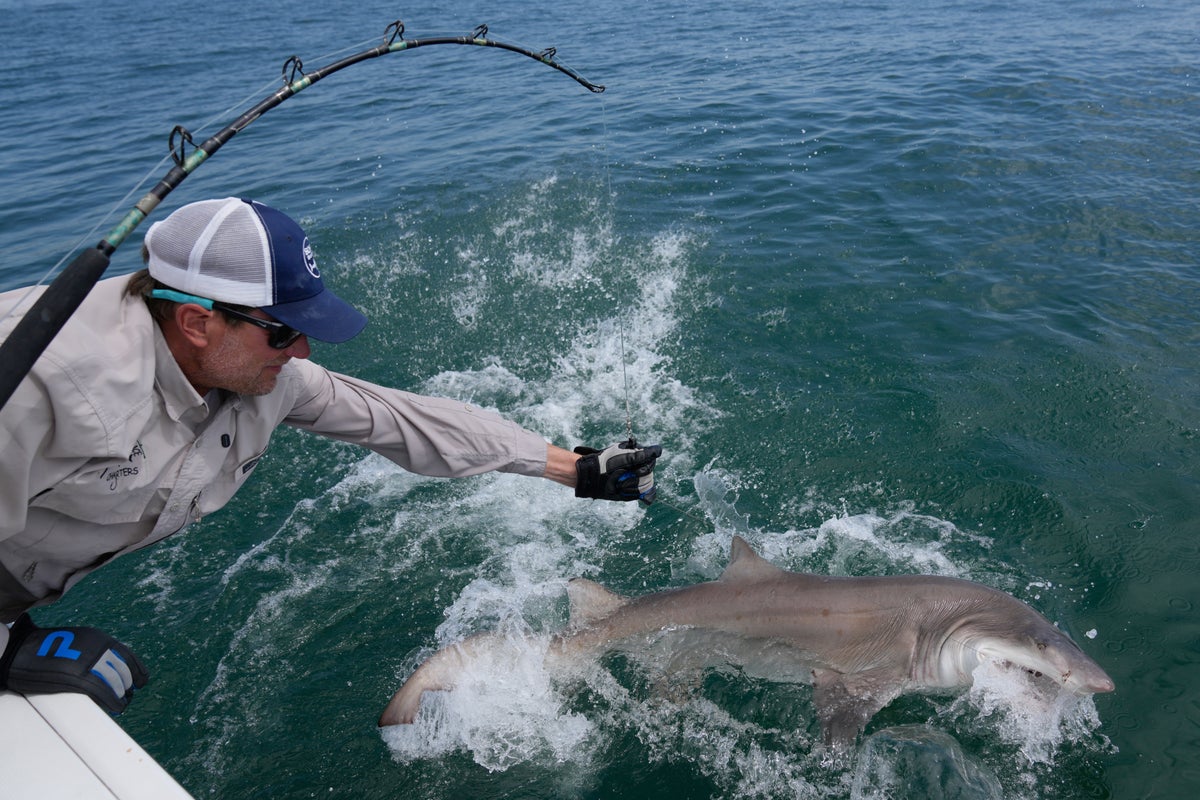
Just off one of New York’s famed Hamptons beaches, shark researcher Greg Metzger reels in one of the day’s prize catches: a young but powerful sand tiger shark.
He and another marine researcher quickly lasso the tail of the sharp-toothed female to the side of the boat and hold it steady as they take tissue samples and work to attach small data collection devices. Metzger marvels as the shark’s thick, rugged skin snaps a surgical-grade scalpel.
“It’s no surprise that they’ve been around since prehistoric times and they’re still going strong,” Metzger says as he stitches up the incision and sends it along its way.
Metzger and other researchers are catching, tagging and releasing a wide range of sharks as they seek to understand the local population and shed more light on one of the world’s few confirmed great white shark nurseries, where masses of young predators spend their first vulnerable years feeding and growing. Other white shark nurseries recognized globally are in the coastal waters off California, Mexico and Australia.
“It’s that initial fear of sharks that captures people’s imagination,” said Metzger, who also teaches marine science at Southampton High School. “Hopefully, through educational opportunities like today, we’ll be able to show that these sharks are far from mindless eating machines.”
Warmer waters are drawing tropical sharks north
The researchers attach different types of tags. One relays location by sending an acoustic signal that can be detected by monitoring receivers set up along the coast. Another measures depth and water temperature for several months, then pops off.
The data illustrates how sharks can cover vast distances in a year, said Bradley Peterson, the Stony Brook University marine scientist working with Metzger this particular day.
“Their tags are being detected in North Carolina and Georgia and Florida and the Gulf of Mexico, and then they’ll be back here the following year,” he said. “So a lot of them are coming up here to get themselves fueled up and fattened up.”
The research also suggests more varied species of sharks are coming up from more tropical southern waters during the summer months, as the waters off Long Island‘s coast and elsewhere are warming, likely due to climate change, said Frank Quevedo, executive director at the South Fork Natural History Museum and Nature Center, which is coordinating the research.
“We’re seeing more spinner sharks, more black tip sharks, more bull sharks,” he said as he showed off the Bridgehampton museum’s interactive exhibit on the work. “These are temperate sharks that utilize this habitat when the food source is here. So right now is like prime time.”
To be clear, the waters off Long Island have long been known to be a haven for all manner of sharks. The best-selling Peter Benchley novel “Jaws” was set in a fictional seaside town in the Hamptons before the blockbuster film version, which Netflix is bringing back to its streaming library Tuesday along with its sequels, was shot on location on Martha’s Vineyard, Massachusetts.
The International Shark Attack File, a database at the Florida Museum of Natural History, includes no records of a fatal shark attack on Long Island, though beachgoers have been bitten in recent years, including one this summer, prompting local officials to invest in safety measures, including shark-spotting drones.
“There’s this huge misconception that there’s this surge of sharks in Long Island waters. These sharks have always been here,” Metzger said. “A reason why we’re seeing more is because of technology. There’s more drones. Everybody’s got a cell phone now.”
Researchers are learning more about baby whites
Quevedo says baby whites are already about 4 feet (1.2 meters) long and weigh up to 80 pounds (36 kilograms) at birth, and they aren’t reared by their mothers, meaning they must immediately fend for themselves.
That’s why they’re drawn to the relatively shallow, coastal areas off Long Island, where they can safely feed on schools of fish away from other predators, including older sharks, he said.
“It’s just like in nursery school, where kids learn the basics,” Quevedo explained.
As they mature, the great whites head north to feast on larger prey, particularly the teeming colonies of seals along the beaches of Cape Cod in Massachusetts.
But as local waters warm, researchers have observed young whites venturing into New England waters sooner, bringing them dangerously close to the adult predators, Quevedo said.
Scientists hope research will inspire more shark conservation
When “Jaws” burst onto the cultural scene more than 50 years ago, it led to a surge in recreational fishing for great whites off the Hamptons that had a devastating effect, according to Quevedo.
Great whites don’t mate until they’re into their 20s and later, meaning many likely never had a chance to reproduce.
“When you kill a shark at a size of 10 years, that shark can only be a juvenile, never reproduced before,” Quevedo said. “So you’re wiping out that whole species, that whole population.”
Conservation efforts in recent decades have helped white sharks and others rebound, though their numbers are nowhere near what they likely were more than a century ago, he added.
“The predators are the ones that are balance keepers,” Quevedo said. “If we can protect apex predators around the world, you’re pretty much sustaining the world and keeping it as healthy as possible.”
___
Associated Press reporters Ted Shaffrey and Julie Walker contributed to this story.
___
Follow Philip Marcelo at https://x.com/philmarcelo