


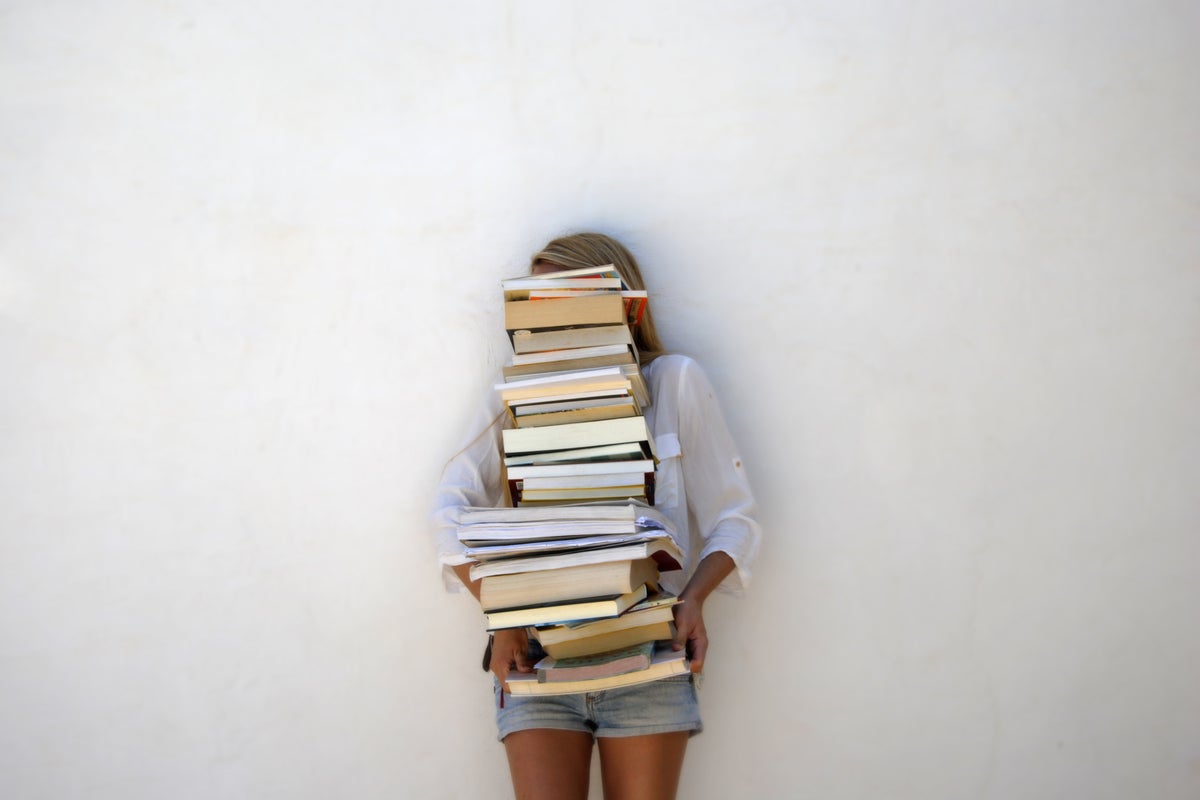
In the Roman Empire, owning a vast and extravagant library was a status symbol. The elite would amass mountains of scrolls and piles of books not only to read but to display as a signifier of wealth and intellect, and wealth of intellect. Lucian of Samosata, the satirical writer of the second century AD, compared folk who did so to “an ass listening to a lyre” in his essay Adversus Indoctum or The Ignorant Book Collector. Oh, what Lucian would have made of Instagram…
The social media platform has long served as an exercise in personal branding, where what you’re reading is part and parcel of who you are – or want to be perceived as. In recent weeks, Instagram has rolled out a feature that makes it more visible than ever: a banner that allows users to display a book title at the top of their profile (albeit with a 20-character limit.) Telling people you read Ulysses just got that much easier.
Book-signalling is nothing new – just look at the Romans. But its current iteration as we know it dates back to the days of yore and by that I mean the 2010s, when literary tote bags had a chokehold on anyone who had ever read The Catcher in the Rye and thought, ‘Wow, that Holden Caulfield guys seems cool.’ Instead of being emblazoned with any specific title, the literary tote tended to cast its net wider. It told passersby not what was on its owner’s nightstand but that its owner shops at independent bookstores like Daunt Books and has a subscription to The New Yorker…
 open image in gallery
Books have also become commodities unto themselves. This happens with buzzy releases like Yesteryear or Famesick, whereby the reading of them signals to everyone else on the tube that you too are part of the zeitgeisty in-crowd. But it is perhaps nowhere more apparent than in the case of the prize-winning publisher Fitzcarraldo Editions, whose stark white and cobalt blue covers are conveniently visible from a mile away meaning anyone within a five mile radius will know you to be a serious reader of serious books, the kind that win Nobel Prizes. Not to mention, there is also the use of books as aesthetic objects, with #BookshelfWealth taking over TikTok and the emergence of Book Stylist as a profession and the dawn of the celebrity book club.
The fashion world is reading up on the trend too, from the book bag charms launched earlier this year as a collaboration between Coach and Penguin Random House (Bleak House too big to fit in your clutch? Here’s a mini Sense and Sensibility) to the literary-focused events hosted by Prada and Miu Miu in recent years. Lucian is surely rolling in his grave.
All of which is to say that Instagram adding this “what are you reading” banner to user profiles is far from surprising. But while it feels like a natural extension of the above, it also feels more dubious in nature. While these other means of book-signalling are certainly in service to digital platforms – did you really read The White Album by Joan Didion if you didn’t post about it on Instagram? – they are, in fact, material. In order to carry a Daunt Books tote bag, you would have to actually patronise Daunt Books. Likewise, in order to bask in the clout of owning a Fitzcarraldo Editions book, you must buy, if not read, a Fitzcarraldo Editions book and in doing so support an independent press. And if, say, you wish to seem like the type of intellectual socialite who attends the sort of chic book readings that have sprung up as of late, well, you have to attend them.
By comparison, the new Instagram update is excruciatingly online – it asks us to log on to prove that we’re doing something that requires, by nature, logging off. It perhaps also misses the point that one of the reasons that reading has become so aspirational is because having a rich offline life has become so aspirational. Is it not just another way of making reading feel like a competition, shifting the focus from enjoying books to performing as a reader?
Still, it is worth noting that the appeal of appearing bookish is underpinned by a frankly optimistic belief: that books matter and reading is cool. At a time when more than a third of UK adults have given up reading for pleasure, that’s nothing to shirk at, I suppose. And so with that, I’ll sign off here: “READING: The Life of M by Rachel Cusk.”