


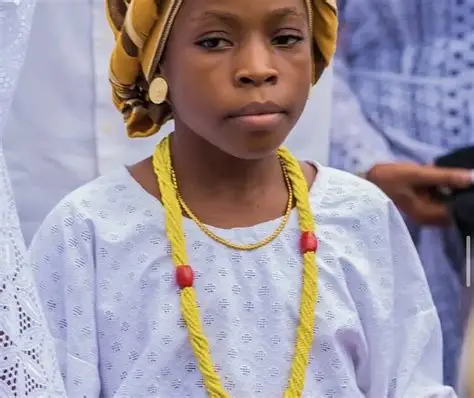
Meet 10-year-old Arugba leading 2026 Osun-Osogbo festival
August 4, 2026 1:40 pm

The new Arugba, Princess Alimot Moredeke Ajoke Osunbunmi…Photo Credit: IG/ osunosogbofestival.official
As preparations gather pace for the 2026 Osun-Osogbo Festival, attention has turned to 10-year-old Princess Alimot Moredeke Ajoke Osunbunmi, the young girl serving as the new Arugba, one of the most revered figures in the centuries-old Yoruba cultural festival.
Alimot, who was selected through the traditional Ifa divination process in March 2025, succeeded Osuntomi Ewatomi, who served as Arugba for about 12 years before getting married.
Here are key things to know about the young Arugba and her role ahead of this year’s festival.

Who is the new Arugba?
Princess Alimot Moredeke Ajoke Osunbunmi is a 10-year-old girl from the royal family of the Ataoja of Osogbo.
She emerged as the new Arugba after traditional Ifa divination identified her as the chosen maiden to serve the Osun deity.
Her emergence followed the end of the tenure of the previous Arugba, whose marriage automatically brought her service to an end.

She was chosen through Ifa divination
The selection of an Arugba is not by appointment or public nomination.
According to tradition, the Ifa oracle guides the choice from among eligible girls within the royal family.
The process is regarded as sacred and accepted by devotees as the will of the Osun deity.
She is described as a virgin
One of the strict requirements for becoming the Arugba is that the chosen girl must be a virgin from a royal lineage.
The role is regarded as sacred, and her purity is considered essential to the spiritual significance of the festival.
Families whose daughters are selected often regard it as a great honour.

She is among the youngest Arugbas in recent years
At just Nine years old, Alimot became one of the youngest girls to assume the revered position.
Her age has also influenced how she performs her duties during the annual festival.

She did not carry the sacred calabash in 2025
Unlike previous Arugbas, Alimot did not carry the sacred calabash during the last edition of the festival.
Instead, a male chief priest, identified as Baba Osun (Adesina), carried the calabash while the young Arugba led the procession.
Traditionalists explained that the decision was made because of her young age and the physical demands of carrying the sacred object.
They expressed confidence that she would assume the full responsibility when she is older.

The Arugba leads one of the festival’s most important processions
Although she did not carry the calabash, Alimot walked at the front of the procession leading worshippers to the Osun Sacred Grove.
The Arugba remains the symbolic link between the Osun deity and devotees, making her one of the festival’s central figures.
What does the Arugba represent?
The Arugba is believed to carry the prayers, hopes and sacrifices of the people to the Osun River goddess.
Traditionally, she bears a sacred calabash containing ritual offerings to the Osun grove.
Many worshippers believe the Arugba spiritually carries away the burdens and prayers of the community during the procession.
About the Osun-Osogbo Festival
The Osun-Osogbo Festival is one of Nigeria’s oldest traditional festivals and is centred around the Osun Sacred Grove, a UNESCO World Heritage Site.
Celebrated annually in Osogbo, Osun State, it attracts thousands of traditional worshippers, tourists and cultural enthusiasts from Nigeria and abroad.
The 2026 festival is scheduled to hold from August 7 to August 19, featuring traditional rites, cultural displays, drumming, dancing and the famous Arugba procession.
A centuries-old tradition
The festival traces its origin to the founders of Osogbo more than 600 years ago.
According to Yoruba tradition, the Osun River goddess protected the early settlers and established a covenant with the people, who have continued to honour her through the annual celebration.
Other important rites during the festival include the cleansing of the town, the veneration of the Ataoja’s crown, traditional sacrifices and the final Osun Ajigun ceremony.
Samuel Omotere is an experienced journalist covering human interest stories, pop culture, and digital trends. He combines his background as a language graduate with a focus on sustainable digital storytelling.
All rights reserved. This material, and other digital content on this website, may not be reproduced, published, broadcast, rewritten or redistributed in whole or in part without prior express written permission from PUNCH.
Contact: [email protected]