


9,000 Jigawa graduates sit CBT for 500 teaching jobs
August 30, 2026 1:56 pm

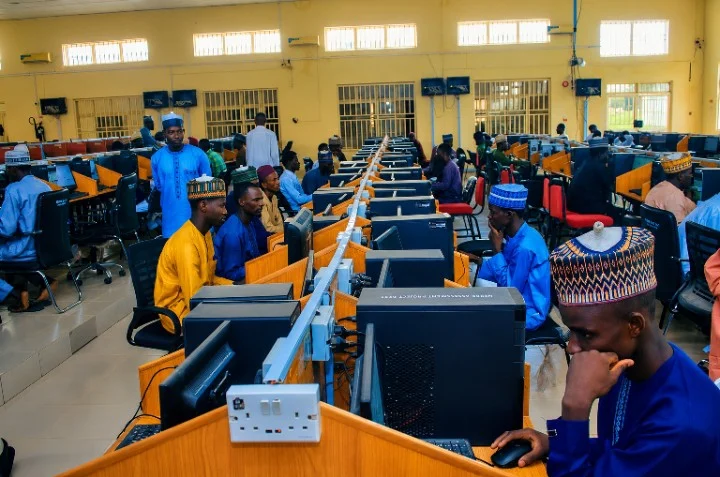
A cross section of candidates who participated in the CBT in Dutse.
The Jigawa State Government has begun Computer-Based Tests for the recruitment of 500 teachers for its J-Tsangaya programme, as over 9,000 graduates and NCE holders jostle for the limited positions.
The Executive Secretary of the Jigawa State Tsangaya Education Board, Abubakar Maje, disclosed this to journalists on Sunday shortly after inspecting the ongoing CBT exercise in Dutse, Hadejia and Gumel. “The government shortlisted 3,150 applicants to sit for the CBT, from which the successful candidates will be selected,” Maje said.
According to him, the recruitment is part of efforts to strengthen the state’s Almajiri Free Zone Programme. “The teachers will support the programme which targets more than 5,000 Almajirai for enrolment in a structured education system,” he explained.
Maje said the new model will combine Qur’anic studies with basic Western education and vocational training, adding that “We want to strengthen the traditional Tsangaya system and reduce the number of children engaged in street begging.”
The Executive Secretary further noted that the plan is to give Tsangaya pupils education, accommodation, healthcare and skills. “Our goal is to help them become self-reliant and have a better future,” Maje stated.
Accordingly, he revealed that under the programme, three mega Tsangaya schools have been designated in Dutse, Kafin Hausa and Ringim, adding that, “Each of the three mega schools is expected to admit about 1,500 children.”
He said pupils in the mega schools will study Qur’an alongside English, Mathematics, Basic Science and Computer Studies. “Vocational training will also be included to prepare them for employment and self-employment,” Maje said.
On the teacher recruitment, he explained the roles to be filled. “Some of the 500 teachers will teach conventional subjects, while others will handle Qur’anic education under the new Tsangaya curriculum,” he said.
Maje stressed that the state government is committed to reforming the Tsangaya system. “We are determined to ensure that children in Tsangaya schools have opportunities comparable to those available to other children across the country,” he said.
Highlighting more, the E.S stated that Jigawa currently has more than 5,481 traditional Tsangaya schools, 130 integrated Tsangaya schools, seven modern Tsangaya schools and three mega Tsangaya schools.
Some candidates who participated in the CBT commended the process but asked for an expansion of the recruitment. “I appreciate how well the CBT was conducted here in Dutse. It was fair and transparent. But with over 9,000 applicants, the government should consider recruiting 1,000 teachers instead of 500,” said Musa Ibrahim, a candidate in Dutse.
Another candidate in Hadejia also praised the exercise and made a similar appeal. “The CBT was smooth, and there was no issue. Considering the high number of applicants and the current economic situation, increasing the slots to even 1,000 will give more people a chance,” said Aisha Bala, who sat for the test in Hadejia.
On their part, community members also welcomed the initiative but urged the Jigawa State government to do more. “This is a good step for our children. We beg the government to expand the mega Tsangaya schools to other local government areas so more Almajirai can benefit,” said Malam Sani Adamu, a community leader in Gumel.
Our correspondent reports that the programme is part of a broader effort to tackle out-of-school children and to reintegrate non-formal schools into the standard education system through a more structured model that combines religious education with basic learning and practical skills.
All rights reserved. This material, and other digital content on this website, may not be reproduced, published, broadcast, rewritten or redistributed in whole or in part without prior express written permission from PUNCH.
Contact: [email protected]