


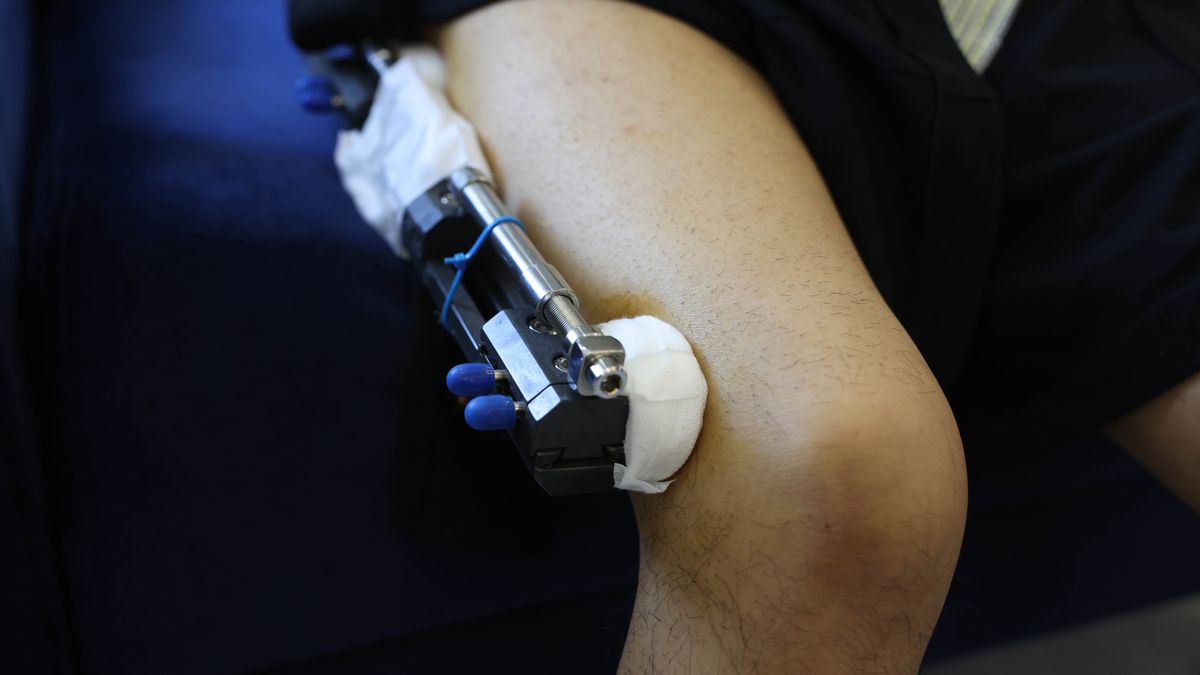
British surgeons are warning of potential horror complications if people travel abroad for controversial surgery to make them taller.
The Royal College of Surgeons has revealed a series of case studies showing how the NHS has to pick up the pieces when leg lengthening surgery goes wrong, including major surgery.
It comes after the Mirror exposed the practice at a clinic in Turkey where British tourists go to gain up to six inches in height by sawing through the leg bones and extending the segments over months, to allow new bone to grow in the gap.
Professor Frank Smith, vice president of the Royal College of Surgeons of England, said: “This study shines a light on a growing patient safety issue. People considering surgery, such as leg-lengthening, may be drawn overseas by lower costs or persuasive marketing, but when things go wrong, the complications can be serious and, at worst, life-changing.”
 View 3 Images
Examples from a clinic’s website promoting the procedure (Cr: wannabetaller.com)
The Mirror spoke to patients who said they were paying to be taller because they were teased about their height at school and now struggle to find a girlfriend. Hundreds of tourists are travelling to Istanbul for the op as part of a three-month stay which can also include a minibus tour of the city before they go under the knife.
The painful procedure comes with a risk of serious complications such as infection, nerve damage and even “permanent disability”, according to the NHS.
The new study led by specialist limb reconstruction surgeons at the Royal National Orthopaedic Hospital NHS Trust calculated that sorting out complications caused by seven cases of leg-lengthening abroad has cost the NHS just over £36,000. Across the whole of the NHS, this cost will be much higher.
Two patients “required major surgery for complications”, including knee surgery and removal of broken nails holding bone together, “with re-nailing for poor bone regenerate”.
 View 3 Images
Bertrand Darmanin told the Mirror he underwent the op to improve his self esteem(Image: Ian Vogler / Daily Mirror)
Peter Calder, lead author of the study and consultant paediatric and limb reconstruction surgeon at the Royal National Orthopaedic Hospital, said: “The desire to become taller is gaining popularity, driven by the internet, social media advertising and affordable treatments based around the world.
“Anecdotally, we have seen an increase in patients presenting to our hospital following lengthening surgery abroad. All required intensive physiotherapy and, in many cases, surgical intervention for serious complications.
“This resulted in both an increase in burden on staff and financial costs for the NHS. It is unclear whether this is a localised problem or more widespread throughout the UK.
 View 3 Images
More examples from a clinic’s website promoting the procedure (Cr: wannabetaller.com)
“The findings provoke debate on health tourism and patients returning to the UK with poor outcomes, especially with reference to cosmetic procedures.”
It comes as MPs prepare to discuss medical tourism and topics such as liquid Brazilian butt lifts during a committee hearing on Wednesday morning.
Writing in the Annals of the Royal College of Surgeons of England, the team said they had seen a “recent increase in patients presenting for rehabilitation and treatment of complications following limb lengthening”, such as implant failure, poor bone healing and severe joint stiffness.
They looked at four men and three women who went abroad for leg-lengthening in the last five years. Five had travelled to Turkey for surgery, one to Russia and one to South Africa.
Six of those studied said they wished to be taller to “improve their feeling of wellbeing and quality of life”, while one went to Russia to correct a congenital lower limb deficiency.
The patients typically needed 10 NHS hospital appointments, with all requiring physiotherapy and some needing extensive follow-up care.
Professor Frank Smith, vice president of the Royal College of Surgeons of England, said: “Patients can then return to the NHS needing complex treatment, placing pressure on already stretched services.
Article continues below
“While many providers overseas offer high-quality care, this research underlines the importance of people fully understanding the risks, the standards of care they can expect, and what aftercare arrangements are in place before undergoing treatment abroad.
“RCS England has long called for better public awareness of the risks associated with medical tourism, and we would also like to see the NHS collect robust data on patients presenting with complications after treatment abroad. That is essential to understanding the true scale of the issue and its impact on NHS services.”