


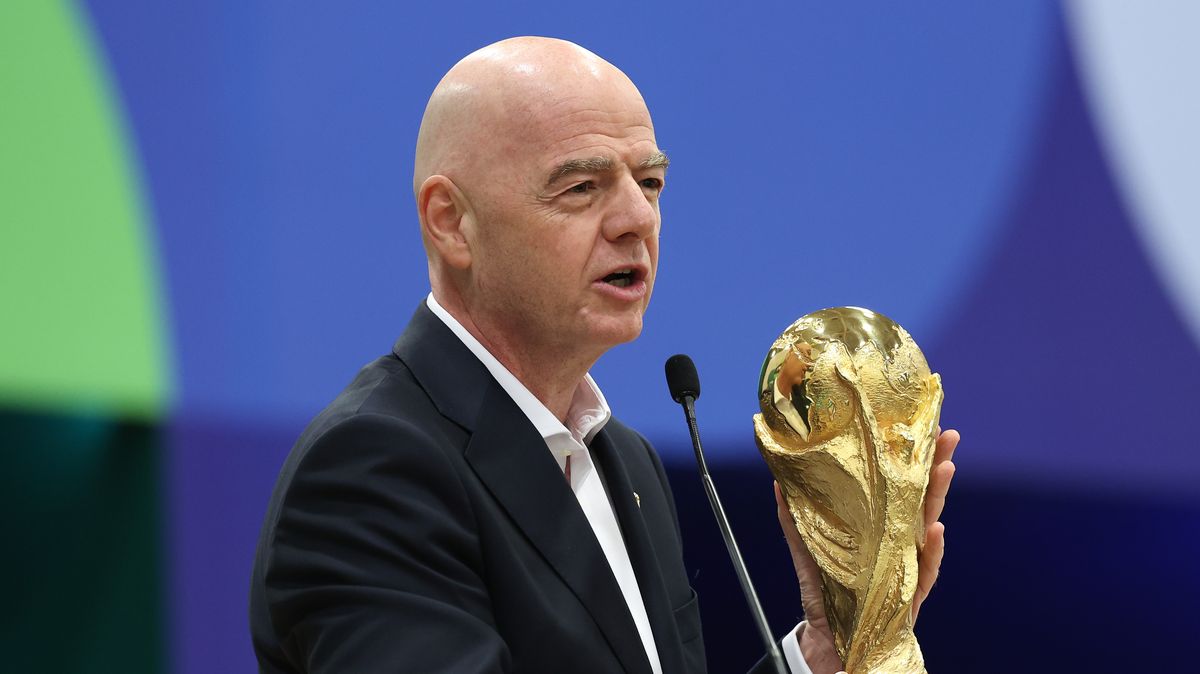
FIFA are proud to call this summer’s World Cup the biggest of all time, but it also tops the charts in another less desirable category: pollution.
By expanding the tournament from 32 teams to 48, and by 64 matches to 108, FIFA ensured it achieved its two major objectives: the public one, of growing the game for the greater good, and the private one, of increasing revenue exponentially.
Under the leadership of Gianni Infantino, FIFA – world football’s governing body and a not-for-profit organisation – have been making money hand over fist. FIFA is predicted to make $13billion (£9.6bn) in the four-year cycle up to 2026. That is an increase of 72 per cent on the previous cycle.
Business is booming and the ticketing system, with its much-criticised ‘dynamic pricing’ structure, for the 2026 World Cup reflects this. The decision to host the tournament across the United States, Canada and Mexico is firmly in-keeping with the direction of travel under Infantino, who has hyperbolically promised “the greatest event that humanity has ever seen”.
And to their critics, it is a decision which will increase the harm on the environment and push FIFA further away from achieving its own stated goals.
According to a report entitled ‘FIFA’s Climate Blindspot’, the World Cup will generate over nine million tonnes of carbon dioxide equivalent (MtCO2e), making it the most polluting World Cup of all time – and it’s not even close. The estimated total is almost double the historical average from previous tournaments between 2010 and 2022.
“We mainly looked at air travel, as that’s the biggest factor, particularly in 2026 because it’s spread across three large countries,” one of the report’s authors, Dr Stuart Parkinson from Scientists for Global Responsibility, tells Mirror Football. “We estimated that to be about nine million tonnes. And we estimated that sponsorship deals, particularly the one with Aramco, could increase emissions by 30m tonnes.
“It’s a combination of expanding the tournament to 48 teams and 104 matches and spreading it across a whole continent – it goes completely in the reverse direction to reducing emissions. FIFA have a net zero target by 2040, but it only covers the organisation itself, so the offices, staff travel, things like that, it doesn’t include tournaments, so that’s a workaround they do.”
 View 4 Images
The 2026 World Cup will see record levels of air travel(Image: Rob Carr/Getty Images)
The World Cup is being played across 16 venues, from Vancouver in the north to Mexico City in the south. It means that air travel is the only real transport option and that will account for 7.72m tonnes of the total 9.02m tonnes in estimated emissions.
“This not only increases the tournament’s contribution to the climate crisis, but also highlights the gap between FIFA’s climate commitments and the practical realities of tournament planning,” the report notes.
It is also damning of FIFA’s wider commitment to tackling climate change, noting that only two of the 18 actions set out in their 2021 climate strategy, which pledged to cut green house gas emissions 50 per cent by 2030 and reach net zero by 2040, have been completed, while 14 have seen “no visible progress”.
In response to detailed questions by Mirror Football, FIFA said it “recognises that climate impact must be taken seriously and welcomes informed scrutiny” and “remains committed to ongoing engagement and transparency throughout the tournament cycle”.
 View 4 Images
Air travel is the only real option for the 2026 World Cup(Image: Doug Barrett / AFP via Getty Images)
FIFA pointed to the fact that – unlike the 2022 World Cup in Qatar, or the 2034 tournament in Saudi Arabia – this summer’s tournament is using existing infrastructure, “reducing the need for new construction and the associated emissions”.
They also said they would “promote public transport, walking and cycling”, use “battery-based temporary power solutions” instead of diesel generators, increase recycling, reduce food waste and support tree-planting initiatives. FIFA will also reinvest nearly 90 per cent of its revenue into development initiatives.
There is another aspect which, to some, demonstrates the paradox at play with FIFA. Two years ago, the organisation signed a sponsorship deal with Aramco, Saudi Arabia’s state-owned oil company, worth $100m (£74m) per year. Aramco – the third highest carbon-producing entity in history, behind only the former Soviet Union and China Coal, according to think-tank InfluenceMap – will be front and centre at this summer’s World Cup.
“FIFA works with a broad, global portfolio of partners, all of which are subject to its governance and compliance frameworks,” the organisation told Mirror Football. But to many, those frameworks are not fit for purpose.
 View 4 Images
Gianni Infantino is close to Saudi Arabia’s crown prince Mohammed bin Salman(Image: Christopher Pike/Bloomberg via Getty Images)
Dr Parkinson and his team estimated that FIFA actively promoting the world’s biggest oil giant to billions of viewers at a tournament that will be impacted by extreme heat will “induce additional emissions of about 30 million tCO2e due to increased sales for the fossil fuel company”.
A report entitled ‘Football ignites the world: How Saudi Aramco and FIFA are driving the climate crisis’ notes that: “By combining the phenomenal power of advertising with the global cultural force that is football, Saudi Arabia is using FIFA to help it extract every last barrel of its vast oil and gas reserves, an eventuality that would be disastrous for the planet.” It argues that the deal is the most worrying, but also the most easily severed link in the chain.
“Players and fans will struggle through the heat with big oil ads all around them. Like Saudi Aramco itself, FIFA is tied to oil profits without a plan to protect against climate change,” said Peter Crisp, of campaign group Fossil Free Football. “Extreme heat threatens not just this World Cup, but the viability of FIFA’s iconic summer tournaments.
“FIFA promoting Aramco in 2026 is like cigarettes being advertised in sport in decades past. They know their business model is toxic, but wrapping their brand in football gives them a lifeline. But just like big tobacco, it’s time to kick oil out.”
Join our new WhatsApp community and receive your daily dose of Mirror Football content. We also treat our community members to special offers, promotions, and adverts from us and our partners. If you don’t like our community, you can check out any time you like. If you’re curious, you can read our Privacy Notice.