


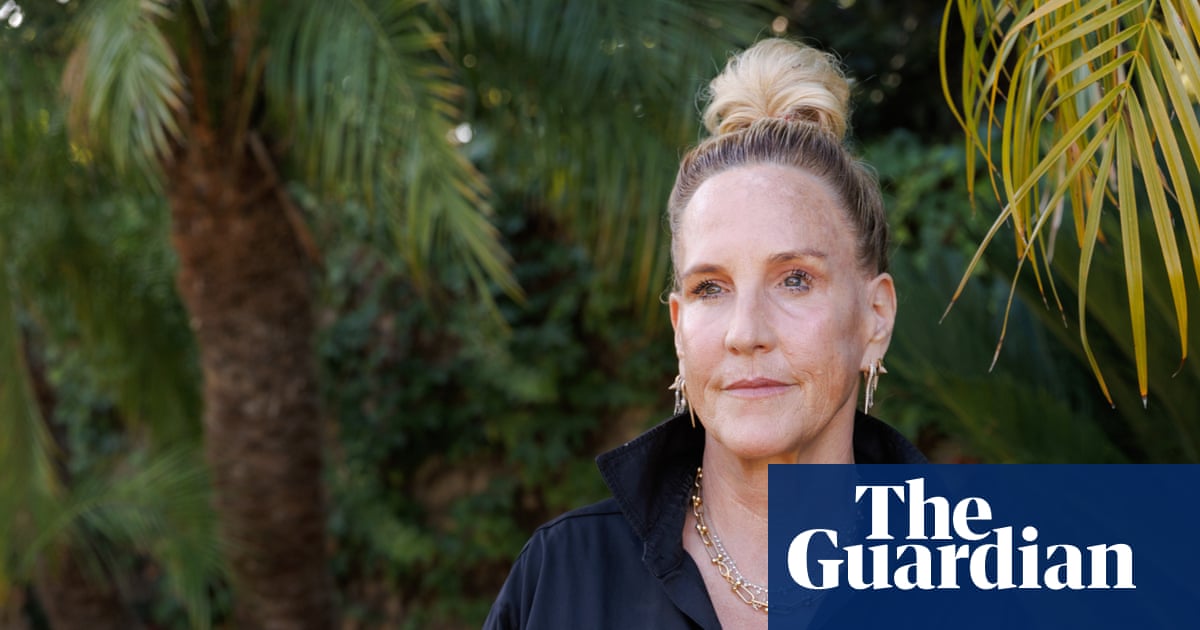
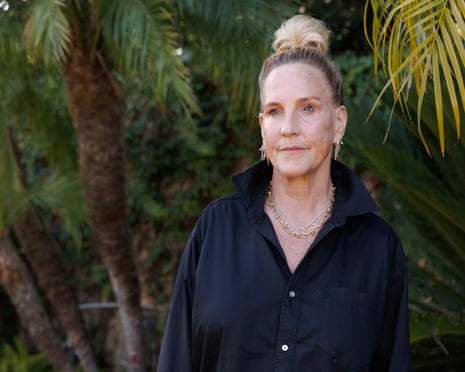
‘We’re up against forces that have all the money in the world’: Erin Brockovich on her battle against AI datacentres
In 1993, she squeezed a $333m settlement from a Californian energy company in a scandal over contaminated water. Three decades later, she has a new target in her sights – and it’s global
When Erin Brockovich woke to find 30 emails from people from the same town, she realised something was going on. People email Brockovich all the time because of what happened in 1993, when she was instrumental in suing Pacific Gas and Electric Company (PG&E) on behalf of residents of the town of Hinkley, California, whose groundwater had been contaminated. The case resulted in a settlement of $333m – then the largest ever payout for a direct-action lawsuit. When she was immortalised by Julia Roberts in the 2000 film Erin Brockovich, she became the hero we didn’t know we needed, a modern day Joan of Arc. She had won against PG&E with no formal legal training.
The emails she received a few weeks ago were about datacentres. In April, she put a callout on her website asking for anyone with concerns about one near them to get in touch. Within a month, 3,862 people had replied. Tech companies have needed datacentres to power their technology “for ever”, she says, but the new ones being built to power AI? “This feels like Hinkley on steroids.”
This isn’t a story about AI, she says. “That genie is out of the bottle: it’s here, it’s an effective tool, you can use it or not,” Brockovich says matter-of-factly. This is about the massive structures being built to house the vast computing facilities AI requires. These datacentres, she says, stretch over “hundreds and hundreds of acres”. In May, Utah gave approval to a centre twice the size of Manhattan.
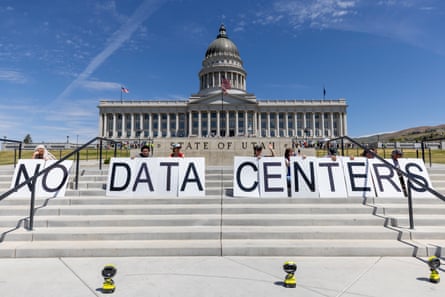
Some of the emails Brockovich gets from people near datacentres express genuine bafflement: “Why did I not know about this? How did this construction just start? Why am I now getting a notice from the city council that this has already passed when I didn’t even have a voice in it?” Others reflect concerns about the impact of the centres: “What about our resources? What’s happening to the water? Who’s paying for all this energy and am I going to foot that bill? What will the future impact on health be from these monstrosities? What’s going to happen to the wildlife?”
From the emails, Brockovich built a map of significant AI datacentres in the US that are either operational or under construction, overlaid with locations where community members have emailed in concerns. This open-source document is chilling: as of 24 June, 33 AI datacenters have been completed and are operational, 68 are under construction and 41 are proposed. And there had been 7,005 reports submitted through the online form, which is to say, all that is known about them is what people have seen. As a post on her Substack blog is headlined: “If data centers are so great, why are they being built in secret?”
“It’s happening in every US state, multiple counties, rural areas, ranches, farms and neighbourhoods. People watch nature because they respect it, they need it. And they’re watching it being destroyed,” says Brockovich. She has heard from people saying: “I’m concerned this is where the bald eagles nest,” “I’m watching wildlife disappear,” “I’m seeing dead animals.” Some communities learn about a centre months after it has been approved; others don’t hear anything about them and watch as a vast building emerges.
Brockovich, 66 this month, is speaking to me on a video call. She is sitting at a glossy, chunky desk of the type a lawyer might use, the louvre blinds behind her revealing symmetrical stripes of her verdant southern California neighbourhood and her two cheerful little dogs. She comes across as purposeful, approachable and indefatigable.
Datacentre developers often enter into nondisclosure agreements with local officials, so it is not possible to see why they were approved without environmental-impact assessments or input from residents. “I am getting reports from people where their local leaders are changing zoning laws for this to happen,” she says, incredulous that anyone would bypass democracy to that degree.
She does not believe this is a story of sudden, nationwide corruption or that local governments are setting out to stonewall residents. “What I’m seeing now is that councils, having heard community responses, are trying to hit pause and they’re getting sued [by the developers] for $100m-plus. They cannot withstand that.” In one case, Hill County in Texas, county commissioners, not expecting the public outcry over a planned datacentre, voted on a year-long moratorium to halt building. The county was then sued by the developers for $100m in damages and, according to the Texas Tribune, has now backed down.
What is certain, though, is that the land cannot withstand these centres’ immense demand for water. According to analysis by the Guardian, two-thirds of planned datacentres in the US are in drought-stricken areas. The larger centres need up to 5m gallons of water a day for cooling, equivalent to the average usage of 50,000 people. It is unclear what the plan is and whose needs will take priority between AI, agriculture and everyone else.
“People are reporting bill spikes,” Brockovich says, reading an email from someone who says their monthly water bill went from $22 (£17) to more than $350 (£265). The threat of these centres is about more than money – it feels existential. “How will the water use disrupt the balance of nature? People are asking: “What will happen to us?”
Brockovich was born and brought up in the midwest. Her father was an engineer and her mother was a journalist. “That’s probably where I got my curiosity. My dad built and ran pipelines for huge companies and he promised me that, in my lifetime, water would be more valuable than gold. He said: ‘I want you to understand, good stewardship is an obligation for you, because what really matters is your land for your food, your water, to sustain life and the health and welfare of your family. Those are your gifts and those are your resources.”

She has a moral certainty, which is what led her into that Hinkley fight, despite not being a lawyer (she was a legal clerk in the PG&E case, then moved into activism and advocacy and has received honorary degrees from two universities and a law school). “I remember being in community meetings and people would talk to me about that and I would not be afraid to tell them: ‘Damned if I know, but let’s talk to a lawyer and find out.’” It was in that fight that she learned that a corporation can withstand a handful of people kicking up a fuss, but it has a problem when 100 people or more are organised and acting in concert.
She learned, too, about corporate gaslighting, when we still called it lying. “I grew up running in the corn fields and the wheat fields, fascinated with thunderstorms and fireflies. And I assure you, in Kansas, I never saw a two-headed frog. When I got to Hinkley, I saw a two-headed frog. Somebody always wants to try to tell you that what you see, you don’t see. I can’t tell you how many times I’ve walked away and gone: ‘Whoa, wait a minute, did that really happen?’ Because someone wants to tell you it didn’t.”
But just as important as her knowledge that sometimes people lie is her nose for when people are telling the truth. “Especially in these rural countries, they know themselves, they know their family, they know their animals, they know their land. The environment tells you a story every single day if you stop and pay attention.”
After Hinkley, she worked on other environmental pollution cases against PG&E related to hexavalent chromium, the chemical that contaminated Hinkley’s water. More recently, she has focused on Pfas (per- and polyfluoroalkyl substances), “forever chemicals” that are a component in firefighting foam used heavily on US military bases. Pfas have been linked to health problems, including fertility issues and some cancers. In 2017, communities living near military bases reported worrying levels of these chemicals in their drinking water.
Brockovich’s renown is plainly the reason people email her when they have concerns. This is what led her to north-west Georgia last year, where staggeringly high levels of Pfas were found in the water and the wider environment. It was believed that they came from carpet factories that used stain-resistant chemicals. The major carpet factories say they complied with all regulations and no longer use Pfas. She is still supporting people there with their campaigns.
Unlike toxic chemicals leaking into water, nothing about datacentres is discreet. Signs that might be subtle one day – an absence of birdsong – the next day will be a centre up and running at full volume. “It really becomes about the noise, the decibels,” Brockovich says. People will write to her and say: “We’re going insane 24/7,” “It’s got to stop,” “It’s humming, it’s hissing, it’s buzzing.” She says: “It’s generators. It’s increased electric bills. It’s power surges.”
These structures are appearing without the consultation you would need to erect a new sports hall, as if people won’t notice. But people certainly will notice, because the buildings are vast. It feels like a step into post-democracy, which is a tech bro fantasy, a world in which laws and regulations have been obviated. The big tech companies seem to have blueprinted their fantasy and started building it.
Alternatives are now being mooted. “People are talking about putting them at the bottom of the ocean,” says Brockovich. “They’re talking about having barges and putting the datacentres there, using waves as the energy in cooler climates. Elon Musk wants to put them in space.” But with innumerable Earth-based datacentres already built or in the works, this feels like puff – the future you could have had, had you not sleepwalked into the one that has arrived.
For Brockovich, this is all a distraction. The first thing she wants is a case-by-case moratorium on approving datacentres. (She is collating these cases through her open-source mapping site and says councils vary in the action they are prepared to take, according to how surprised by, or receptive to, local complaints their officials are. Many states are only now stopping to consider whether there should be state-level regulation and oversight of datacentres – and, if so, what implications that would have for local decision-making and autonomy.
This takes time. Seventy-nine municipalities in the US have so far have issued moratoriums, many immediately being hit with lawsuits for breaking their original deal. Pauses have been introduced in Georgia, Maryland, Michigan and South Carolina – one introduced in Maine was then vetoed – but these are early interventions against tech behemoths.
When I ask Brockovich about the political climate – a president committed to AI and blatantly dismissive of environmental concerns – she is careful to stress that opposition to datacentres is bipartisan. She knows from her work fighting Pfas, though, that a change in administration can make an enormous difference to the success of these campaigns. In the final days of Joe Biden’s presidency, a clean-up operation was announced by the Pentagon. However, this plan has quietly been delayed by Donald Trump’s Department of Defense: in some areas, it won’t start until 2039.
Yet the nature of Brockovich’s campaigning is not to go straight to the top and demand policy change, but rather to build lawsuits from the ground up. Victory, to her, is won by way of a pragmatic to-do list. To start, she would go to local government and say: “I’d like to see an environmental-impact report. I’d like to see how you propose to power all this. Are you going to build your own power? Are you relying on our already strained resources?” She says: “Let’s get that information first and then have a town hall meeting where the people can be a voice in it.” She has a degree of confidence that the law still has teeth. “Lawsuits aren’t settling for $333m any more; they’re settling for billions,” she says.
Brockovich’s datacentre work goes beyond the US; she has been contacted by people in Australia, India, Scotland and Ireland. There is already a moratorium on any more datacentres in Dublin; even by 2023, such centres were accounting for a fifth of Ireland’s electricity usage. “This is a planetary thing,” she says. “It’s overwhelming. We have to have some courage to show up, and it’s difficult to do that when you’re up against forces that have all the money and all the intelligence and all the bandwidth in the world.” She, meanwhile, is “getting too old for this, by the way. I’m in my legacy phase. I have six grandchildren.”
She is smiling. All that may be true, but even if this is her final campaign, she won’t walk away until it’s over. She can beat this – she just can’t beat it on her own.
Explore more on these topics
- Energy
- The big interview
- Climate crisis
- AI (artificial intelligence)
- Computing
- Erin Brockovich
- Water
- interviews