


Keir Starmer’s fatal flaw? The blankness on to which voters projected their years of frustration

His government was directionless and confused, and from that murk emerged the Peter Mandelson scandal
On a bone-chillingly cold morning in January, it felt as if I had suddenly found at least part of the reason for Keir Starmer’s chronic unpopularity. I was in the Mancunian constituency of Gorton and Denton, where the prime minister and his people’s decision to block Andy Burnham from standing was about to hand victory to the Green party. More specifically, I was in a forlorn covered market about to be regenerated into a “food and drink cluster”, talking to a sixtysomething man nursing a mug of tea.
What, I wondered, did he think of the man at the top? He gave me roughly the same answer that I’d heard from a lot of my other interviewees: “I really don’t like him at all.” But like most other people I met that day, he couldn’t quite explain what fired his antipathy, which seemed to make it worse. His face scrunched into a mixture of scepticism and exasperation. “I don’t know why – I just don’t,” he said. The most specific answer I got from anyone else was: “He hasn’t done what he said he’d do.” So there it was: as well as a modern tendency to loathe politicians that regularly seems arbitrary, whipped-up and way over the top, a sense that Starmer’s sheer blankness – his painful lack of clarity and the absence of a halfway coherent story about his own government – was making a lot of people dislike and mistrust him all the more.
A couple of months before, Ipsos had put Starmer’s approval rating at -66, the lowest figure recorded for a PM since it had first started calculating them. Even Liz Truss had not reached such a howling nadir. The chant of “Keir Starmer’s a wanker”, to the central riff from the White Stripes’ Seven Nation Army, had echoed around not only football stadiums, but January’s world darts championships at Alexandra Palace. The following month, the more generous descriptions of Starmer offered by focus groups included “jellyfish” and “doormat”. Even the people in charge of them were surprised at the levels of venom and mockery. “I can normally understand where the public are coming from,” said Luke Tryl of the polling organisation More In Common. “But I admit this is surprising.”
Perhaps it wasn’t that surprising. When Starmer made his concise, gently emotional resignation speech on Monday morning, he spoke of his initial drive to rescue a party he saw as “politically, financially and morally bankrupt” and “change Britain for the better, to build a fairer country with dignity and respect, where everyone is seen, everyone is valued … not just the privileged few.” But wherever I had been in the wake of Labour’s win in 2024, I had heard a widely diverse selection of people distill the Starmer government’s record to a single act: the planned cutting of pensioners’ winter fuel allowances only three and a half weeks after the election (usually summed up as “taking money off the old folks” or similar). Soon enough, the public’s refusal to forget that awful move was made even more indelible by freebiegate, the serial stories of Labour high-ups getting Taylor Swift tickets and free clothes, topped off by a £240 pair of glasses – glasses! – donated to Starmer by the Labour peer Waheed Alli.
The stink it all kicked up (which still lingers) was then joined by another pointer to Starmer’s eventual demise: keen public awareness of all those U-turns, on so-called welfare reform, farmers’ inheritance tax, business rates for pubs, a national grooming gangs inquiry and more. Starmer also made the trailblazing move of reverse-ferreting not only on policy, but mere rhetoric. In May last year, to a great chorus of dismay about echoes of Enoch Powell, he said that immigration risked making Britain “an island of strangers”. Forty-six days later came the by-now inevitable expression of contrition about that toxic turn of phrase. “I’ll give you the honest truth: I deeply regret using it,” he said, and another groan went up from the faraway towns that had presumably been somewhat optimistically envisaged giving him a round of applause.
It is not unreasonable, I think, to see the entire Starmer project as one gigantic volte-face, given what he promised to the 275,000 Labour members who gave him the job of leader: a 10-point leftwing shopping list that included everything from multiple nationalisations to the defence of migrants’ rights. When Starmer was the leader of the opposition, moreover, the public got a sharp flavour of his seemingly limitless flexibility. In June 2020, he and Angela Rayner were photographed taking the knee in support of Black Lives Matter; by 2022, Queen Elizabeth II’s Platinum jubilee had begun Starmer’s passage into an increasingly bizarre world of flags and zealous patriotism. By that point, I could not help but think of a pearl of wisdom beloved of the market traders of the West Midlands: “Never make a mug of your punter.”
Then came the general election. In all the places I visited, what most struck me was the pained contrast between constant projections of a historic Labour win and the shrugging, muted mood that was prevalent absolutely everywhere, as well as how indifferent people were to the party’s leader.
People had endured so much: the overflowing bins and shuttered libraries caused by austerity, the pantomime of Brexit, the pandemic that politicians still seem strangely reluctant to talk about, and then a cost of living crisis that has stubbornly endured. And what all of that experience had put in the hearts of most voters was either disbelief that, even if they voted Labour, anything would actually change, or a seething, upturn-the-Monopoly-board belief in the chaos and mischief offered by Nigel Farage. In England, it often felt as if these two strands of opinion were all there were. Given Starmer’s inability to convince the public that real change was ever on its way, it feels like the same picture still largely holds. It will be Andy Burnham’s job to attempt to try to change that and imbue politics with some optimism.
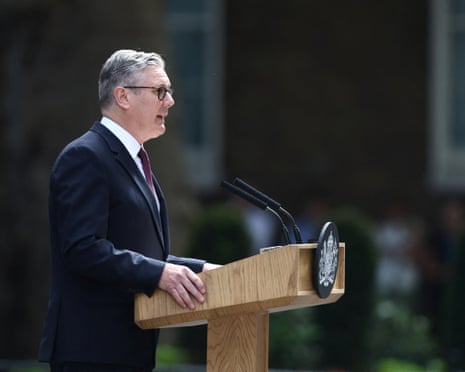
Starmer, by contrast, did the opposite. Only a month or so after Labour’s win – with the backing of only a fifth of the total electorate – he made a speech in the garden of 10 Downing Street from which most people only took one line: “Things will get worse before we get better.” He and Rachel Reeves quickly decided that positivity was much the better option, but it felt like most people had tuned out. His government – and yes, it did quite a few good things, from gradual rail nationalisation to the Renters’ Rights Act, improved rights at work, more NHS funding and finally taking a step back towards Europe – was seemingly locked into regular bursts of confusion and absurdity: witness a reference on the Labour List website to “six milestones, five missions, [and] three foundations”.
From such murk emerged the endlessly unfolding Peter Mandelson affair, and that was pretty much that. “No 10 symbolises the principles of public life in this country: selflessness, integrity, objectivity, accountability, openness, honesty and leadership,” Starmer said in 2022. If you were now to read those words out to the average member of the public, they would surely collapse in contemptuous mirth.
Such qualities, of course, are more important than ever. But in the era of TikTok, Instagram and all the rest (if you are old enough), people now favour leaders who are flamboyant, outspoken, capable of delivering surprises and able to look as if they enjoy what they do. Surreal modern levels of scrutiny also mean that basic consistency – or a talent for faking it – is usually an absolute must. At the risk of sounding cruel, Starmer failed on all those counts – and one other. As that man in the covered market well knew, where there should have been hope and a sense of where the UK was headed, there was usually a blank space.
In June 2024, Starmer was asked by the Guardian’s Charlotte Edwardes about what happened in his head when he was asleep. “I don’t dream,” he said. It was not just a contemptibly unbelievable answer but an accidental symbol of a flat, directionless premiership, and why the voters Starmer needed to carry on backing him never really bought in. As he announces his exit, he has an approval rating of -46: fittingly enough, a modest improvement, but not nearly good enough.
-
John Harris is a Guardian columnist