


Steve Brusatte has spent his life searching for some of the most fearsome, dangerous and unusual creatures the Earth has ever known. But if the Scots-based paleontologist ever needed reminding that his beloved dinosaurs are still with us, it came in the form of a seagull attack off the coast of Fife.
The Edinburgh University professor was visiting Inchcolm Island a few years ago when his group was repeatedly divebombed by a mother seagull protecting her nest after a friend had got too close to the eggs.
So it’s no surprise that Steve, who has helped shape the creatures of the Jurassic World movies and Walking with Dinosaurs TV series, has turned his attention to the flying descendants of beasts such as velociraptors.
His book The Story of Birds looks at the way many dinos evolved into modern birds, with near identical footprints, skeletons and behaviours – and many crucial fossils were found in Scotland. As well as some angry seagulls.
Steve said: “Towards the end of a talk I gave on dinosaurs, I show some photos of dinosaur fossils with feathers to make the connection between the dinosaurs of prehistory and birds today and then I show a picture of a seagull with a chip in its beak.
 View 5 Images
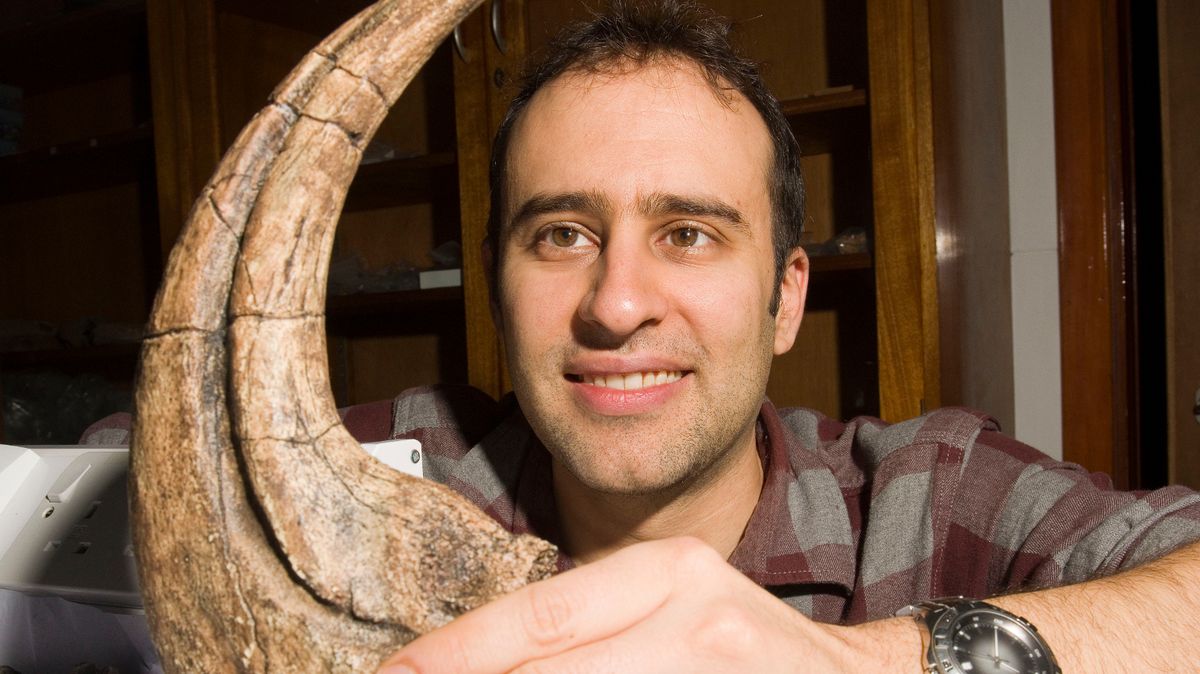
Dinosaur expert Dr Steve Brusatte in the lab at Edinburgh University(Image: Sunday Mail)
“And I say that if one of these things dive bombs you, it’s that inner velociraptor – and that all comes from an experience on Inchcolm Island. It happened around the time I was starting to write my first book. I’ve had this fear of gulls since that moment.
“But I think it’s genuinely true they can be very ferocious and very feisty. They’re very intelligent. Velociraptor is one of the closest ancestors of birds so it’s not just a turn of phrase.”
Steve’s first book The Rise and Fall of the Dinosaurs was a worldwide hit. And while he’s known outside of the scientific world for his film and TV work, he had no qualms about veering sideways to look at birds – precisely because of their connection with his lifelong professional passion.
The Story of Birds was a New York Times bestseller when it was launched in the US last week, and he hopes it helps connect the dots between the famous prehistoric creatures, and the flying animals populating the world today. And he discovered just as amazing finds in the air as on land.
 View 5 Images
Steve Brusatte with oscar winner Mahershali Ali on set of Jurassic World Rebirth(Image: Daily Record)
He said: “There were the terror birds that stood taller than a human, with a head bigger than a horse’s head. They were the top predators in South America for tens of millions of years and basically took over the T-rex niche in the ecosystem as apex predators.
“There were things called elephant birds in Madagascar, and they were freaking huge, the heaviest birds of all time with some of them getting close to a ton in weight. My wonderful six-year-old boy is not obsessed with T-rex or triceratops, but he really likes birds.
“One time we were meeting a bunch of Jurassic World movie fans and one of them asked him, ‘What’s your favourite dinosaur?’ And immediately he says penguins – they couldn’t believe it. So with the book, I was seeing birds kind of through the eyes of my son.
“That’s helped me find a way to talk about birds that can connect with people, seeing these amazing birds with a six-year-old, seeing what he sees, and being mesmerised by them.”
 View 5 Images
Steve at the London premiere of Jurassic World Rebirth(Image: Daily Record)
Illinois-born Steve has been working at Edinburgh University since 2013, and is part of the generation of paleontologists who fell in love with the field at the peak of the Jurassic Park film success.
Steven Spielberg’s 1993 movie was the first time the wider world had heard the idea of animals like velociraptors evolving into birds, featuring scenes of dinos flocking like avian descendants.
This idea, first developed around the time of Charles Darwin’s evolutionary discoveries in the 1860s, is now widely accepted and Steve has loved tracking the creatures in digs all over the world. But one of his favourite places to learn the lessons of the past is much closer to home.
He said: “When you look at some of these footprints we find out on Skye, they look like a chicken’s footprint or something bigger like a swan. I have a photo in the book of a theropod dinosaur footprint from the Isle of Skye next to the footprint of a modern swan. And they are basically identical.”
 View 5 Images
Steve Brusatte’s book – The Story of Birds(Image: Daily Record)
Another key part of the study of dinosaurs and birds’ evolution was the discovery that many dinos were covered in feathers rather than just scaly skin as traditionally depicted. And Steve was thrilled when he got to help depict that on the biggest stage of all in the last two Jurassic World films.
He was asked by blockbuster director Colin Trevorrow to help bring the feathered creatures to life as a consultant on Jurassic World Dominion in 2022, and then returned to the series for last year’s Jurassic World Rebirth.
He said: “I was hired on to the films because Colin Trevorrow read The Rise and Fall of the Dinosaurs and he just randomly got in touch with me in the summer of 2018 and said, ‘I make these dinosaur films, I’m coming to Edinburgh, do you want to meet up?’.
“We talked about the films and about dinosaurs, and he told me right away he wanted feathers on some of these dinosaurs and would I be able to help with that? I was all in.
“This dinosaur-bird connection is something that maybe when you hear about it, it almost sounds like it must be some technicality, a play on words or scientists trying to fool us or change the definition. No, it’s very literal. Birds evolved from dinosaurs. And when you see those feathers on dinosaurs, that’s what really drives it home.”
Steve has travelled the world studying dinosaur, mammal and bird fossils but he reckons there’s no place like home. He has helped make the Isle of Skye a global hotspot for dino finds, and he loves going all over Scotland with students chronicling new parts of the country’s pre-history.
He said: “This university is where the whole science of geology started. We can do field trips during class time to Arthur’s Seat and Wardie Bay, where you can find amazing fossils.
“We continue to go to Skye and find new fossils. And some of those bones and footprints are from meat-eating, theropod dinosaurs. That is the group of T-Rex and velociraptors that gave rise to birds.”
He added: “We want to understand how the Earth works, how ecosystems work, how species rise and fall. What happens when climate changes, when sea levels change, when temperatures change? That’s what the fossils can tell us. So I think they’re fun, but also very, very important.”
Article continues below
The Story of Birds by Steve Brusatte is out now on Picador, £25.