


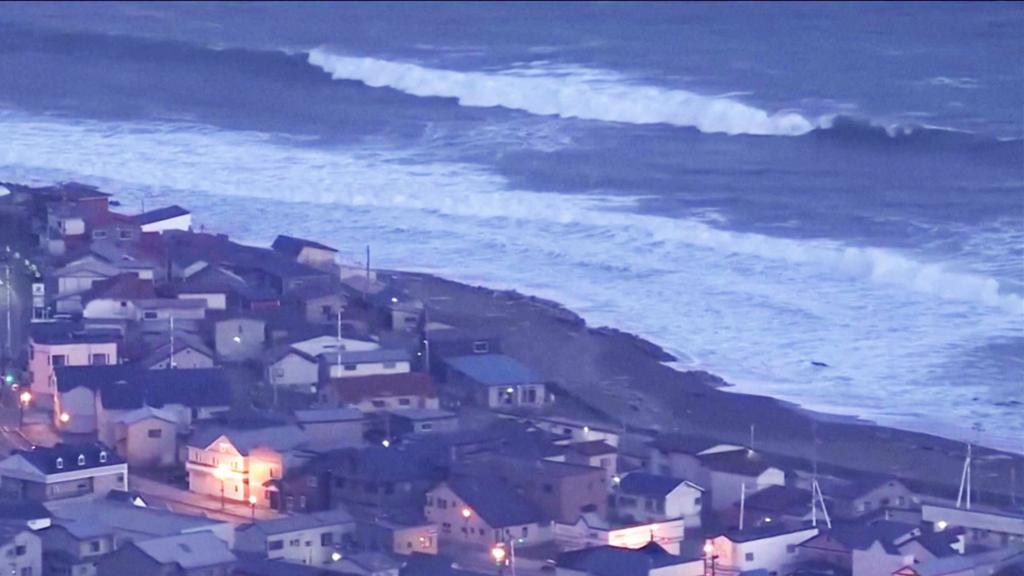
Earlier tsunami warnings for Japan have now been downgraded after a 7.7 magnitude earthquake struck off the country’s north-east coast
As soon as the alert went off, everyone ran one person in Hokkaido tells the BBC
So far, nuclear plants in the area appear to be operating as normal
After a 9.0 magnitude earthquake killed thousands in 2011, the government now urges people to seek higher ground as soon as possible,
A 7.7 magnitude earthquake occurred off Sanriku, off Japan’s northeast coast, at 16:52 (08:52 BST) local time and had a depth of 19km (11.8 miles).
Its strength was revised up, after previously being recorded at 7.5 and 7.4. The Japanese Meteorological Agency warns of aftershocks that could continue throughout the week.
A tourist in Japan told the BBC he experienced the building “swaying and everyone’s phone sounded the emergency alarm”.
Following the quake, tsunami warnings were triggered, covering much of the northeast. All the warnings have been downgraded to advisories, but people are still advised to remain away from the coast and large bodies of water.
The first tsunami waves reached the Iwate prefecture, with one as high as 40cm recorded in Miyako port.
The Japan Meteorological Agency initially forecast tsunami waves of up to 3m (10ft) reaching the Pacific coast of Hokkaido and Iwate prefectures – footage shows waves swelling in Hokkaido.
As for public services, around 100 households are without power, according to the cabinet secretary, and some bullet train services have resumed after earlier cancellations, the operator announced.
The East Japan Railway Company says its bullet train operations between Tokyo and Hachinohe have resumed.
The services between the capital and Morioka Station and Fukushima have also started back up again.
Operations remain suspended between Morioka and Akita. There is currently no time scheduled for these services to resume. There are delays remaining between Fukushima and Shinjo.
The operator said it had to suspend services due to the earthquake.
The Japanese Meteorological Agency (JMA) says that the possibility of a large earthquake following today’s 7.7 one is “relatively high”.
It has issued a subsequent earthquake advisory off the coasts of Hokkaido and Sanriku, but says that in such cases, the probability of the larger earthquake is only about one in 100.
This represents a roughly tenfold increase in risk compared to normal conditions when it’s usually 0.1% or less.
Japanese authorities say it is essential that people remain vigilant for about a week, and are advised to make preparations to evacuate and confirm what routes they would take to do so should the need arise.
The JMA says that it’s not guaranteed a large quake will happen again, adding that there is no need for advance evacuation.
Images show people on the move after Japan tsunami warning
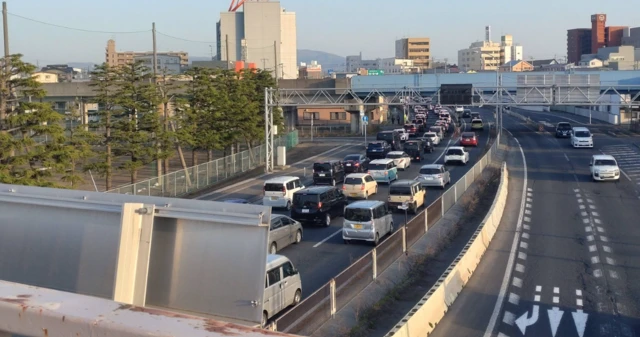
Images verified by the BBC show busy roads heading away from the coast of northeast Japan after an earthquake earlier today resulted in tsunami warnings from local authorities.
These have now been downgraded to advisories – although the authorities say people should stay away from the coast.
In one image, which we located to the city of Hachinohe, three queues of heavy traffic can be seen heading southwards along a main road.
Other images from the city show people in cars turning up at a military installation to seek shelter inland and away from the city’s port area.
We checked these pictures emerged online today and geolocated where they were taken by using street view mapping.
Content retrieved from: https://www.bbc.com/news/live/c07jpy3vxxvt.