


Air-raid alerts and frontline memoirs: Kyiv hosts literary festival amid war
Visitors flock to Book Arsenal in Ukraine’s capital as wartime writing takes centre stage
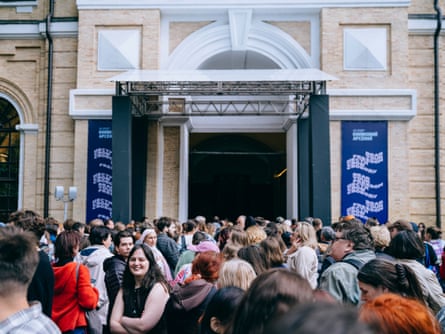
It was a literary festival, all right, but if your reference for such things is Hay-on-Wye and Edinburgh, or Melbourne and Sydney, or New York and Washington DC, then at Kyiv Book Arsenal you might think you had slipped through a crack in the universe and landed in an alternative reality.
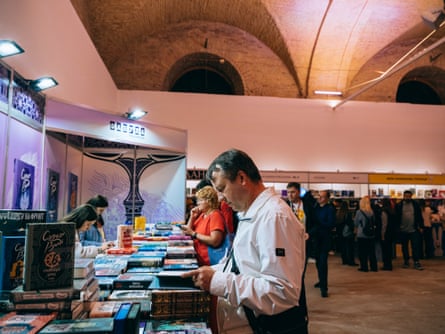
For a start, they were so young, the audience members. Dressed in their considerable best, they clutched their bags of books bought directly from publishers’ stalls and stopped to hug their friends – the festival providing the perfect opportunity for a people-watching passeggiata through its venue, the city’s vast 18th-century military arsenal.
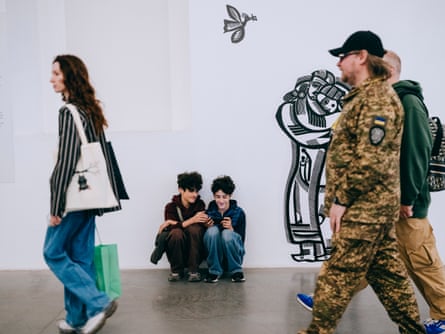
As an outsider, you wouldn’t know it from the surging crowds and the loo queues, but, remarkably, this was, everyone said, a touch quieter than previous editions of the festival. That was partly the fault of the terrible weather (Kyiv apparently having swapped its usual spring heat for Hay-on-Wye’s accustomed rain). But there was also the small fact that there had been repeated warnings of an imminent Russian attack of the kind that had struck the previous week, when the invaders let loose 60 missiles and 600 drones, most of them targeted at Ukraine’s capital.
Such an attack – a rain of ballistic missiles and Shahed drones on the city – did not come until after the festival had ended, on Monday night. Even so, on Friday the venue was evacuated several times, and the deputy minister for culture, Bohdana Laiuk, had to compete with the air-raid alert to award a prize for the best foreign translation of a Ukrainian book (won by Nina Murray for her English version of Lesia Ukrainka’s early-20th-century feminist verse drama, Cassandra).
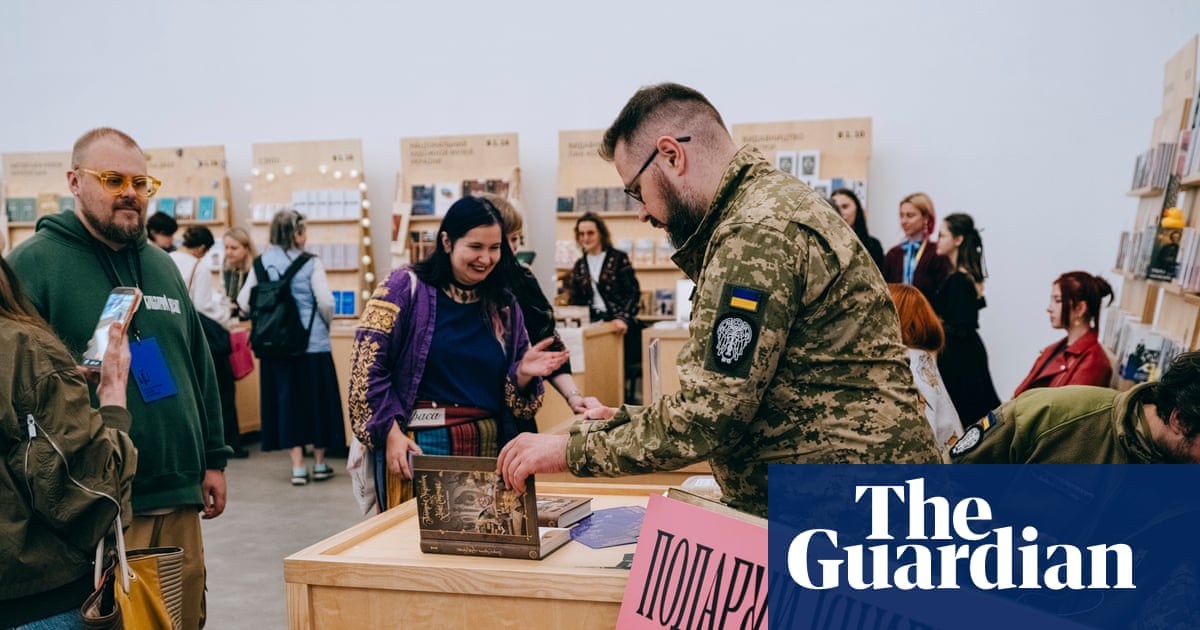
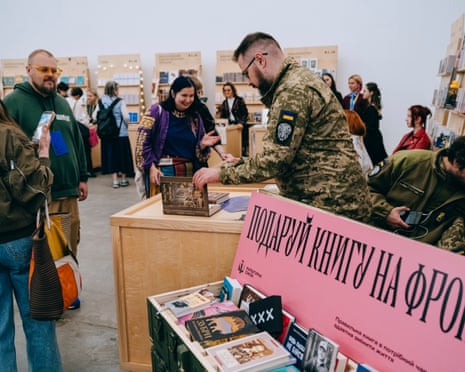
Then there were the military uniforms, everywhere. The 8th Air Assault Force was running arguably the best coffee stand (setting a high bar in a coffee-obsessed country), handing out bookmarks printed with the slogan “If you love reading, we like you”, and a link to donate. The cultural forces of the army had set up an ammo box for donated books to be sent to the frontline: offerings included Ukrainian translations of Alice’s Adventures in Wonderland and The Hitchhiker’s Guide to the Galaxy, plus a volume by the contemporary poet Halyna Kruk and a recent work about life on the frontline, Please Don’t Be Afraid, by Pavlo “Pashtet” Belyanskiy.
A sign of the nation’s complete engulfing by war was the presence of so many soldiers on the stages; writers who had become soldiers, soldiers who had become writers. The Russia-Ukraine war has dragged on so grievously, and for so long, that entire publishing cycles have turned since 2022. Earlier in the full-scale invasion, it was volumes of verse that emerged, poetry being the form that could most swiftly encapsulate the explosion of time and meaning wrought by war.
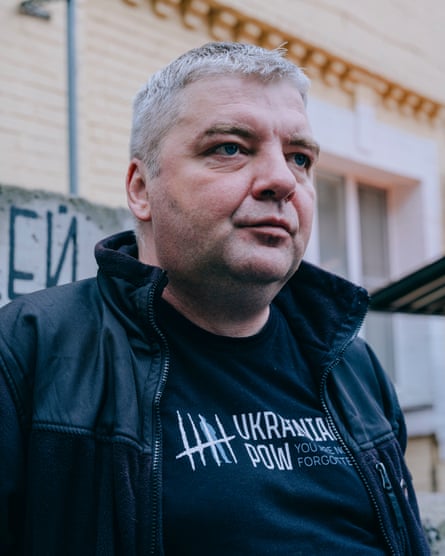
But now soldiers have had time, after four years, to put together finely tuned volumes of frontline memoir. “I’m seeing more and more books describing the experience of those who have joined the army, reflecting a change of status from civil to military and how it has impacted on their sense of selves,” said one of the festival’s programmers, Maksym Butkevych, a human rights defender who volunteered for the army in 2022 and was captured, tortured and held prisoner for two years.
It was he who had suggested the tagline for this year’s festival, which, in its English translation “bear your freedom”, hinted at the burden of responsibility that comes with the privilege of liberty. “Reading is a symbol of freedom – something that during most of my time in captivity I was forbidden from doing. It is the place where you have an inner world that cannot be invaded by the captors,” he said.
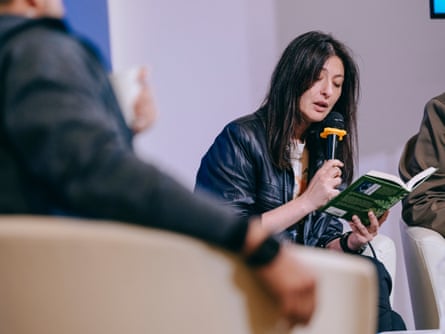
A balance between freedom, frankness and responsibility was one of the subjects of onstage discussion between soldier-memoirists, including Artur Dron’, a young writer and poet whose new volume of essays, Hemingway Knows Nothing, has become a bestseller. In a context in which such writing is not subject to government censorship, where truth-telling about ugly frontline conditions seems a necessary precondition for bridging the gap of experience between combatants and civilians, the writers debated whether they had a duty to impose a degree of self-censorship, for the common good. “It’s not about forbidding yourself something,” said Dron’ in the session, “but about feeling responsible for what you do.”
In another session, titled Fragility of the Hero, Dron’ and others dwelled on the importance of disengaging from an old-fashioned Soviet image of the soldier as an inhumanly, untouchably, perfect being. That kind of hyperbolic rhetoric, said Dron’, risked allowing citizens to outsource individual responsibility for the country on to these supposedly flawless “heroes”. “If we put the military on to a pedestal,” added Butkevych, “we deprive them of the right to be ordinary, imperfect human beings.”
Time has also engendered new approaches in prose. From the clipped, self-consciously unexperimental documentary writing of the early years, new forms are emerging, such as Katya Iakovlenko’s poetic book-length essay Donbas as a Metaphor, newly out in Ukrainian from ist publishing. Sasha Dovzhyk, the director of the Institute for Documentation and Exchange (Index), which supports writers and researchers in documenting the invasion, pointed to work by Anna Gruver, who, in her hybrid of “diary, essay and poetic writing” was “breaking free of expectations of what ‘war writing’ should be. Writers are ready to experiment.”
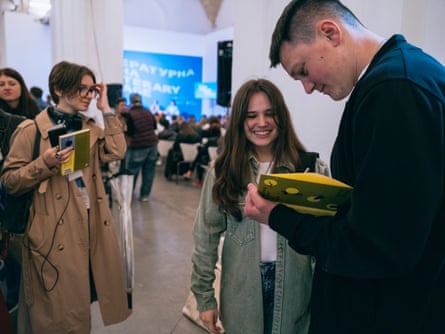
Not everything was directly focused on the war. There were huge book signing queues for Ilarion Pavliuk’s fat mystery novels (one air-defence volunteer was carrying two to be signed, along with a handful of kids’ books for his grandchildren in the US). The national treasure and public intellectual Oksana Zabuzhko talked about the 30th anniversary of her novel Fieldwork in Ukrainian Sex, which was a bestselling feminist succès de scandale when it was published in 1996 and a trailblazer for Ukrainian-language publishing in the newly independent country. The Osnovy publishing house was promoting titles including the first Ukrainian translation of EM Forster’s A Room With a View. On the outdoor stage, performers were competing for the national slam poetry championships. There were collage workshops for teenagers, soft play for kids, a Ukrainian calligraphy studio and a quiet room in case the sensory overload got on top of you.
But of course, the war pervaded everything. The publishers themselves had had a tough ride, along with everyone else over the past winter of blackouts and freezing temperatures. One talked of rising material costs exacerbated by the exchange rate against the euro; the necessary but costly use of generators in printing factories and warehouses; floods damaging stock when heating systems exploded after the winter freeze; delayed print runs. All of it meant books were more expensive for buyers. “Two years ago people were buying two or three books without hesitation,” the publisher said. “Now it’s a question of, this one, or this one?”
It was hard to imagine a book festival in which the stakes could be higher. The boom in Ukrainian publishing that began three years ago was the direct result of a shift in consciousness for many Ukrainians, one that encompassed a move away from the Russian language and literature that many had grown up with. As Bohdana Laiuk (then Neborak) said in 2023: “People began to understand that the Russians came here to kill people simply because they were Ukrainian. So people are asking: what does it actually mean to be Ukrainian? Literary culture gives us the place to understand who we are.”
“Kyiv Book Arsenal is more than a book festival, it’s a laboratory for exchanging ideas,” said Butkevych. “It’s about discussing our values and what we share as a community. Everything is intertwined: the Ukrainian language, book buying, discussing ideas – these are the threads that knit our community together.”