


AdvertisementWD at COMPUTEX 2026Business
AI infrastructure is multi-tiered, and HDDs are central to scaling AI, WD shares
- As data continues to accumulate and compound, shaping every next step in AI, the industry is rediscovering a hard truth: sustainable AI depends on storage that can scale cost-effectively in capacity and bandwidth. Global AI storage infrastructure leader WD says that the future of AI infrastructure will be built on tiered systems with HDDs as the economical and architectural foundation.
Paid Post:WD (Western Digital)4-MIN READ4-MIN Listen
Advertising partnerPublished: 12:00am, 6 Jun 2026
[The content of this article has been produced by our advertising partner.]
AI has long been caught in a paradox: AI workloads demand high performance storage, long associated with flash, but scaling at AI levels with all-flash is prohibitively expensive. Hard disk drives (HDDs), on the other hand, already store the majority of AI data cost-effectively at scale. They are the proven, cost-effective capacity foundation of the modern data centre. What has separated them is the assumption that performance and economics cannot scale together.
At Computex 2026 in Taipei, that assumption was on trial. Hyperscalers, enterprises, neoclouds, sovereign clouds, and AI labs gathered not only to show new models and applications but to tackle a fundamental question: how to build infrastructure that can sustain AI’s data gravity without unsustainable cost?
Advertisement
One message stood out. AI infrastructure is inherently multi-tiered, and HDDs are the critical foundation.
That view is being championed by WD (Western Digital Corporation, Nasdaq: WDC), a global leader in storage infrastructure for the AI-driven data economy. The company unveiled a full range of innovative solutions at its “Innovation Day 2026” in February this year, with the aim of extending HDD relevance deeper into AI workloads by closing the gap between capacity economics and performance. WD also showcased a selection of these cutting-edge storage solutions at Computex designed to drive next-generation AI workloads.

Stefan Mandl, Vice President of Worldwide Sales and Marketing at WD, argues that continued HDD innovation is the solution. “Because AI infrastructure is a system, not a single tier, our innovation breakthroughs are in expanding HDD capabilities into new storage tiers and workloads and broadening where HDDs deliver value across the entire AI data infrastructure stack.”Advertisement
From compute obsession to data-first design
For years, AI readiness meant compute density – more GPUs, faster interconnects, denser memory – but at production scale, the real constraint has shifted from episodic compute to persistent data. “Compute defines the moment; data defines what happens next,” Mandl says. Every inference creates data that compounds into institutional memory, making storage a core requirement, not an afterthought.
The true constraint in AI lies in managing and storing massive datasets economically at scale, where insufficient storage planning can turn data into a system bottleneck.
Advertisement
“The future of AI infrastructure depends on multiple tiers working together,” Mandl says. “Memory enables high-speed processing and real-time computation, while HDD storage provides the durable, scalable foundation where data persists, grows, and compounds over time.”
A single tier architecture may be appropriate in early pilots, but it fails as workloads and systems scale — and the solution lies in architectural tiering. AI workloads span hot, warm, and cold access patterns, with each optimized for different workloads. Memory and flash deliver the speed needed for real-time inference and training bursts; HDDs deliver the durable, cost-effective capacity at scale that holds the growing corpus of model inputs and outputs. Together they form a complementary stack. It’s not an either/or choice.
At scale, storage becomes a design constraint. How much data a company can afford to store and scale effectively determines how much historical context its models can learn from, how often it can retrain, and how quickly it can iterate. “The right tiering strategy lets teams keep more useful data while keeping total cost of ownership (TCO) efficient. That balance — fast memory for the immediate, flash for hot working sets, and HDDs for massive, persistent context — is the foundation of sustainable AI,” Mandl notes.
AdvertisementScale breaks simple storage because compute grows in waves while data compounds continuously, creating two predictable failure modes: architectural fragility – systems assuming uniform access patterns cannot handle diverse AI workloads – and economics shock, where flash storage used for data that does not require instant access drives costs through the roof.
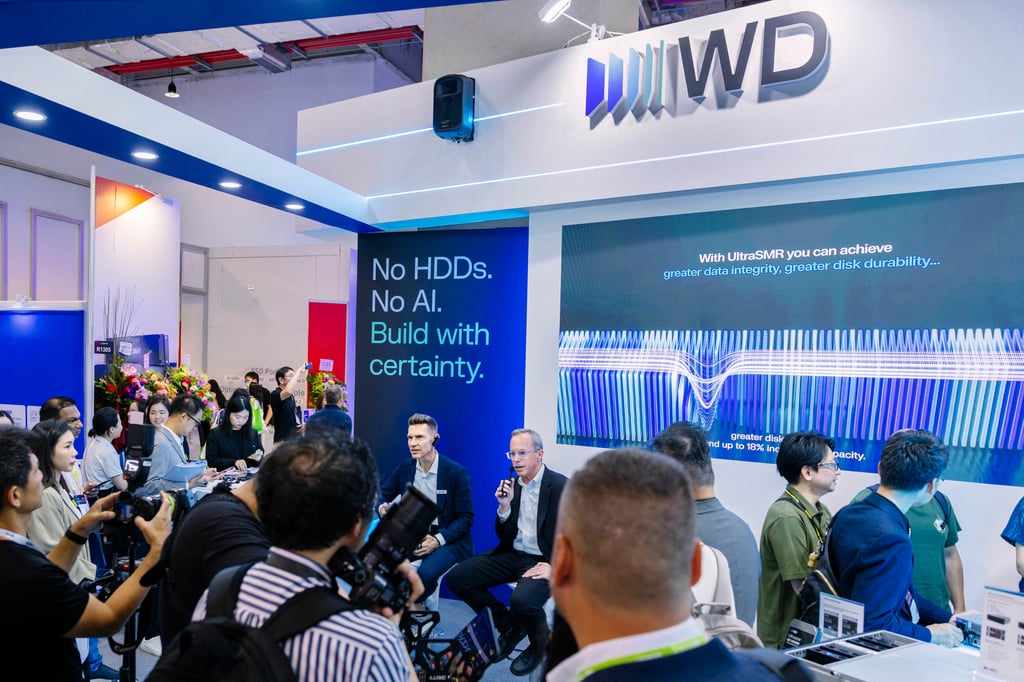
At AI scale, economics becomes architecture. “If a company cannot store and reuse data cost-efficiently, model improvement stalls and the business case for AI weakens. The imperative is to design storage around the data lifecycle and to treat data storage as foundational in architecture decisions.”
Reinventing HDDs: A new performance tier for AI
As HDD capacity grows, a core technical challenge has been access-density. Although HDDs have been the backbone of data centers for decades, capacity growth has outpaced throughput. Since 2017, drive capacity has risen dramatically while per-drive throughput performance has lagged. That creates a risk: drives that are capacity-rich but performance-constrained are unacceptable for bandwidth-intensive AI workloads.
Advertisement
Past attempts to close the gap — higher RPMs, hybrid drives, or single-actuator tweaks — often traded capacity or cost for speed. Flash addresses the performance gap today, but it breaks economically at exabyte scale.
“The market needs flash-like throughput at HDD economics — a combination that unlocks warmer, higher-throughput tiers without sacrificing the cost advantage of HDDs,” Mandl says.
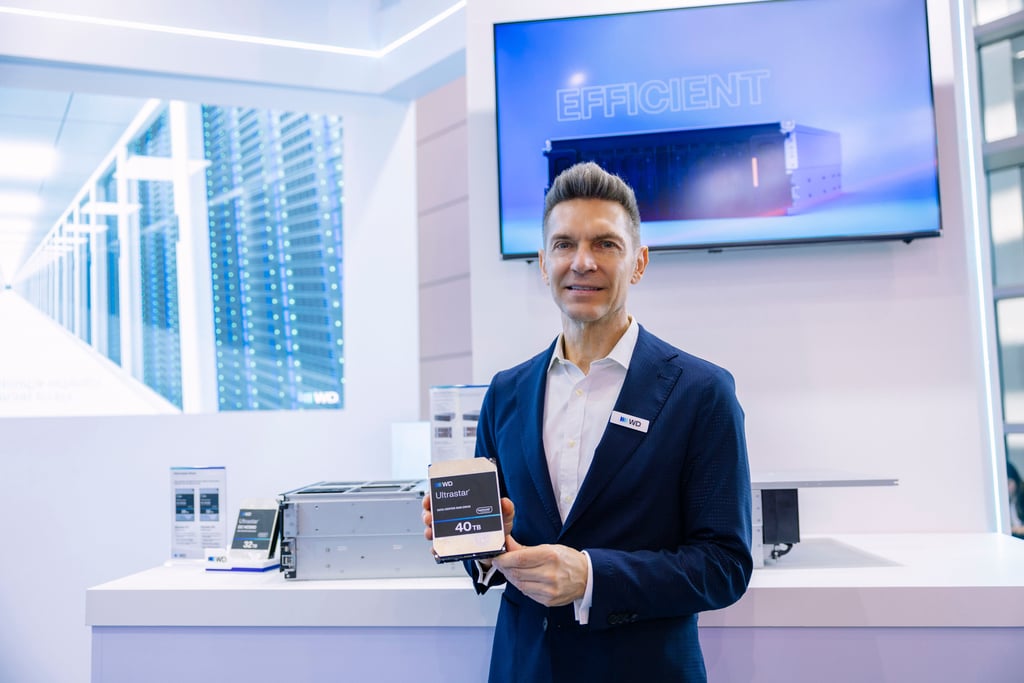
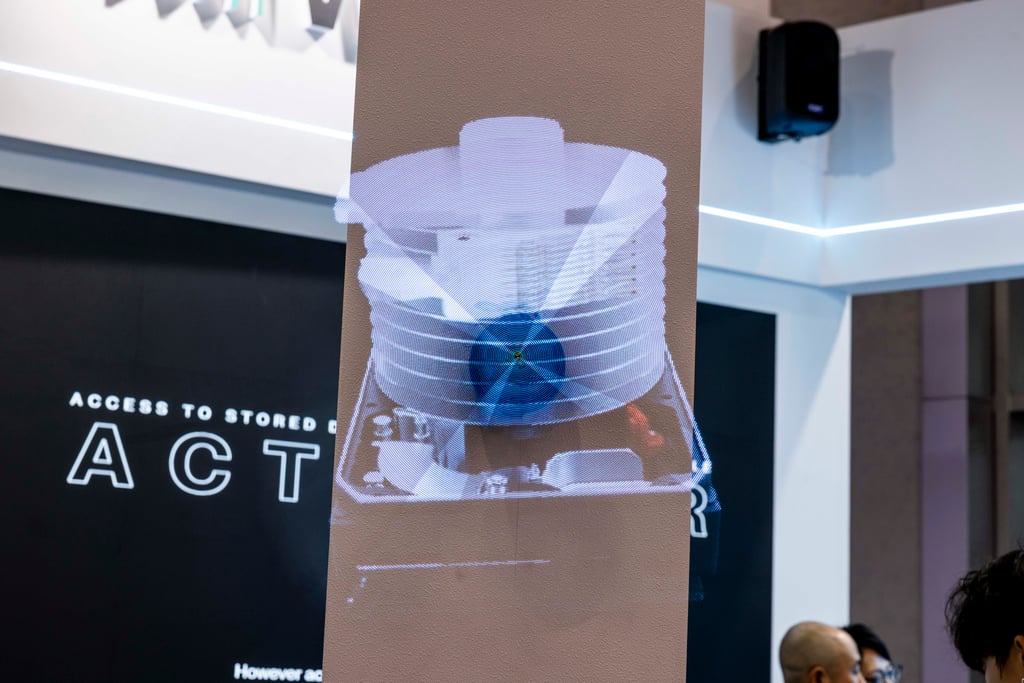
WD is pushing HDDs into new territory. The company unveiled two complementary technologies that together change the calculus: High Bandwidth Drive Technology and Dual Pivot Technology. “The first delivers up to 2x bandwidth compared to conventional HDDs shipping today by reading and writing from multiple heads and tracks simultaneously. Dual Pivot Technology adds a second set of independently operating actuators to increase both performance and capacity without the old tradeoffs,” Mandl explains.
When combined, these approaches project a multi-fold increase in throughput. “Both the High Bandwidth and Dual Pivot technologies project a 4x throughput increase: from 300MB/s today to approximately 1.2GB/s — extending HDD relevance into warmer and performance sensitive tiers previously reserved for more expensive flash,” he continues. “It’s a new class of infrastructure: flash-like throughput with HDD economics. For AI data centres, this will reduce the need to increase SSD deployment or rearchitect services as capacity scales.”
Advertisement
For AI builders and operators, the implications will be immediate and strategic. The solution empowers teams to plan for the data lifecycle and design storage around creation, active use, and long-term retention rather than GPU counts. They can adopt tiered architectures and use memory and flash for latency-sensitive work and performance-optimised HDDs for warm and capacity tiers. These hot, warm, and cold patterns are the access profiles that tiered storage must service to make AI infrastructure sustainable.
“Moreover, the solutions empower companies to design for growth by choosing technologies and layouts based on where their data estate will be, not where it is today. They should also make storage economics at scale a primary design decision upfront, so infrastructure improvement is sustainable,” Mandl says.
The bottom line: Scale effectively and cost-efficiently
The next phase of AI is not just about bigger models or denser compute. It’s about building systems that can sustain the relentless growth of data those models create. By treating AI as a data system, adopting tiered storage by design, and embracing innovations that bring flash-like throughput to HDD economics, organisations can scale AI without breaking the bank.
Advertisement
“The winners will be those who stop asking whether performance or economics should win, and instead design systems where both do,” Mandl notes.
WD is at the centre of that transition, delivering storage technologies and solutions that make long-term, large-scale AI practical and affordable. As AI systems generate ever more persistent and compounding data, the companies that master storage economically at scale will shape the future of the AI-driven data economy.
AdvertisementAdvertisementAdvertisementSelect VoiceSelect Speed00:0000:001.00x