



Farage says woke kills – and the real, hard questions we could be asking are swamped by the culture war

What we must learn from the murders of Henry Nowak in Southampton and Barnaby Webber in Nottingham is that kneejerk assumptions either way are dangerous
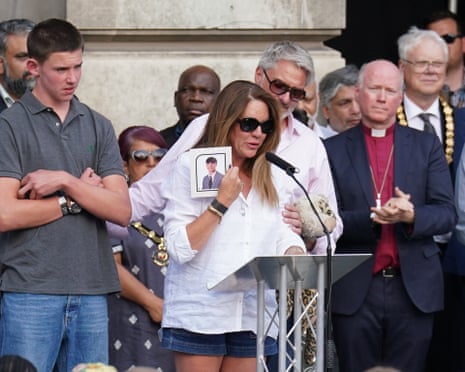
Emma Webber brought one of her son’s old T-shirts to the hearings into how he died. Holding on to Barney’s clothes is comforting, as is sometimes sleeping in his bed. He was only 19, a student walking home at night with his friend Grace O’Malley-Kumar, when both were fatally stabbed by a paranoid schizophrenic recently discharged from hospital who wasn’t taking his medication.
Valdo Calocane went on to kill 65-year-old school caretaker Ian Coates and gravely injure three others that night before being caught. The T-shirt is still here but Barney is not, as his mother said in a video this week offering her sympathies to the parents of 18-year-old Henry Nowak, the Southampton student who died in handcuffs at the feet of police who failed to realise he was the victim not the aggressor in an attack they had been falsely told was racist.
The two families have never met but are bonded both in grief and in a desire to avoid what Webber called “political grandstanding”. The Nottingham families fought like tigers for a public inquiry into how Calocane was free to kill, which heard evidence on everything from bed shortages and the dismantling of specialist teams seeking out high-risk patients, to the former mental health tsar Prof Louis Appleby’s warning last week that the pendulum had swung too far from public safety towards respecting patients’ wishes. They fervently hope its findings, due next year, will save lives. Yet, if the right continues hijacking it as it has this week, then its sober lessons risk getting swept up in a hurricane.
This week, the shadow home secretary, Chris Philp, advanced an argument that has long bounced around the rightwing infosphere, after surfacing early in the inquiry: that doctors hesitated to section Calocane (who is black) partly because of controversy over disproportionately high section rates for black men, leading – in Philp’s words – “directly to the murder of three innocent people”. For good measure, he noted that the Southport killer Axel Rudakubana’s headteacher was accused of racially stereotyping a black boy when describing her concerns about him, though a public inquiry did not find that central to what followed.
The shadow equalities secretary, Claire Coutinho, meanwhile, tweeted that the Southport and Nottingham killings and the Manchester Arena terror attack – where an 18-year-old security guard later testified that he had failed to challenge the suicide bomber despite thinking he looked suspicious, for fear of seeming racist – were evidence of racism being “weaponised in public services”, costing innocent lives.
Woke kills, in other words: the same message Nigel Farage is remorselessly pumping out, alongside threats to repeal swathes of anti-discrimination law if Reform UK gets elected, jeopardising the rights not just of ethnic minorities but anyone else with reason to be grateful it’s not the 1950s.
There is no way back from this madness without acknowledging hard truths. Calocane was sectioned and discharged four times, and two of his doctors testified that race hadn’t influenced those decisions. But Dr Jonathan Gibson – who saw Calocane four months before the killings, and now believes he should have pushed for his patient to be forcibly medicated – testified that he had been repeatedly told psychiatry was “institutionally racist” and too coercive, especially with young black men, adding that he was “viscerally” aware of the argument and “I do not believe it had no bearing on VC’s care”. It will be for the inquiry to reconcile all these accounts. But, at best, the picture looks too fuzzy for responsible politicians to be pouring petrol on bonfires, or throwing decades of progress casually under the bus.
If professionals are now questioning their own judgments and assumptions, then that’s healthy and necessary – and I say that as a writer who has had to learn how to do it. But it’s also undeniably difficult, forcing people in already complex, pressured careers such as policing and medicine to work with what can only be described as a bewildering number of mental tabs constantly open – including the idea, expressed in police guidance now being reviewed by government, that fairness isn’t necessarily treating everyone the same. (Reading a deaf suspect their rights like anyone else is equal treatment, for example, but it’s not fair if they can’t hear you.)
Though a consultant psychiatrist should be capable of exceedingly fine judgments, it’s a big ask of an 18-year-old security guard on minimum wage or a rookie police constable straight out of sixth form. Walking these high wires takes skilled and supportive management, and better diversity training, not less. What it doesn’t need is the collective hysteria of excessively online politicians, or the anglicising of an American rightwing argument that anti-racism is somehow more dangerous than racism itself, despite all the latter’s long history of bloodshed. Britain is still, for now, a country more than capable of feeling for any mother’s child left to die alone and frightened on some cold city pavement, regardless of colour, and politicians who behave as though that were not true are peddling not just hate but nihilism, failure and contempt for their own supporters.
If any professional has been too squeamish, then the takeaway is that kneejerk assumptions either way are dangerous and need confronting, not that the legacy of the Macpherson report on racism in policing needs dismantling, as Farage is now arguing. The lesson of Henry Nowak’s awful death is not that Stephen Lawrence’s has somehow ceased to matter, but that lessons must be learned from both. If not, too many families will be left holding nothing but faded T-shirts.
-
Gaby Hinsliff is a Guardian columnist
-
Do you have an opinion on the issues raised in this article? If you would like to submit a response of up to 300 words by email to be considered for publication in our letters section, please click here.