


A new universal vaccine is being developed which could protect against whole families of viruses to prevent future pandemics.
The world-first jab is being developed by British scientists using artificial intelligence (AI) to protect against future mutations. Typically viruses evolve over time so current vaccines become less effective and have to be constantly updated.
Now experts at Cambridge and Southampton universities have created a “game changer” vaccine that viruses cannot mutate to avoid immunity from – preventing pandemics before they begin and avoiding future lockdowns. Their trial has shown that a coronavirus vaccine made using the technology is safe and they are now set to launch the second phase of the trial.
 View 3 Images
Professor Jonathan Heeney said his jab could be a ‘game changer'(Image: University of Cambridge/PA Wire)
The vaccine was developed by feeding the AI all data on all past mutations globally to identify a “super antigen” on the viral molecule that is essential for all similar viruses to survive.
Chief investigator Prof Saul Faust, of Southampton University, said: “Viruses like flu, coronaviruses and the ebola group are evolving continuously and by the time vaccines are rolled out, they may be poorly matched. The current “reactive” vaccine system struggles to keep pace.
“This new class of universal vaccines are future-proofed. They not only protect against many variants simultaneously, but potentially against related viruses that haven’t yet emerged and spilt over to humans. If we can develop and clinically advance this new class of vaccines before a virus outbreak begins, millions of lives could be saved, lockdowns avoided and the economy preserved.”
 View 3 Images
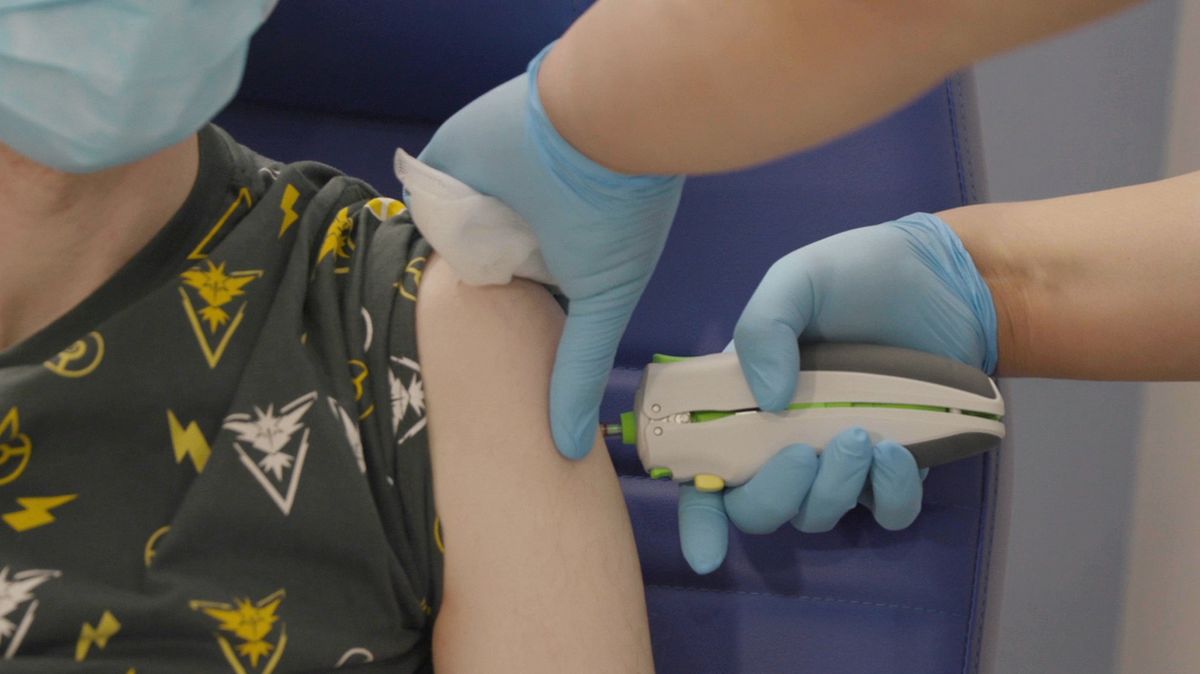
Sarbeco jab is administered through a micro fluid jet to push vaccine blueprints directly into skin cells.(Image: University of Cambridge/PA Wire)
The Covid-19 pandemic occurred because the SARS-CoV-2 virus that causes it evolved in bats and spread to humans. Existing SARS vaccines did not protect against it.
Professor Jonathan Heeney, co-author from the lab of viral zoonotics at Cambridge, said: “What that Covid pandemic taught us is how fast we can make vaccines, but we’re still using the old paradigm. This is about making one vaccine that will get them all based on their relationships. You hoover up all the genomic sequences, what’s known from around the world, from past outbreaks and current outbreaks and you do some basic structural science.
“We take all these different sequences… and we think, `OK, what’s consistent amongst them, what’s not changing, what is essential for their life’ and that’s what we target. It not only predicts, but it targets what is essential for that virus family. We’re targeting something in a virus family, which the virus can’t change easily.
The universal Sarbeco coronavirus vaccine, developed with biotechnology company DIOSynVax was tested on 49 healthy volunteers aged 18 to 50 who had the jab in Cambridge and Southampton. It was administered as a DNA vaccine through a micro fluid jet – a needle-free method that uses a high-pressure, hair-thin stream of liquid to push vaccine blueprints directly into skin cells.
Researchers found the jab is safe and that it triggered an immune response to not only SARS-CoV-2 and SARS, but to related bat viruses that could potentially jump from animals to humans.
A previous study in animals also found the jab sparked a strong immune response against a range of coronaviruses. The phase II trial will now recruit over 200 volunteers to test it.
Prof Heeney said he is hopeful that the technology can be a “game changer” that could provide broad protection from thousands of variants of viruses, such as ebola. He added: “There’s a lot of viruses out there, and once we know them, we start chasing them, but we have to change that paradigm. That’s what this is about, it’s about making vaccines that not just protect us from today’s viruses, but the ones that haven’t yet happened.”
Article continues below
Prof Marian Knight, scientific director for National Institute for Health and Care Research (NIHR) Infrastructure, said: “The remarkable success of this AI-designed super-antigen trial marks a pivotal leap forward in our ability to deliver broad, lasting viral protection.”
The study was sponsored by University Hospital Southampton NHS Foundation Trust.