


Disney racks up $4.2bn deficit on Paris parks
Exclusive: Analysis shows resort has yet to recoup Disney’s investment despite record revenue and 16m annual visitors
Disney has still not recouped $4.2bn of its investment in Disneyland Paris after more than 30 years, even though the resort is now its best-performing international outpost, according to an analysis of recent filings.
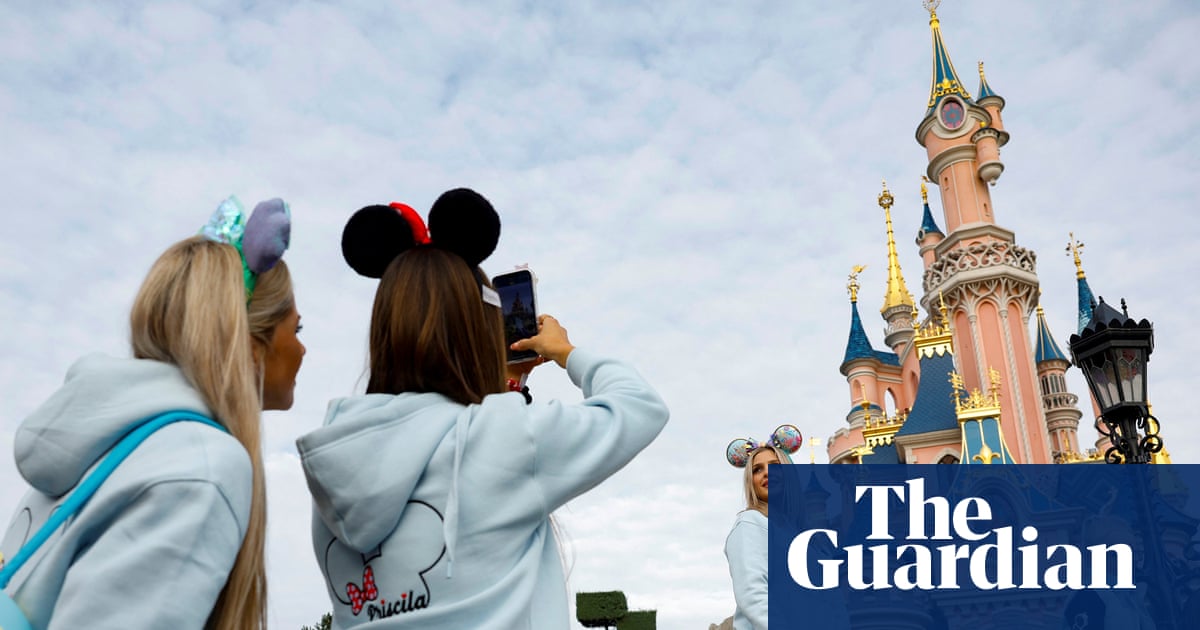
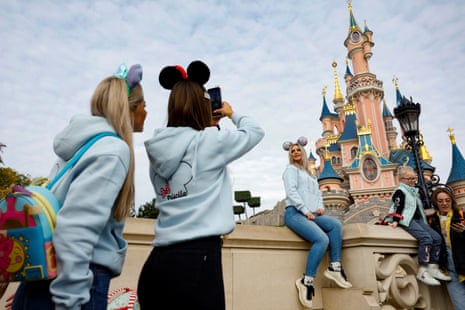
The sprawling theme park complex swung open its ornate iron gates in 1992 and now attracts about 16 million visitors every year. It is wholly owned by Disney and is home to two theme parks – the fairytale-inspired Disneyland and Disney Adventure World, which launched its largest-ever expansion in late March. The lavish land, themed to the hit animated movie Frozen, is part of a $2.5bn (€2bn) investment by Disney, and its new chief executive, Josh D’Amaro, was on hand for the opening alongside Emmanuel Macron.
Before the festivities, the resort’s parent company, Euro Disney Associés (EDA), posted sparkling results. They showed that in the year to 30 September 2025, the introduction of dynamic pricing led to EDA’s revenue rising 8.4% to a record $4bn (€3.4bn), which beat every other Disney resort outside the United States. It gave a magic touch to Disney’s theme parks division, which produced nearly 40% of the company’s $94.4bn revenue and 57% of its $17.6bn operating income last year.
EDA’s net income surged almost threefold to an all-time high of $304.2m (€260m), though this was still a drop in the ocean compared with the red ink that the company spilled in its first 25 years.
Disney doesn’t break out the results of individual theme parks in its US filings, but French disclosure obligations shine a spotlight on the performance of Disneyland Paris. Analysis of more than three decades of its filings reveals Disney’s blockbuster deficit, which is ultimately due to the enormous size of the resort: Disney wanted a massive plot of land to lock out rivals, and it got what it wanted, as the site spans 5,510 acres (2,230 hectares), making it nearly a fifth the size of Paris. But it came with a catch.
The French government sold Disney the land on the condition that it enter into a public-private partnership. The media giant owned 49% of Euro Disney, with the remainder in the hands of the public; it was listed on the Euronext exchange. This structure led to the company filing detailed accounts and cast a dark spell on its bottom line.
As Disney wasn’t the company’s majority owner, it didn’t pour money into it as it had done with its US parks. Instead, 59.8% of the $4.9bn (FF23.7bn) construction cost was covered by bank loans, with the remainder coming from the public and Disney, which provided just $132.1m (FF833m).
Clouds soon gathered as French tourists objected to high ticket prices, the lack of alcohol in its restaurants and English being the first language.
Weighed down by its debt mountain, Euro Disney has only posted a net profit 13 times since 1992, with its combined losses coming to a staggering $3.7bn (€3.3bn). Just one year after opening, Philippe Bourguignon, the Euro Disney chair, said in the annual report that “the severe imbalance in Euro Disney’s financial structure has become such a burden that it is jeopardizing the very existence of the company”.
By the end of 2015, Disney had invested $1.3bn in four rights issues by the company and paid $214.3m to buy assets from it, which were then leased back, giving it a cash injection. Disney even paid off its bank borrowings and replaced them with a low-interest loan before converting $750.7m of it to equity.
Euro Disney has also been blighted by bad luck. It debuted during a severe recession, while its second park launched in 2002 during the tourism downturn following 9/11. The final straw came in 2016, when Euro Disney made a record net loss of $961.8m (€858m) after attendance crashed in the wake of the November 2015 terrorist attacks in Paris.
Disney acted decisively. In 2017, it spent $250.8m (€224.1m) buying out every other shareholder and delisted the company. Completely deleveraging it cost $1.7bn (€1.5bn) and put the resort on course for sustained profitability. The pandemic brought that to an end, and although Euro Disney has recovered, it is now threatened by the war in the Middle East, which has sent gas prices and air fares soaring.
All told, Disney has invested $6.8bn (€5.7bn) in Euro Disney and has yet to make its money back after 34 years. The company has only ever paid one dividend, which was in 1993, yielding just $10.2m (FF56.6m) for Disney. Euro Disney declined to comment, but it is understood that it is not even possible for it to pay a dividend until its negative retained losses have been fully offset, so a happy ending could take some time.
Disney’s only other return on its shares in the company came when it sold a 10% stake to Saudi investor Prince Alwaleed bin Talal bin Abdulaziz al Saud, for $140.9m (FF745m) in 1994. Every year, Euro Disney pays its parent tens of millions of euros to cover services such as park design, web hosting and character costumes, but they all come with costs, so they aren’t pure profit to Disney. Even the asset sale and leaseback only generated $26.1m (€23.1m) for Disney.
Its greatest gains have come from management fees and royalties Euro Disney pays for using Disney characters and movies in the parks. At a total of $2.4bn (€2.1bn), they have offset less than half of Disney’s investment in the resort. However, that’s not the end of the story. Disneyland Paris promotes its products and movies to millions of guests, so even though it hasn’t broken even for Disney, it still casts a powerful spell.