


Nvidia is already planning N2X and N3X chips — the goal is the Star Trek computer
“It’s like Scotty talking to that mouse,” says Nvidia’s CEO.
“It’s like Scotty talking to that mouse,” says Nvidia’s CEO.
by Jun 3, 2026, 8:03 PM UTC
 Sean Hollister is a senior editor and founding member of The Verge who covers gadgets, games, and toys. He spent 15 years editing the likes of CNET, Gizmodo, and Engadget.
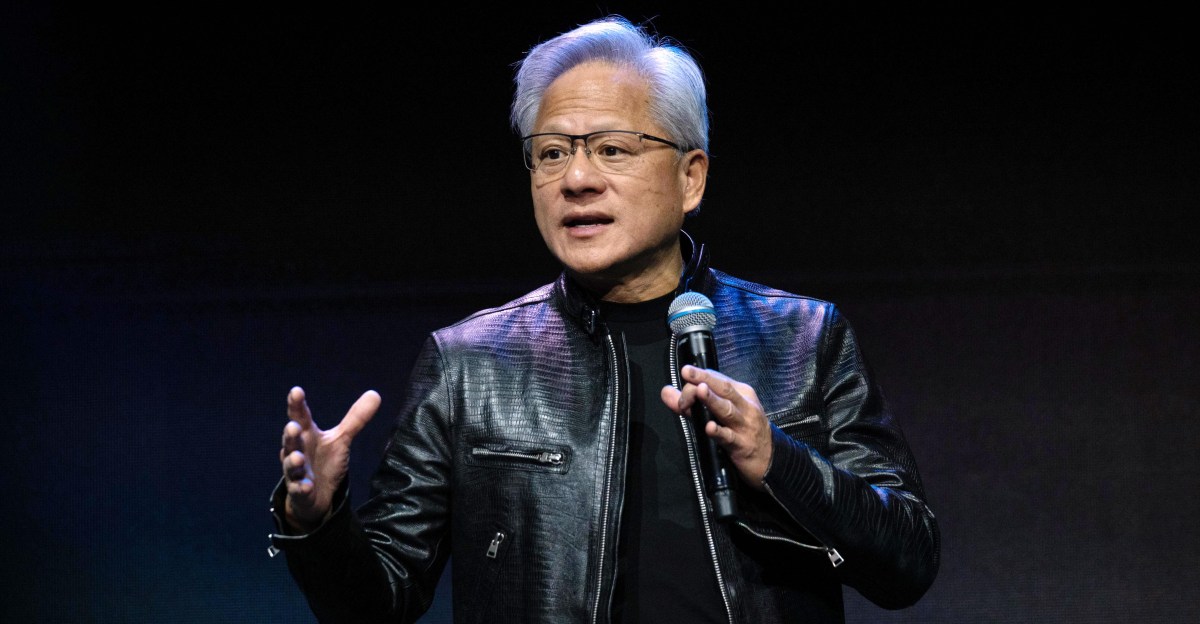
Just in case you were wondering, Nvidia’s RTX Spark isn’t supposed to be a one-off. The company is not just flirting with becoming the fifth high-profile vendor of consumer laptop chips to see if people bite. At Computex 2026 in Taipei, Nvidia CEO Jensen Huang confirmed at least two additional generations of RTX Spark are already planned. The eventual goal, he said, is to build Star Trek-like computers and and Star Wars-like droids you can order around with your voice.
“I want to talk to my laptop! I want R2-D2!” he told analysts and investors at Computex, revealing that he started working with Microsoft CEO Satya Nadella “about three years ago” to build towards that goal.
“Satya and I, we’re going to walk up to our Windows PC and go ‘hello, do something.’ It’s like Scotty talking to that mouse. You know what I’m talking about? Star Trek. No?” he said. He’s referring to the famous Star Trek IV scene where the Enterprise’s chief engineer, having time-traveled to the past, expects a computer to be intelligent and mistakes the mouse for a microphone:
“In the future this computer’s going to be an AI. Everything’s going to be an AI. Your vacuum cleaner, you’ll talk to it, go mop that up,” Huang adds.
But Huang also imagines that “R2-D2” won’t necessarily need to be within reach. Not unlike when Artoo saves Luke and friends from the Death Star’s garbage compactor, he thinks you’ll be able to phone your computer remotely:
If I want to talk with my laptop today, I gotta wait until I get back to my room. In the future, if I need my laptop to do something, I just text it with WhatsApp. I say “R2-D2, there’s this thing with the PowerPoint slide, slide number 17, that image is scaled or titled wrong. It should not say CX9, it should say CX10. R2-D2 opens up PowerPoint, modifies it, puts it in PDF, sends it to me. Can you imagine that? Easy.
If we’re talking remote control anyway, why would we want to buy a pricey laptop instead of talking to AI in the cloud? He says it’s partly economic:
You don’t want to necessarily run everything in the cloud, because if you can run it locally, it’s free. Why rent a television? You’re going to use that every day. Why rent a washer dryer, you’re going to use that hopefully once a week? Why rent a refrigerator? You’re going to use it every day. Why rent an assistant computer? You’re going to use it every day.
And partly because your machine is where your private data and tools already exist. Here’s Huang admonishing his friend Dylan Patel (you might remember him from our Vergecast RAM Holiday Spec-tacular):
What, am I going to call Claude to control my laptop? Are you insane? It doesn’t make any sense! I want to talk to my laptop! I want R2-D2! I want you to do a few things for me when I’m gone. I’m here giving a keynote, and there’s some code I want finished… hey I’ve got an idea, I’m going to call R2-D2, all the files are here in my laptop, all the tools are here, get that done. You can’t do that with Claude Code in the cloud.
Again, Nvidia has so far shown almost nothing to prove that the first generation of RTX Spark laptops will deliver anything close to a Star Trek computing experience. That’s up to Microsoft and software partners; what Nvidia is selling is a small but potent pocket of local AI compute. The Spark has up to 128GB of RAM, which Nvidia says is enough to hold 120-billion-parameter AI agents. Is that enough for R2-D2 to figure out how to do what you want?
Either way, they will cost. When Patel posed a question beginning with “These laptops are $3,000 or something on that order of magnitude, the power user is the one who has to buy the first generation of it,” Nvidia’s CEO nodded along while repeatedly saying “yep.”
Still, as we’ve reported, the RTX Spark will scale down from the first “superchip” with 128GB of RAM down to as little as 16GB of RAM, and Nvidia is looking to produce an entire family of them across multiple generations.
“N2X and N3X are already planned, and N1X is called N1X because it has a smaller version called N1. We’re going to expand our family. We’re going to extend this architecture for a very long time,” Huang told journalists, according to Tom’s Guide.
Follow topics and authors from this story to see more like this in your personalized homepage feed and to receive email updates.