


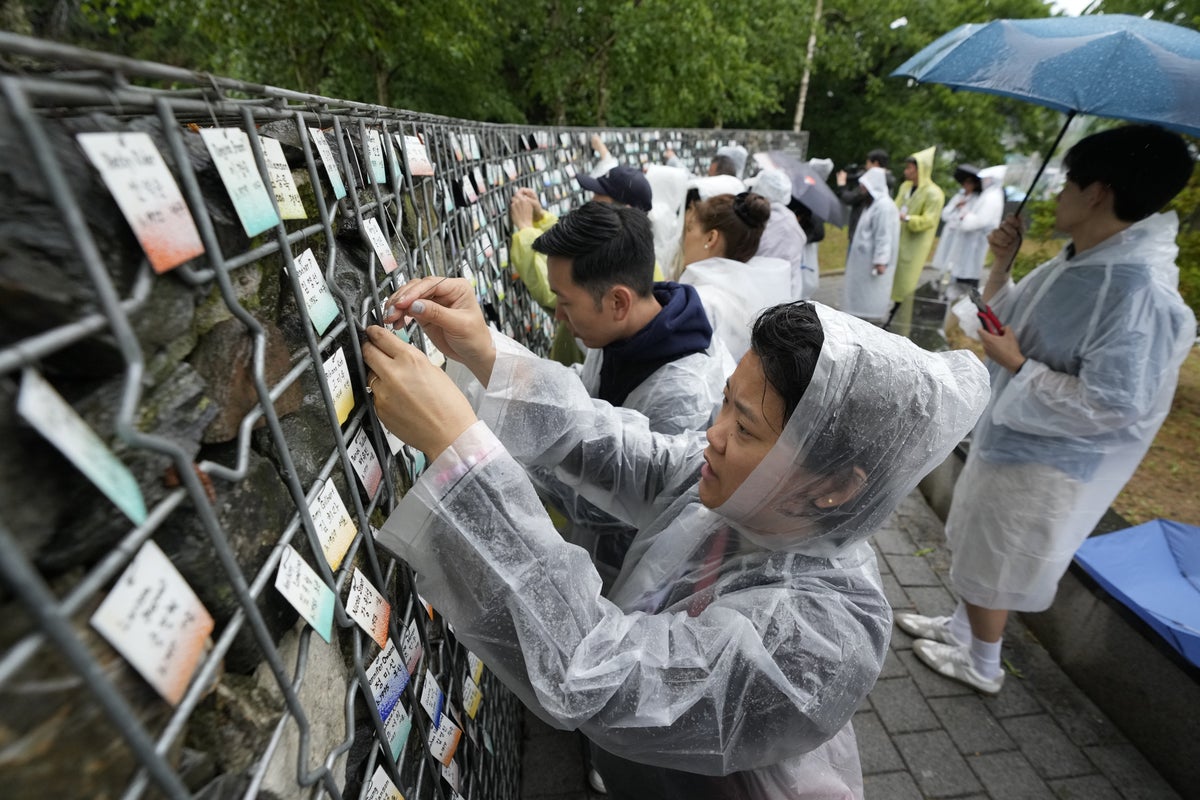
Dozens of Korean adoptees from North America and Europe recently gathered to leave their names on a wall at a former U.S. military base, hoping that, after decades, a birth mother might still be looking for them.
Misted in rain, they fastened ceramic nametags onto mesh that covered a cobblestone wall at Omma Poom Park — meaning “mother’s embrace” — in Paju, South Korea.
More than 900 tags, suspended like unmailed letters, formed a quiet monument to years of mass child-parent separations that has created what’s likely the world’s largest diaspora of adoptees.
“There are so many tiles that hang, and yet that is merely a small fraction of us that exist,” said Nicole Rieth, adopted to Michigan when she was 4 months old, in January 1989.
“As far as connecting with my birth mother, it’s not about gleaning specific information from her or even necessarily seeking a relationship. I’ve just always wanted to know who I looked like, because I’ve never had that before.”
Each nametag, hand-painted by an artist, carries the adoptee’s name, birth year and birthplace. Colors mark the decade of adoption, and most are red and sky blue, for the 1970s and 1980s, when foreign adoptions peaked. White is for adoptees who died without reunions.
One laminated note fluttered among the tags, left by anonymous parents searching for a child named “Bora.”
“You are not alone. You have a mother and a father,” it said. “I’m so sorry and I love you.”
Resurfaced pain
Paju, which sits near the North Korean border and once hosted U.S. military bases, carries a long memory of foreign adoptions, which began in the aftermath of the 1950-53 Korean War with mixed-race children born to Korean women and American soldiers, regarded as outcasts at home.
Adoptions surged in the 1970s, when the focus shifted to fully Korean children, typically born to unwed mothers or impoverished families. Thousands were sent annually to the West for decades through the mid-2000s, including more than 6,600 a year during the 1980s, when Seoul’s former military dictatorship aggressively sought to reduce mouths to feed.
Omma Poom opened in June 2025 after a yearslong campaign by Paju-based photographer Lee Yong-nam and Me & Korea, an adoptee support group.
Lee, 72, said his interest in adoption issues grew from searching for a Black-Korean childhood friend likely adopted to America.
“Adoptions continued unchecked and now the pain is surfacing,” he said of the visitors, who are mostly younger than the war generation.
1,000 letters to birth mothers
On a hill overlooking Omma Poom, a converted U.S. army building serves as a museum, where some 1,000 profile pages — each containing an adoptee’s photo, birthdate and message to a birth mother — are stored.
One of the profiles belongs to Angela Lee-Pack, adopted to Canada in 1971 at age 2.
“I think about you every day and only wish the best for you,” she wrote to her Korean mother. “I hope one day I will be able to know who I am.”
Growing up in Ontario, Lee-Pack says she endured severe abuse from her adoptive mother, including being locked in a closet without food. She says she was later abused in another home, left at 15, and struggled for years before finding stability as an adult.
Lee-Pack has visited South Korea twice while searching for her birth mother, putting flyers across Seoul and Jeonju.
During her first trip in 2019, a man reached out, believing Lee-Pack was the daughter of a late uncle. The lead unraveled slowly and painfully. The man later found a woman in her 70s whose background appeared to match. But she denied giving up a child and refused contact. Lee-Pack collapsed in her hotel room and cried.
“Every time I look in the mirror I wonder who she is and what she looks like,” she said of her birth mother. “The thoughts never end.”
Lost connections
Rieth says that becoming a mother to two sons led her to begin looking for her birth mother.
According to her adoption file, Rieth was the third child of a couple who relinquished her shortly after her birth in 1988, citing financial hardship during a time when Seoul was actively pressuring families to have fewer children.
Rieth began searching for her biological family in 2024, but letters her adoption agency sent to her birth mother’s last known address went unanswered.
She is now pursuing another search through the National Center for the Rights of the Child, a government office. She wants her sons to know the heritage she grew up without.
“I kind of don’t want to allow myself to hope because the whole journey has been a roller coaster of hoping, finding something out, and diving down into hopelessness, getting a glimmer of a maybe,” she said. “And yet I want to exhaust every effort … so that there are no regrets.”
Deep scars
During the peak of adoptions, authorities largely ignored rampant fraud, including illegal child procurements from hospitals and orphanages and manipulation of children’s origins. Many were falsely labeled as abandoned orphans to ease placements with Western families.
The deception left generations of Korean adoptees not knowing who they were, where they came from, whether they had been loved, abandoned or stolen.
On the other side were birth mothers pressured to surrender children born out of wedlock, separated from them without consent, or left searching for decades before learning they had been sent overseas under falsified records.
The gathering at Omma Poom came shortly after a group of birth mothers asked South Korea’s Truth and Reconciliation Commission to investigate the alleged illegal adoptions of their children, adding to hundreds of fraud and abuse claims filed by adoptees.
Adopted in 1993 to Michigan, Jalyn Smith’s agency in in 2021 located her birth mother, who, according to the file, had relinquished Smith after separating from her biological father. The woman declined contact.
Five years later, Smith is pursuing the search again.
“Hanging it up, I felt proud,” Smith said about her name on Omma Poom’s wall. “I feel proud to be part of this community, though it comes with a lot of conflicting feelings of sadness and anger and grief.”