


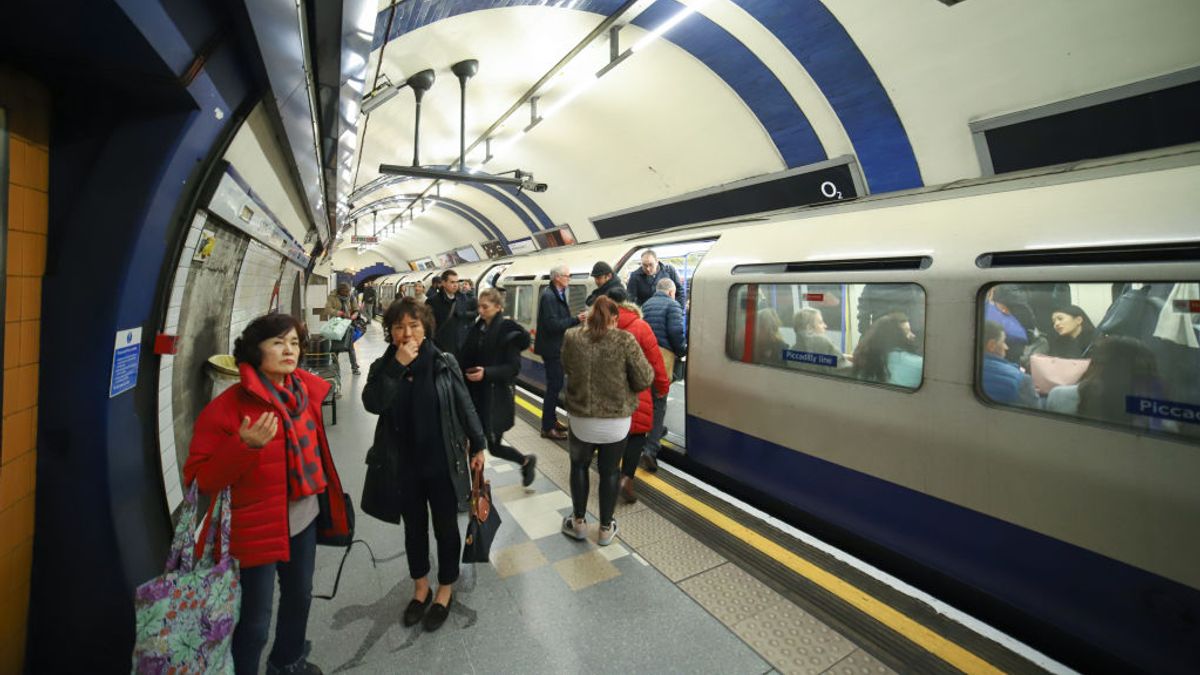
London is set for more travel chaos this week as the Underground is hit by two 24-hour Tube strikes.
The Rail, Maritime and Transport (RMT) union voted for walkouts back in February, with April seeing 48 hours of strikes. Further planned industrial action in March and May was called off.
If the dispute between Transport for London (TfL) and RMT is not resolved, the latest strikes will take place a day apart on Tuesday (June 2) from midnight to 11.59pm and on Thursday (June 4) between the same times.
The strike action would mean no service on the Circle and Piccadilly lines. There would also be no service between Baker Street and Aldgate on the Metropolitan line, or between White City and Liverpool Street on the Central line.
New UpdatesView PostView PostView PostView PostView PostToday06:16 BST
Some lines will be able to run but with delays during the strikes.
The Piccadilly line was able to run in April with severe delays.
The Victoria and Northern lines – the busiest on the Tube network – operated with minor delays during the walkout.
Most lines are expected to shut early due to staffing shortages caused by the strike.
Olivia BeesonToday05:53 BST
Previous industrial action by the London Underground drivers planned for May 19 and 21 was called off at the last minute by the RMT. The day before the strikes were due to start the RMT said, “at the 11th hour the employer has shifted its position allowing us to further explore our members concerns around the imposition of new rosters, fatigue and safety issues”.
It remains to be seen if a last minute cancellation of industrial action will be brought about this week, but when the last strike days were cancelled, TfL said they were “pleased” and added “We look forward to further discussions on the implementation of these proposals with all of our trade unions.”

Strikes are set to cost the London economy up to £760m(Image: ZUMAPRESS.com / Avalon)
TfL are aiming to find a way to minimise disruption.
Claire Mann, Transport for London’s chief operating officer, said: “We still believe that the points they have raised can be worked out in time, through more detailed discussions and we are continuing to talk to the union’s representatives to find a way to avoid disruption to London.”

Tube strikes also took place last year (file)(Image: Peter Fleming via Getty Images)
Meanwhile, Transport for London has warned passengers to double check their trips before they travel if the strikes go ahead. TfL spokespeople warned that Tube services will be disrupted before, during, and after the strikes.
The industrial action is in response to issues including a new four-day week which the union has said its members do not agree with. The drivers’ union Aslef, however, has accepted the new arrangements.
Rachel Vickers-PriceToday05:08 BST
Talks will be held on Monday in a last-ditch bid to avert two 24-hour strikes by London Underground drivers in a dispute over the working week.Members of the Rail, Maritime and Transport union (RMT) are planning to walk out on Tuesday and again on Thursday, threatening huge disruption to travel in the capital.Acas – or the Advisory, Conciliation and Arbitration Service – will take up the role of an impartial mediator to arbitrate Monday’s talks.
Rachel Vickers-PriceToday04:12 BST
Claire Mann, TfL’s chief operating officer, said she was “disappointed” with the strike action.
She said: “The completely voluntary four-day week has been designed to improve work-life balance and any of our Tube drivers who do not wish to take up the new proposed way of working and associated changes to working arrangements can remain on a five-day working pattern.
“A significant number of drivers have indicated that they want us to progress plans for the pilot of this new working pattern on the Bakerloo line, bringing benefits both for our colleagues and our customers.”
Olivia BeesonToday02:48 BST
The RMT have said that their members have been left with no choice but to ‘proceed with strike action’.
The RMT union criticised TfL and the changes in a fresh statement ahead of the strikes: “TfL’s continued refusal to engage meaningfully with the union’s concerns over the proposed compressed four-day working arrangements”.
It added: “Our members have raised serious concerns around fatigue, longer shifts, reduced flexibility and the impact these proposals could have in a safety-critical role.
“RMT remains available for meaningful talks, but London Underground cannot push ahead with changes to drivers’ working conditions while refusing to properly address legitimate safety and workplace concerns.”
Olivia BeesonToday00:26 BST
TfL have warned that services not impacted by strike action are likely to be busier than normal.
A spokesperson said: “Some disruption is expected during the early mornings of Wednesday 3 and Friday 5 June as we return our services to normal.
“During these strikes other TfL services such as buses, Elizabeth line, DLR, London Overground and Trams will be running as normal but are expected to be busy.”
Olivia Beeson31st May22:55 BST
Tube drivers represented by the Rail, Maritime and Transport (RMT) union are set to take strike action on the Tube network next week on Tuesday (June 2) and Thursday (June 4).
Unlike previous walkouts, which have run over a four-day period, services on Wednesday (June 3) and Friday (June 5) are expected to run as normal.
Eliana Nunes31st May22:14 BST
ASLEF – another trade union representing Tube drivers – has agreed to the voluntary four-day working week, saying it gives drivers an extra 35 days off a year “in return for some fairly minor changes to working conditions”.
“It will be the first strike in the history of the trade union movement designed to stop people having a shorter working week and more time off,” an ASLEF spokesperson said.
ASLEF represents just over half of London’s Tube drivers.
Eliana Nunes31st May21:13 BST
Two 24-hour walkouts are set to take place on Tuesday and Thursday, each starting at midnight and running until the end of the day.
During the strike action, no service is expected on the Circle line, the Piccadilly line, the Metropolitan line between Baker Street and Aldgate, and the Central line between White City and Liverpool Street.
Transport for London (TfL) expects services on other Tube lines to run on both days but warns that:
- Journeys will be disrupted
- Service levels will vary across the network
- Services will start later and finish earlier
- There will be limited services before 6.30am on both days
- Customers should complete their journeys before 9pm
Eliana Nunes31st May20:37 BST
Last month, two 24-hour walkouts took place, affecting services from April 21 (Tuesday) until April 24 (Friday).
As Transport for London (TfL) had warned, the strikes caused significant disruption across the capital, with Tube ridership falling by almost 50 per cent on April 22 compared with usual levels.

Impact of previous strikes on ridership(Image: Transport for London)
Londoners have voiced frustration in response to Transport for London’s latest post on X warning of the upcoming strike action.
One user wrote: “Thousands of students use the London Underground to get to school, including myself. Many of those thousands have GCSE and A-level exams next week; this needs to stop now.”
Another said: “Just automate the trains at this point.”
Eliana Nunes31st May19:19 BST
As a reminder, Tube strikes are planned on the following dates:
- Tuesday (June 2) from 12.01am to 11.59pm
- Thursday (June 4) from 12.01am to 11.59pm
During the strike action, no service is expected on the Circle line, the Piccadilly line, the Metropolitan line between Baker Street and Aldgate, and the Central line between White City and Liverpool Street.
While services on other Tube lines are expected to run on both days, disruption is likely.
There will be limited services on all Tube lines before 6.30am on both days.
Eliana Nunes31st May18:47 BST
The Elizabeth line – which is not part of the London Underground network – will run as normal but is expected to be much busier than usual as passengers seek alternative routes.

The Elizabeth line will run as normal throughout the week(Image: PA)
Some commuters may opt for a “Boris bike” – officially known as Santander Cycles – or a Lime bike to avoid delays and beat some of the road traffic.
You can find more information on how to rent a Boris bike on the Transport for London website, and how to rent a Lime bike on the Lime website.
If you choose to cycle into the city, it’s worth revisiting how to cycle safely in London, as well as the key Highway Code rules for cyclists.
Eliana Nunes31st May17:21 BST
The Elizabeth line, DLR, London Overground, buses and trams will be running as normal on days of strike action, although they are expected to be busier than usual.
Eliana Nunes31st May17:06 BST
Transport for London (TfL) has advised Tube passengers to check before they travel and plan ahead using the following travel tools:
- The TfL Go live Tube map app
- Journey Planner, which helps plan routes by public transport, cycling or walking
- Status updates for Tube, rail and trams
- Status updates for buses and traffic
- The Nearby function, which shows nearby Tube, bus, rail and Santander Cycles locations on a map
Eliana Nunes31st May16:39 BST
Strikes hit the bottom line across a wide range of industries, and it is these ripple effects that make industrial action by the RMT such an effective bargaining tool in securing conditions for its members.
The Centre for Economics and Business Research (CEBR) estimated in April that two 24-hour strikes that month cost the economy directly between £130m and £250m in lost working days – both from RMT members themselves and commuters unable to get to work across the city.
However, it said that due to the increased popularity of cycling schemes and remote working, the direct cost of lost work days is higher than it would have been a few years ago.
But the cost is not limited to working days. Sectors such as hospitality and retail take a major hit when there is a Tube strike, particularly businesses in central London, which see a sharp drop in footfall and “less consumer spending”, the CEBR says.
Ahead of the April strike days, pubs and restaurants were braced for nearly a 40 per cent drop in sales, while cafés and coffee shops were expected to lose 34 per cent, according to trade body UKHospitality, which put the overall figure at around £600 million.
Emma Mackenzie31st May16:05 BST
The graph belows shows how next week’s strike action is expected to affect Tube services.
The red symbol indicates services will finish early or start late, while the orange symbol indicates disruption to journeys.

A graph shows how strike action will affect Tube services(Image: Transport for London)
The industrial action, called by the Rail, Maritime and Transport (RMT) union, relates to a dispute over plans to introduce a voluntary four-day working week, which would condense Tube drivers’ weekly hours.
The RMT union has called the plan “fake” and said it raises “serious concerns from our members about shift length and resulting fatigue impacting safety”.
RMT General Secretary Eddie Dempsey said union members have “approached negotiations with Transport for London (TfL) in good faith” but “TfL seem unwilling to make any concessions”.
Claire Mann, TfL’s chief operating officer, defended the proposal, saying it would give drivers an extra day off and bring the Underground “in line with the working patterns of other train operating companies”.
“The changes would be voluntary,” she said. “There would be no reduction in contractual hours and those who wish to continue a five-day working week pattern would be able to do so.”
Eliana Nunes31st May15:21 BST
It comes after plans for Tube drivers to strike in May were called off by the Rail, Maritime and Transport (RMT) union.
A spokesperson for the union said at the time: “At the 11th hour the employer has shifted its position allowing us to further explore our members concerns around the imposition of new rosters, fatigue and safety issues. The dispute is not over and more strike action will follow if we fail to make sufficient progress.”
Eliana Nunes31st May14:37 BST
No services would be expected on two lines if the industrial action goes ahead, with sections of two others also affected – and while other lines will be operating, severe disruption should be anticipated across the entire TfL network.
TfL have advised commuters to complete their journeys across the capital before 9pm on both strike days, warning that in the early morning – before 6.30am – there will be a limited service “because services will start late and finish early”. They have also cautioned that the number of trains in operation will vary across the network.
The affects, in full, would be:
- No service on Circle line
- No service on Piccadilly line
- No service between Baker Street and Aldgate on Metropolitan line
- No service between White City and Liverpool Street on the Central line
- Reduced services on Bakerloo line, Jubilee line, Northern line, District line, Hammersmith & City line, Victoria line, Waterloo & City line
Christopher Mallett31st May14:37 BST
The strikes will take place a day apart and last a full 24 hours each, with disruption expected the following mornings as the services start to resume.
Here is when the strikes will take place:
- Tuesday June 2 (midnight to 11.59pm)
- Thursday June 4 (midnight to 11.59pm)

There would be no service on the Central Line if the strikes go ahead(Image: AFP via Getty Images)