


US ‘more than capable’ of resuming war against Iran, Pete Hegseth says
Pentagon chief also tells Singapore defence summit of ‘alarm’ at China’s military buildup but says US does not seek ‘needless confrontation’
The US warned on Saturday it was “more than capable” of resuming war with Iran after President Donald Trump said any peace deal must adhere to his red lines, including Tehran never being able to develop nuclear weapons.
The White House had signalled Trump was close to a decision on an initial deal on Friday after weeks of mixed signals in tenuous negotiations, though Tehran denied there was a final agreement on ending the Middle East conflict that has jolted the global economy.
Trump emerged from the White House situation room after spending more than two hours with senior aides but did not immediately announce his decision.
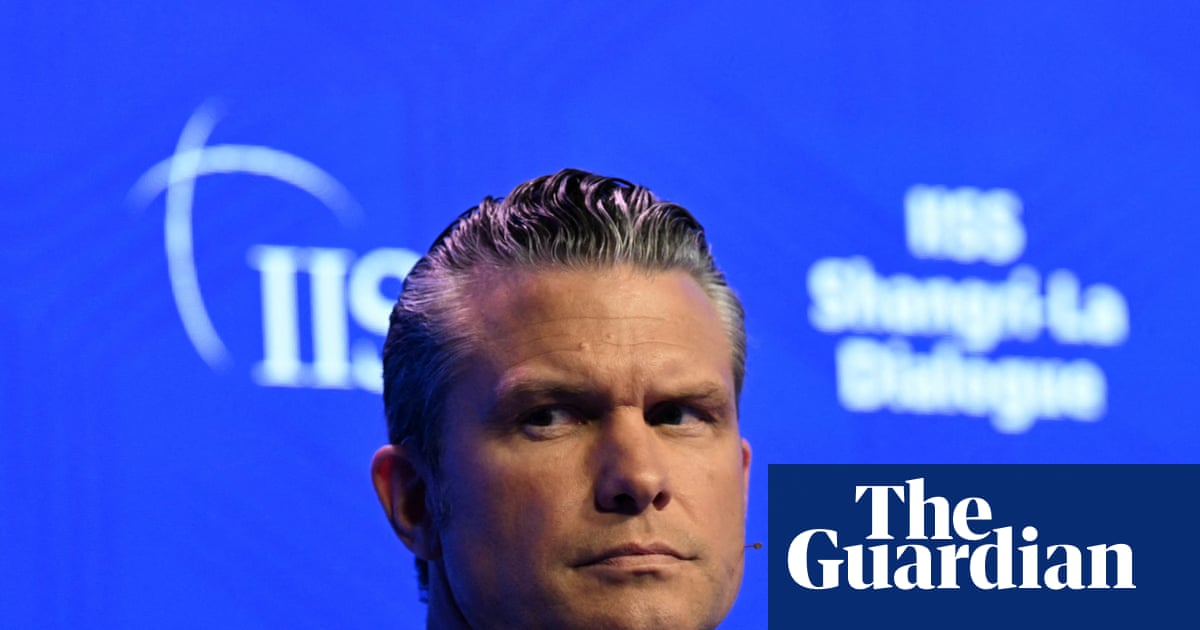
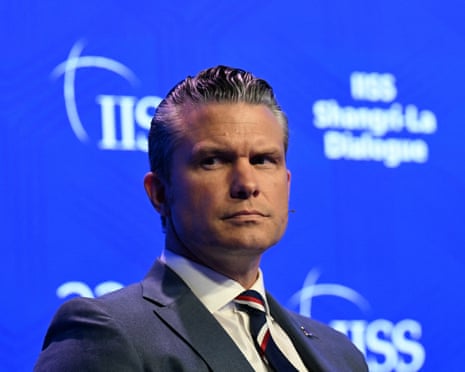
Meanwhile the Pentagon chief Pete Hegseth, while attending a major Asia defence summit in Singapore, said on Saturday local time that Washington could restart the war if it wanted.
“Our ability to recommence if necessary is (that) we are more than capable, our stockpiles are more than suited for that, both there and around the globe because of how we balance exquisite and more plentiful munitions,” he said.
That echoed the US Central Command, which posted on X that American forces “remain present and vigilant across the region”.
The efforts to strike a deal mediated by Pakistan were thrown into question this week by US strikes on the southern Iranian port of Bandar Abbas, countered by retaliatory fire from Iran.
Nevertheless diplomacy continued including in a parallel process to stop fighting in Lebanon – which Iran has insisted be included in any formal end to the war and where the Israeli prime minister, Benjamin Netanyahu, announced Israeli forces had advanced further even as military delegations from both nations met at the Pentagon in Washington.
Two weeks after Trump’s meeting with Chinese leader Xi Jinping in Beijing, Hegseth also said there was “rightful alarm” about Beijing’s military buildup, but the US sought a “respectful” regional balance.
His headline speech at the Shangri-La Dialogue defence summit, which brings together top defence officials and experts from about 45 countries, contrasted with his strongly confrontational remarks on China at last year’s event.
Unlike Beijing, which has sent a panel of military experts and scholars instead of defence minister Dong Jun for the second year running, Hegseth is leading a bumper US delegation to the event that provides chances for both open debate and behind-closed-doors diplomacy.
“When we look across the region today, there is rightful alarm regarding China’s historic military buildup and the expansion of its military activities in the region and beyond,” Hegseth said.
Washington does not seek “needless confrontation in the region,” he said, but rather “a genuinely stable equilibrium [in Asia] that works for Americans as well as our allies”.
That means “a favourable but durable balance of power in which no state, including China, can impose its hegemony and hold the security or prosperity of our nation and our allies in question”, he added.
He said the US sought “respectful” and “good-faith” engagement with Beijing, adding: “I wish my counterpart was here at this conference, but I look forward to other options when we can cross paths.”
In Beijing, Trump had talked up “fantastic” trade deals but provided few details and later suggested that Washington could use its arms sales to self-ruled Taiwan as a bargaining chip with Beijing.
There had been “no change” in Washington’s stance towards Taiwan, but “any decision about future Taiwan arms sales … will rest with” the US president, Hegseth said.
Analysts have said Dong’s no-show reflects Beijing’s confidence as an established power with little inclination to answer publicly for its assertive moves in the region.
But some argue that China is also running the risk of having no senior policymaker present if two major security issues arise: reopening the strait of Hormuz, and Beijing’s claim to Taiwan.