



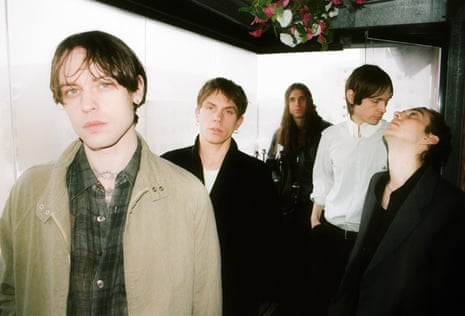
Iceage: For Love of Grace & the Hereafter review – Danish punks ace sixth stellar album on the trot
(Mexican Summer)
The quintet add shoegaze, country and 50s rock’n’roll to their core indie-punk sound, resulting in songs that offset lyrical bleakness with gleeful, uplifting music
Iceage have always seemed like a band in a state of constant development. You might say that’s understandable, given the Danish musicians were in their teens when their debut album New Brigade was released in 2011: if you don’t change between the age of 18 and your early 30s, you’re probably in trouble. But rock music isn’t real life, and a less adventurous band might have been minded to stick with a good thing, given the reception New Brigade was afforded. Twenty-four minutes of hardcore blended with noisy Birthday Party-esque post-punk and a sizeable pinch of gothic gloom, it was praised so vociferously that the praise itself provoked heated debate, as claims any one band are the “saviours” of an entire genre are wont to do, particularly when said genre is punk.

Iceage seemed entirely unbothered about any ensuing weight of expectation. If they didn’t exactly sound like a completely different band on 2014’s Plowing Into the Field of Love, they were still doing things you would never have imagined the authors of New Brigade doing: piano ballads, country-rock and, on Abundant Living, attempting to join the dots between Howlin’ Wolf’s Smokestack Lightning and the ramshackle sound of frontman Elias Rønnenfelt’s favourites the Pogues. In 2018, Beyondless offered Dexys-style horns, New Orleans jazz and a track that sounded like mid-80s U2 equipped with a string section. By 2021’s Seek Shelter, they had a gospel choir on board and mixed anthemic songs – imagine Oasis mired in angst, gloom and distortion – with tracks that interpolated the Carter Family’s Can the Circle Be Unbroken? or bore the influence of French chanson.
Their sixth album, For Love of Grace & the Hereafter, is billed as a return to punky first principles. “We wanted to try to shed any unnecessary weight,” Rønnenfelt has said, describing its contents as “immediate, urgent, raw and fast”. It’s certainly less epic than its predecessor – but the barely contained chaos that Iceage once dealt in is conspicuously absent.
Instead, the new album feels powerful, but streamlined in every sense, and the songwriting is extraordinarily tight and punchily melodic throughout. For all the ragged energy of the guitars and the full-bore punk assault of opener Ember, there’s an ease and deftness with which the band navigate tempo changes and dynamic shifts mid-song on Match Head Girl or No Fear.There’s a distinct hint of 50s rock’n’roll that hangs around The Weak, baggy-era British alt-rock is audible on Star, and True Blue impressively melds county-rock with shoegaze’s pitch-bent guitars – but these musical approaches are corralled into an articulate, cohesive album that flows rather than heaves between different styles.
The songs have a sparkle to them: a curiously effective backing for Rønnenfelt’s lyrics, which still tend to the pugilistic, visceral and bleak, and make love sound like mortal combat. “I’m a bee and I’m jammed by my stinger in you / It is home, it is death,” he sings on Holy Water – great inspo for next year’s Valentine’s Day card – and elsewhere he offers encouragement that might make the recipient wish he hadn’t bothered. “You’ll be a good mother,” he soothes on Mother-of-Pearl, after enumerating the grim circumstances in which said pregnancy is taking place, including a heroin-using jailbird father and a “shithouse” home shared with other addicts.
It should be heavy going, but it never is, because the actual music is so gleeful. Mother-of-Pearl leavens its lyrical misery with an iridescent chorus and a freewheeling backing that evokes a sunlit version of Iggy Pop’s Lust for Life; Holy Water blazes breathlessly along on a simple, addictive riff that sounds like it’s being played on twin guitars and a toy piano. The appearance of the latter instrument points to a intriguing streak of humour that runs intermittently through the sound. In lieu of a guitar solo, The Weak throws up a burst of squeaking atonal recorder-playing, the racket that might ensue when a teacher temporarily leaves a primary school music class unattended; 1835 proceeds with a breezy rhythmic swing that lends a peculiar, shrugging cast to Rønnenfelt’s thoughts on the meaningless transience of life.
The result is the sixth fantastic Iceage album: a hugely impressive streak. It leaves you thinking that while the band’s constant development and diversity is striking, their consistency is more striking still. Being very good at what you do is one thing; being very good at what you do, when what you do keeps changing, is another thing entirely. And that’s what Iceage are: long may they stay in a state of flux.
This week Alexis listened to
Dames Brown and Amp Fiddler – As I Am (Moodymann remix)
The original version is fine, funky old school soul, but Moodymann’s remix transforms the Detroit vocal trio into purveyors of raw, bumping, psychedelic house music.