


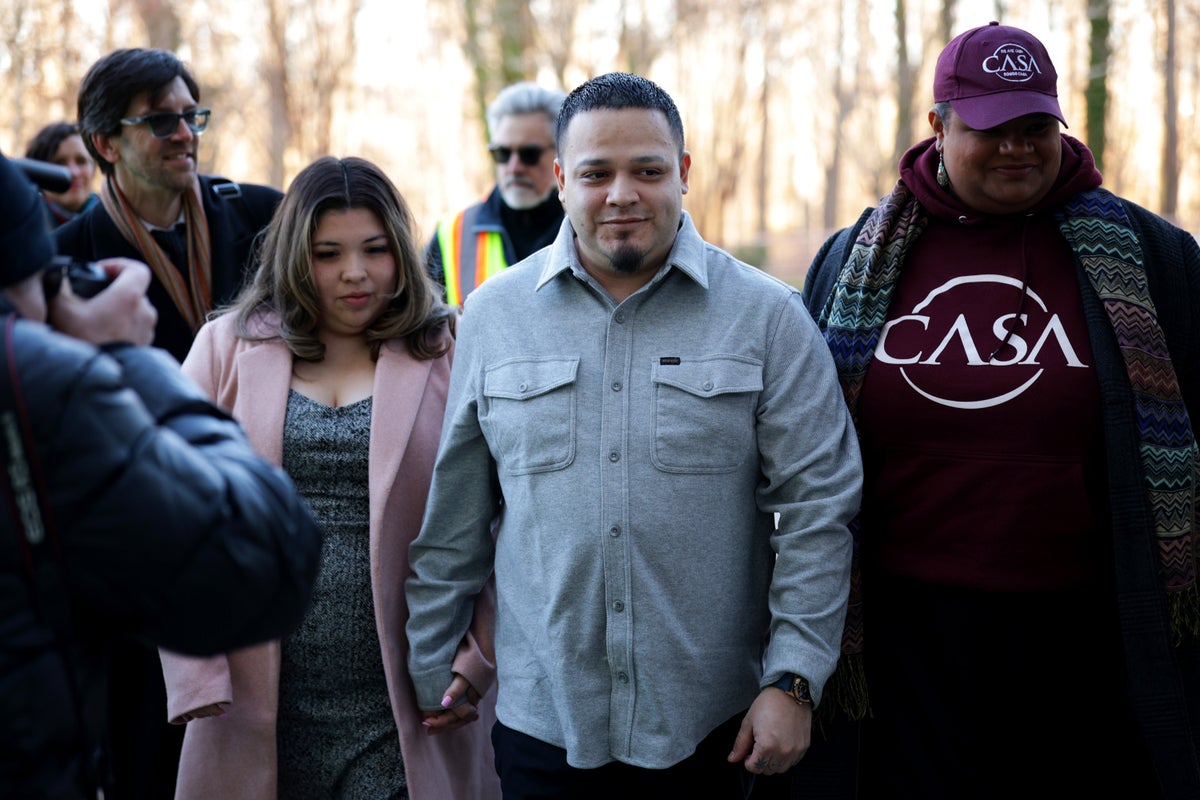
A federal judge has dismissed a criminal case against wrongly deported Salvadoran immigrant Kilmar Abrego Garcia, who accused Donald Trump’s administration of unlawfully targeting him as part of a smear campaign.
Last year, he was abruptly deported to a brutal Salvadoran prison where he says he endured torture and “severe” abuse for several weeks before he was transferred to a separate jail. Government officials admitted in court that his removal was due to an “error,” and several federal judges and a unanimous Supreme Court ordered the administration to “facilitate” his return.
The government spent weeks battling court orders to bring him back while White House officials launched a barrage of public attacks against him and declared that he would never again step foot in the country.
He was returned to the U.S. last June — only to face allegations that he illegally moved other immigrants across the country. He pleaded not guilty.
“Objective evidence” has shown that federal prosecutors only brought charges against Abrego Garcia after he won his lawsuit challenging his arrest and removal, according to Friday’s order from District Judge Waverly Crenshaw in Tennessee.
 open image in gallery
A decision to re-open a previously closed investigation against Abrego Garcia — coupled with public statements from administration officials including Acting Attorney General Todd Blanche that tied the case to Abrego Garcia’s lawsuit — “taints the investigation with a vindictive motive,” Crenshaw wrote.
That “vindictive taint” continued as prosecutors worked on the case leading to last year’s indictment, including as the White House “found a way” to bring him back from El Salvador to comply with court orders to return him to the U.S., the judge wrote.
Crenshaw found “insufficient evidence of actual vindictiveness” but said the government “has failed to rebut the presumption of vindictiveness.”
“Because the presumption of vindictiveness remains unrebutted, the indictment must be dismissed,” Crenshaw wrote.
In August, lawyers for Abrego Garcia filed a motion to throw out the case on “vindictive and selective prosecution” grounds, arguing that he was “singled out” by the administration for “having the audacity to fight back, rather than accept a brutal injustice” after he was wrongfully deported to the Salvadoran prison.
Prosecutors cannot abuse the law to “punish someone for exercising his constitutional rights,” lawyers wrote in court filings. “Yet that is exactly what has happened here.”
Two months later, Crenshaw determined that administration officials who celebrated his arrest may be enough “direct evidence” to throw out the case against him for “vindictive” prosecution.
 open image in gallery
The case against Abrego Garcia has been a lightning rod in the Trump administration’s mass deportation efforts.
Abrego Garcia has an American wife and child and has lived in Maryland for years after fleeing gang violence in El Salvador and entering the U.S. illegally as a teenager. An immigration judge blocked the government from deporting him to his home country in 2019.
But a series of court rulings against his deportation to CECOT, and a legal saga in which government attorneys admitted to the mistake, have infuriated the White House and top administration officials.
A gag order blocks officials from making “any extrajudicial statements” that could compromise a fair trial against him, but that hasn’t stopped top officials including FBI Director Kash Patel from falsely labeling him a convicted criminal.
Top officials at the Justice Department — including Todd Blanche — personally oversaw the decision to criminally charge Abrego Garcia, according to court documents. Blanche’s then-Associate Deputy Attorney General Aakash Singh played a “leading role in the government’s decision to prosecute,” according to Abrego Garcia’s lawyers, citing an order from Judge Crenshaw last year.
 open image in gallery
A two-count indictment accused him of participating in a years-long conspiracy to illegally move undocumented immigrants from Texas to other parts of the country. He faced one count of conspiracy to transport aliens and one count of unlawful transportation of undocumented aliens.
In their request to keep him in jail before trial, federal prosecutors also claimed he is a member of transnational gang MS-13, and “personally participated in violent crime, including murder,” despite not providing any evidence. They also claimed he “abused” women and trafficked children, firearms and narcotics, and there is also an ongoing investigation into “solicitation of child pornography.”
Abrego Garcia is not facing any charges on those allegations and judge determined that the government failed to link those allegations to evidence that implicates him.
While pursuing the criminal case against him, the Trump administration has been trying to deport Abrego Garcia, again, to at least five different countries, including four in Africa, before the criminal case had even reached a trial.
Last month, the administration announced it has “analyzed and eliminated all other options” from the table and “settled on a final country of removal”: Liberia.
Immigration and Customs Enforcement is currently blocked from deporting or detaining him, after a separate judge noted earlier this year that the government has made “one empty threat after another to remove him to countries in Africa with no real chance of success.”
His legal team has said he’s willing to deport himself to Costa Rica, which has agreed to take him. But in a memo earlier this year, ICE’s then-acting director Todd Lyons argued that sending him to the Central American country would be “prejudicial to the United States.”
The Independent has requested comment from the Justice Department and Abrego Garcia’s legal team.