


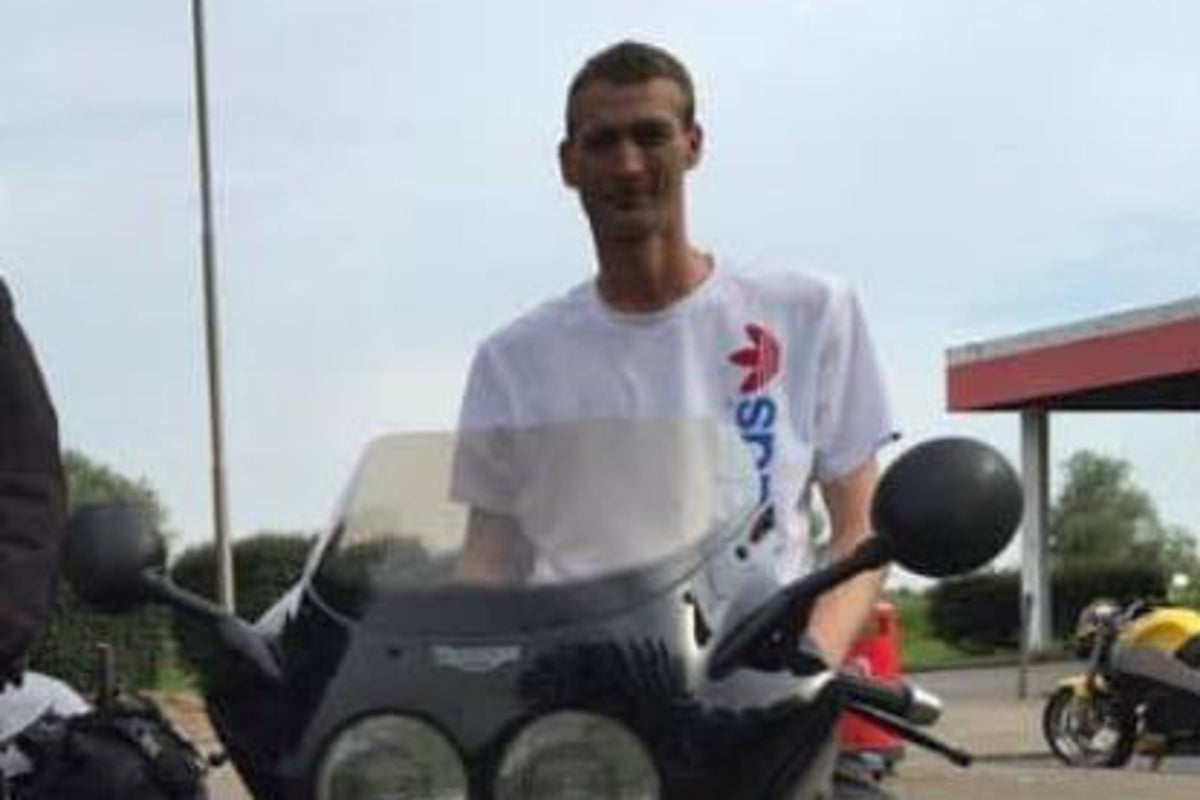
A “malingering” engineer who claimed he needs a mobility scooter and struggles to tie his shoelaces after crashing his motorbike has had his “dishonest” £5m compensation claim thrown out after a judge found he is an “unembarrassed liar.”
Grant Greening-Steer, 51, sued for £5m in compensation – including a specific £160,000 for someone to walk his dog each day – after suffering a serious accident on his bike in June 2019.
He fractured his spine when a car pulled out in front of his Yamaha motorbike near his home in New Milton, Hampshire, with the impact also causing a “moderate to severe traumatic brain injury”.
Last month, he sued the driver’s insurers for around £5m damages over his injuries, which he said have stopped him working, left him sometimes needing a mobility scooter and struggling “with laces and buttons”.
But lawyers for the driver and his insurers unveiled secretly shot surveillance footage, which they said showed Mr Greening-Steer walking normally and proves that he is in fact a “malingerer” and “deliberately lying” about his symptoms to claim millions.
At the High Court today, Mr Justice Ritchie dismissed Mr Greening-Steer’s claim after finding that he had been a “regular, detailed, unembarrassed liar, with the aim of gaining higher damages than he is honestly entitled to.”
Far from being unable to do day-to-day tasks and needing extensive help, he was capable of work, fixing and driving cars – and could walk his own dog.
 open image in gallery
He said Mr Greening-Steer’s claim was in fact worth about £378,420, a fraction of what he claimed, but that because he had been dishonest in exaggerating his disabilities, he would get nothing.
In his case, Mr Greening-Steer had complained of a range of ongoing disabilities, including problems standing up and “an altered gait with a dragging left leg, a plodding right leg and no arm swing”.
He claimed the need of a standard and off-road mobility scooter to help get around, as well as sometimes needing walking poles and a stick to help deal with his “limited walking range”.
In court documents, he recounted problems getting in and out of the bath, difficulties carrying things without spilling them and a generalised “debilitating fatigue”.
At the time of the accident, he was running a refrigerated trailer business, but the effect of his injuries ultimately made work impossible, he claimed.
Despite struggling to return to work, he “found he could no longer cope with it,” he claimed, maintaining that he is now unlikely to return to work.
His injuries also caused “reduced manual dexterity” and he “struggles with buttons and laces”.
“The principal challenges are physical disability, reduced balance, pain, fatigue, cognitive blunting, incontinence and emotional dysregulation,” he explained.
The total sum he claimed in damages included individual heads of claim such as over £1.8m for lifetime care and assistance, £116,176 for holidays and £160,655 to pay someone to walk his dog for an hour each day.
At the start of the case last month, Charles Woodhouse KC, for motorist Derek Ainge and his insurers, accepted the severity of the accident, which caused extensive physical damage on top of his spinal fracture, including a fracture to the lower back and injuries to his left shoulder and hip.
But he went on to say that the surveillance footage proves that Mr Greening-Steer has by now “made a reasonable functional recovery” and is exaggerating his symptoms.
He showed the court footage taken of Mr Greening-Steeer driving to a petrol station and filling up, claiming that when progressing to and from the car he “walked with a normal gait and with a normal arm swing”.
 open image in gallery
Soon afterwards, the engineer, who claimed difficulties with driving long distances, got back into his two-seater Aston Martin and headed off on the motorway, travelling for 55 miles before the pursuing investigators allegedly lost sight of him.
The court heard Mr Greening-Steer had submitted a damages bill totalling £4,924,418, although some of his needs have still to be quantified, but the defence KC argued this his claim was worth much less – and should be rejected entirely due to his lies.
“It is submitted that the surveillance evidence unequivocally contradicts Mr Greening-Steer’s account of his disability and its impact on his day-to-day activities and ability to work,” he added.
“His dishonesty has been present from the start of and throughout his claim.”
Neurosurgeons who examined the cooling engineer and assessed the surveillance video had concluded that it established exaggeration of his symptoms, said Mr Woodhouse, citing one medic who stated: “conscious exaggeration is clearly depicted…I am strongly of the view that he is malingering to enhance the value of his claim”.
The KC highlighted medical records suggesting he made a “reasonable recovery” during the first year after his accident, and was able to get back to part-time work, including driving a forklift truck, while still suffering “ongoing symptoms”.
In the witness box, Mr Greening-Steer accepted telling a medic who examined him in 2024 that “he couldn’t go out when it was windy for fear of being blown over” – explaining that he is vulnerable to the wind as he lives near a cliff top.
He also accepted telling the doctor he couldn’t walk more than 100 metres without experiencing exhaustion and a burning sensation in his leg.
“If I sit down for a long period of time, my left foot goes stiff and if I stand for a long time my leg will spasm,” he explained.
“I can walk a bit further now, maybe 150 metres. This was back then.”
Giving judgment today, Mr Justice Ritchie said the contents of the footage, combined with the way Mr Greening-Steer had behaved in the witness box, led him to conclude that he was a “malingerer.”
“He made an obvious effort not to use his left arm or hand at all in the witness box and on two occasions showed how very difficult it was for him to open his clenched left hand,” he said.
“It took over 10 seconds and the fingers never became straight.
“Comparing that behaviour with the normal and free use of his left hand in the surveillance videos was part of the evidence which convinced me of his malingering.
“Having compared his evidence to the documents and the medical experts’ reports I conclude that the claimant has been a regular, detailed, unembarrassed liar, with the aim of gaining higher damages than he is honestly entitled to.
“The main areas of untruth are: his mobility, his pain, his spasms, his strength, his ability to drive, his concentration, his memory, his fatigue, his urinary urgency, his ability to work, his sexual functioning, his smell and taste, his balance, his pain and his foot drop.
“I consider that the claimant knew very well from mid-2021 that he had recovered well. He knew that he was able to walk middle distances safely, with a normal gait, to drive manual vans up to at least 200 miles in one day, to drive very powerful sports cars, to do mechanical work on beach buggies and kit cars and to drive them, to go out in boats on the salt water, to carry out some medium effort manual work, including driving forklift trucks and box vans, and to do his domestic housework, cooking, shopping and administrative paperwork.
“I consider that, probably from mid-2021, he put on a disabled presentation which he knew to be worse than his actual physical disabilities and he claimed cognitive dysfunction at a grossly exaggerated level.
“I consider that the claimant had been involved, part time, in running his own business, using the works van, visiting clients and doing what he could to contribute.
“In my judgment, objectively, the claimant’s reports of disability and his disabled presentation to, and behaviour in front of, the medico-legal experts, his case manager and many of his treating experts and his reports to the DWP, have been untrue and he knew they were.
“His display to the court of his inability to open his left hand was one such dishonest display.
“I find that the claimant has a work capacity which has probably been near full time since mid 2021. He is only a little limited by fatigue, some minor weakness of the left leg and some low-level right leg pain.
“I find that the claimant’s left shoulder function is close to normal. His left arm has had minor neurological weakness but not enough to prevent normal activities of daily living including grasping, carrying, driving, lifting and pushing. He has no left foot drop.
“He can walk his dogs, mend and build kit cars, bend and carry moderate weights and drive manual shift vans and powerful sports cars.
“I consider that objectively the man on the Clapham omnibus and the woman on the Sheffield tram would consider that his grossly exaggerated presentation of his level of disability was dishonest, taking into account the facts which the claimant himself knew.
“In my judgment the claimant’s dishonesty was fundamental to the claim. It was not minor, collateral or peripheral. It hugely inflated the damages under each head of loss and created large dishonest heads of loss.
“It lasted for many years and affected both the claimant’s presentation of the claim and the defendant’s defence thereof.”
The judge said that, but for his dishonesty, Mr Greening-Steer would have been entitled to £378,420 damages for his genuine injuries, but because he had lied so blatantly he will get nothing.
He concluded: “It is disappointing to be driven to find that a man so seriously injured through the torts of another has been fundamentally dishonest about the sequellae arising from his injuries, with the intention of defrauding the defendant’s insurer.
“That conduct has deprived him of a substantial sum in damages to which he would otherwise have been entitled.”