


Football’s house of failure
September 8, 2026 12:12 am

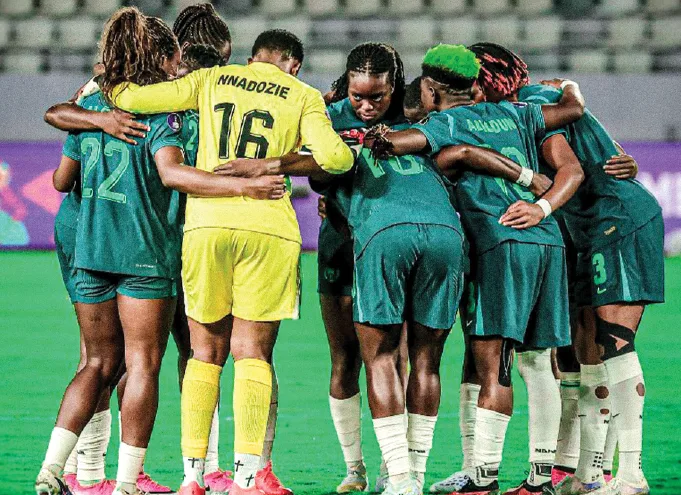
File Photo: Super Falcons
NIGERIAN football faces a sombre moment. For a country once regarded as a continental power, it should not be. The corrosive gloom deepened between July and August after the Super Falcons’ landmark failure to qualify for the 2027 FIFA Women’s World Cup Finals in Brazil.
Nigeria’s pride as the African women’s football lodestar was extinguished at the Women’s African Cup of Nations in August when the 10-time African champions were unceremoniously disgraced in the quarterfinals by Cameroon. The Falcons lost 1-0.
Just like the men’s team, the Super Eagles were sent packing by DR Congo in March during the playoffs (on penalties); South Africa’s Bayana Bayana eliminated the Falcons 2-1.
As expected, that set off a loud alarm bell: Nigeria’s football is on the ropes. Years of ineptitude and corruption have finally caught up with its administrators.
In this context, the Falcons’ no-show was a massive disaster. Since FIFA inaugurated the women’s World Cup at China ’91, the Nigerian ladies had always qualified. That was until the 2025 WAFCON in Morocco.
This regression instigated the immediate resignation of Justin Madugu, the head coach. In Morocco, the Falcons lacked a soul. They were dispiriting. Even the usually effervescent Ashisat Ozoala became evanescent. It was an all-round shocking display of mediocrity, highlighted by the 3-2 loss to debutants Malawi in the opening group game.
In turn, the Nigeria Football Federation board, led by Ibrahim Gusau, resigned en masse. Gusau’s board was grossly inept. So, it’s good riddance to bad rubbish.
Nigeria failed repeatedly in continental age-grade competitions. The Super Falconets, however, qualified for the FIFA U20 World Cup in Poland.
The mess dated back to the NFF board before Gusau. That board, led by Amaju Pinnick, witnessed Nigeria’s failed bid to qualify for the Qatar 2022 World Cup.
Nigeria refused to learn its lesson by installing Gusau. The disaster that followed was predictable. The Eagles, who had missed only one World Cup after their debut at USA ’94, went out limply in the 2026 World Cup qualifiers.
President Bola Tinubu lavishly rewarded the Falcons after they won an unprecedented 10th WAFCON (2024) title last year in Morocco. Each of the 24 players received $100,000. Each of the 11-member coaching crew got $50,000, a three-bedroom flat in the FCT and the OON national honour.
Ordinarily, this was meant to inspire confidence and performance. Curiously, it did not. The rot runs much deeper than just throwing money at it.
So, the recurring blights refused to go away: delayed bonuses, poor accommodation, quarrelling before critical matches, coaching incompetence and political interference pushed the national teams to their nadir.
Unfortunately, the Federal Government refuses to do things properly. The EFCC has kick-started a wave of investigations into the Gusau board, alleging that the erstwhile administrators mismanaged the N17 billion that was released to it.
The National Sports Commission, led by Shehu Dikko, is also muddying the waters. Members have already gone to Europe to meet with the embattled FIFA president, Gianni Infantino.
This is illogical and a waste of resources. It is absolutely unnecessary. It solves nothing. It is undue interference.
Nigeria cannot have its cake and eat it. When the Eagles flopped woefully in the 2010 South Africa World Cup, the then President Goodluck Jonathan suspended Nigerian football at the international level in apparent frustration. But it was a misguided decision that he was forced to reverse.
Sadly, the Tinubu administration is treading the same worn path.
Indeed, political interference remains the bane of football in Nigeria. Most heads of the defunct NFA and the NFF are not chosen because of competence; they are installed by power brokers and influence peddlers in government. This is wrong.
The argument is that the government must have a say because it funds football. This is moot. Football administration is an exact science. It is not governed by the whims or wishes of political leaders.
Nigeria is already repeating the mistake by mandating the inept NSC to shop for a new NFF board. It will fail.
Over time, the government has subtly imposed its candidates at the top level of football administration. The result has been predictable: football continues to head south.
Therefore, the field should be open to independent candidates who combine integrity, savviness, experience and technical depth to constitute the new board.
In jurisdictions where football is making progress, their governments match investments with competence driven by independent boards. Private sector entities reward such competence with sponsorships that benefit clubs and players, uplifting the game.
Failure has consequences in these countries. Sadly, Nigeria finds it difficult to hire reputable coaches. When it hires coaches, the NFF fails to pay them as and when due, provoking international odium toward the country.
In contrast, Morocco has invested billions of dollars in football in the past two decades. The Mohammed VI Football Academy, which has produced global stars like Achraf Hakimi, Youssef en-Nesyri, Hakim Ziyech, Sofyan Amrabat and Noussair Mazraoui, began with an initial investment of $65 million in 2010.
Eighteen years after Mohammed VI launched his dream to elevate football in the country, stars are still rolling off the production line.
To co-host the 2030 World Cup, Morocco pledged to invest $16 billion, including modernisation of its stadium infrastructure.
In contrast, the NSC received an allocation of N210 billion ($151.7 million) in Nigeria’s 2026 federal budget. That is peanuts.
The result? Morocco is the first African country to qualify for the World Cup semifinals (2022) and also the first African country to qualify for consecutive World Cup quarterfinals (2022 and 2026).
Unlike in the 1980s, the national teams currently lack a dedicated stadium to play international matches.
Therefore, Nigeria should modernise its football administration, invest in it and other sports and create an environment for substantial and sustained private sector investments.
All rights reserved. This material, and other digital content on this website, may not be reproduced, published, broadcast, rewritten or redistributed in whole or in part without prior express written permission from PUNCH.
Contact: [email protected]