


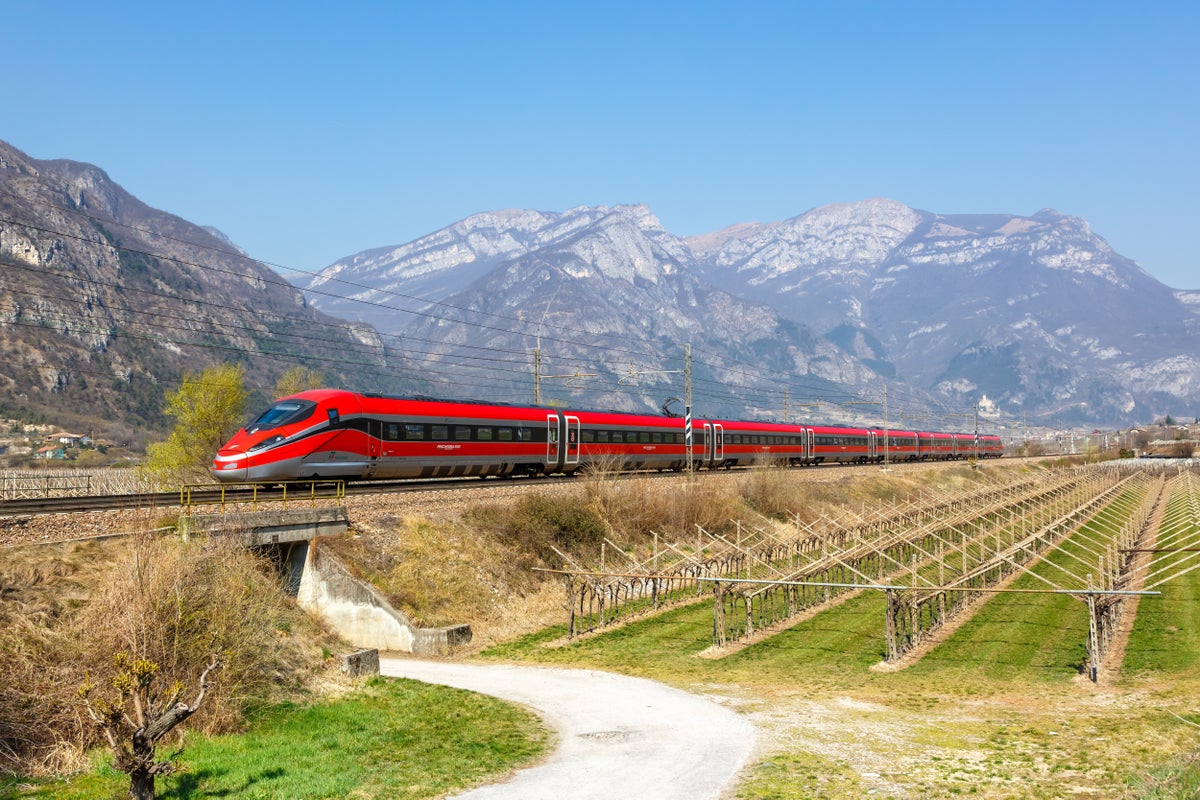
Trial runs of new high-speed trains connecting Italy, Germany and Austria have begun on European rail lines.
Italy’s state railway Ferrovie dello Stato (FS) has started tests on a rail route between Berlin and Munich, and Salzburg and Vienna, in partnership with with the German and Austrian national railways, Deutsche Bahn and ÖBB.
The Frecciarossa 1000, Trenitalia’s high-speed trains designed to run on rail networks across the continent, will operate the services between Germany and Austria.
Commercial trains are scheduled to launch ahead of summer 2027.
Initially, four connections will operate on the existing Milan to Munich and Rome to Munich lines.
Journeys between Milan and Munich will take around six and a half hours with stops in Brescia, Verona, Rovereto, Trento, Bolzano and Innsbruck.
With stops in Florence, Bologna, Verona, Rovereto, Trento, Bolzano and Innsbruck, the estimated journey between Rome and Munich will be eight and a half hours.
Trenitalia and Deutsche Bahn will collaborate on dedicated courses for drivers and the “sharing of technical expertise” in line with the new rail service.
Ten further connections are also planned to link routes through Milan, Rome and Munich to Naples and Berlin from December 2028.
According to the FS Group, the new service will “also meet demand for other European destinations, such as Frankfurt and Krakow”.
Gianpiero Strisciuglio, CEO and general manager of the FS Group, said: “The launch of test runs in Germany and Austria is a step towards the realisation of a project that confirms our ambition to make trains the benchmark for European mobility.
“Thanks to our collaboration with Deutsche Bahn and ÖBB, we are moving towards the creation of Europe’s high-speed metro, providing passengers with a service capable of bringing together regions, people, and economies.”
FS has also ordered 19 trains via its subsidiary Trenitalia France as part of a plan to disrupt Eurostar’s Channel Tunnel monopoly. The company has said it aims to run high-speed connections between Paris and London from 2029.
Read more: French train startup secures license to launch high-speed rail competitor