


Shettima demands accountability for food security interventions
August 29, 2026 5:51 pm

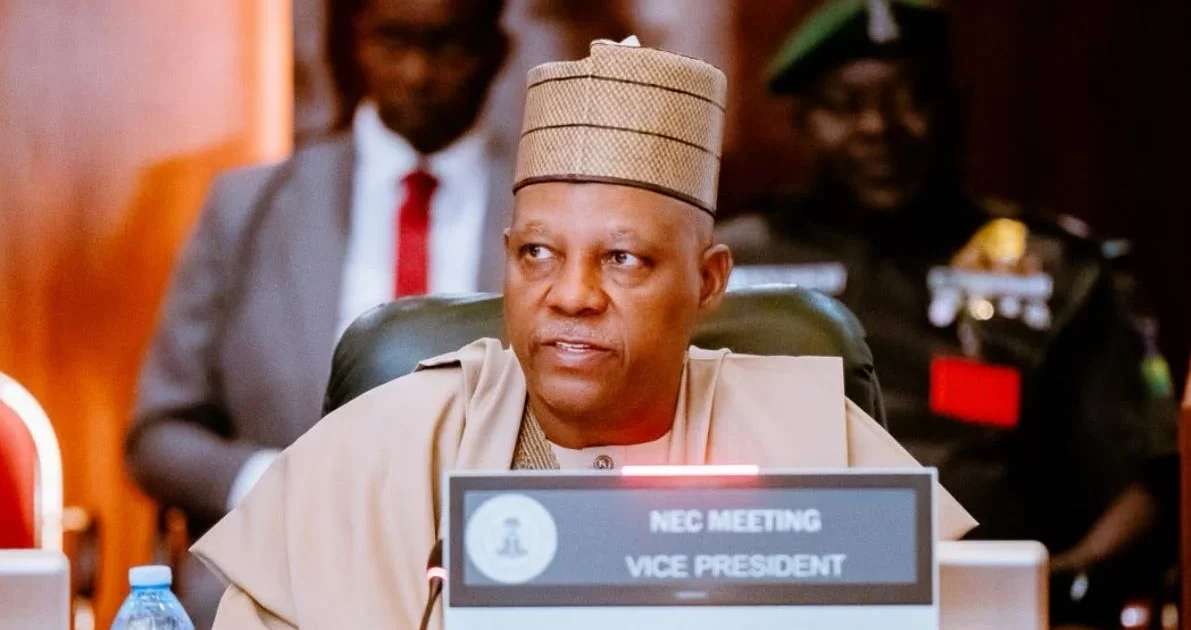
Vice President Kashim Shettima. Credit: Stanley Nkwocha/X
Vice President Kashim Shettima has demanded greater accountability in the Federal Government’s food security interventions, saying public resources must translate into tangible outcomes for farmers, markets and Nigerian households.
The Presidential Food Systems Coordinating Unit disclosed this in a statement issued on Saturday following the seventh meeting of its Steering Committee, chaired by Shettima at the State House, Abuja, on Friday.
The meeting brought together governors, federal ministers, private sector representatives and development partners to review Nigeria’s food systems outlook and coordinate action on domestic production and food availability.
According to the PFSCU, Shettima “called for stronger visibility and accountability across ongoing interventions,” with greater emphasis on ensuring that available resources deliver tangible outcomes.
The Vice President also called for increased domestic food production alongside measures to make food more affordable for Nigerians.
He stressed the importance of coordinated action among the Federal and state governments, the private sector and relevant institutions to translate President Bola Tinubu’s food security agenda into measurable results.
With the main harvest period approaching, the committee considered measures to support farmers and domestic production, improve the movement of food from producing areas to consumers and strengthen strategic reserves.
It also examined transportation, logistics, levies, market access and other distribution factors affecting the final cost of food.
The committee said improving the efficiency of food movement between producing and consuming areas was necessary to address pressures within the food supply chain.
The PFSCU Executive Secretary, Marion Moon, said the government would increasingly rely on evidence to determine where interventions were needed.
“Our focus is to ensure that the Government has the evidence to act early and precisely – supporting farmers, improving the movement of food, strengthening preparedness and directing interventions to where they can make the greatest difference,” Moon said.
Jigawa State Governor, Umar Namadi, called for farmers to remain at the centre of agricultural policies, highlighting irrigation, inputs, financing, production support and market access as priority areas.
He also advocated stronger Federal-State coordination to ensure national interventions respond to conditions confronting farmers at the state level.
The Minister of Finance and Coordinating Minister of the Economy stressed the need to align domestic production with trade policy.
According to the statement, the committee noted that trade measures could complement domestic production and address verified supply gaps but should be considered alongside strategic reserves, market conditions and the need to maintain incentives for Nigerian farmers and agribusinesses.
The committee also reviewed major food security initiatives, including the $500m Nigeria Sustainable Agricultural Value-Chains for Growth programme, known as AGROW.
The PFSCU said the programme had completed its design and coordination phase and had been transferred to the Federal Ministry of Agriculture and Food Security and participating states.
Other initiatives reviewed included the National Agribusiness Policy Mechanism, the development of the National Agro-Productivity System and the National Food and Nutrition Crisis Preparedness Framework, anchored in the Office of the National Security Adviser.
According to the unit, the initiatives are expected to improve the government’s ability to understand farmers’ production plans, monitor in-season output and anticipate emerging risks.
The PFSCU Steering Committee coordinates food system interventions involving the Federal, state and local governments, the private sector, security institutions and development partners.
The PUNCH earlier reported that food inflation rose to 20.31 per cent year-on-year in July from 17.52 per cent in June, while the month-on-month rate climbed to 5.56 per cent from 3.75 per cent.
Comercio Partners attributed the renewed food price pressure to agricultural supply constraints, logistics and distribution costs, seasonal factors and broader structural bottlenecks that cannot be resolved through monetary policy alone.
Solomon Odeniyi is a journalist at Punch Newspapers with over six years of professional experience. He has covered key national beats including the judiciary, military, and police, and currently reports on anti-corruption and related issues. Solomon’s work reflects a strong commitment to development-oriented reporting, public interest journalism, and accountability.
All rights reserved. This material, and other digital content on this website, may not be reproduced, published, broadcast, rewritten or redistributed in whole or in part without prior express written permission from PUNCH.
Contact: [email protected]