


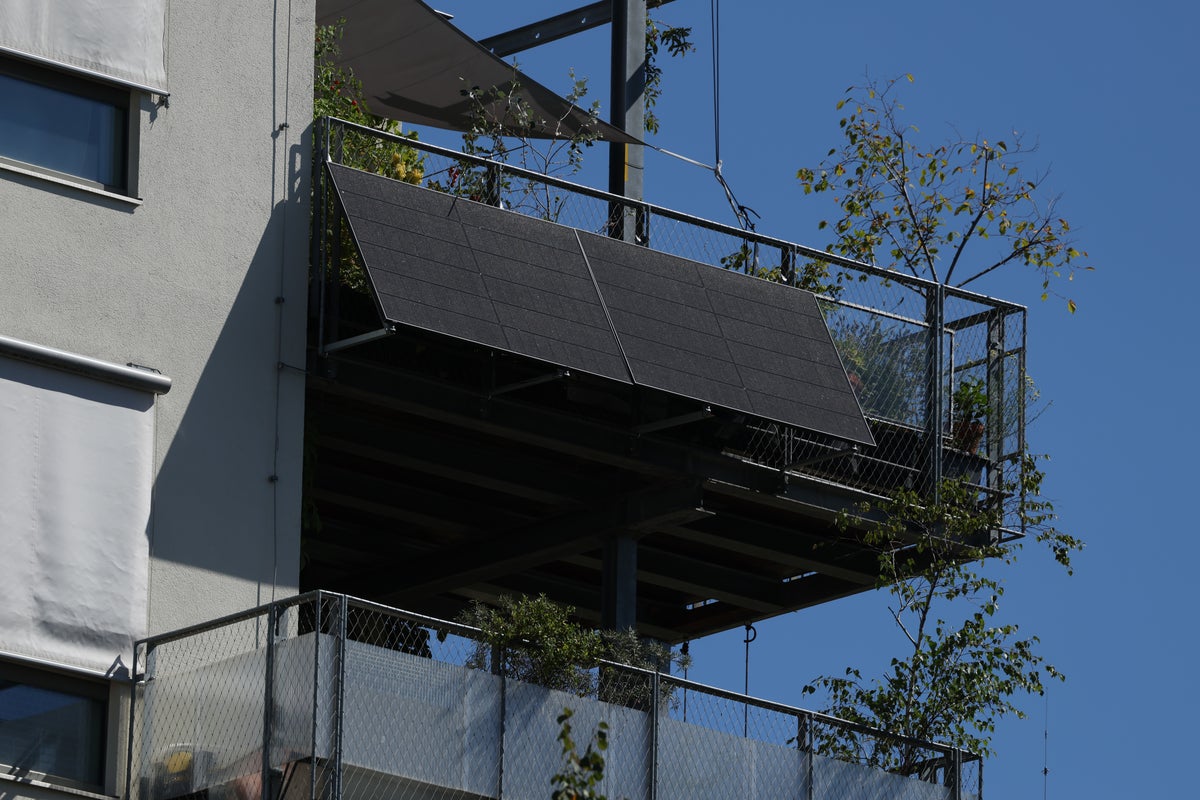
Plug-in solar panels are now legal in Great Britain, but anyone browsing the first systems to go on sale may have spotted what, on the surface, looks like a contradiction with the government’s new rules for compliance.
The new rules limit plug-in solar to 800W, yet Argos is already selling UKSOL kits labelled 890W, 1,030W and even 1,260W. So how can they be allowed under the new rules?
The answer is that those larger numbers describe the combined generating capacity of the solar panels, while the legal limit applies to the amount of power the system can feed into your home.
Under the government’s new plug-in solar specification, a compliant system can have a maximum apparent AC power output of 800VA – generally presented to consumers as an 800W limit. The plug-in panels have a microinverter built into the system that ensures it can’t supply more than this amount to your household circuit.
Read more: First look at plug-in solar panels
Get a free quote for solar panels for your home
Panels and inverters have different ratings
Solar panels generate direct current (DC) electricity, which passes through the system’s microinverter and is converted into alternating current (AC) electricity, which is used by the appliances in your home.
The plug-in solar panels and the inverter therefore have their own separate power ratings.
Take, for example, the £989 UKSOL Pro Max kit currently listed by Argos. It includes two 630W solar panels, giving it a total nominal panel capacity of 1,260W, but those panels feed into an 800W microinverter. No matter how much electricity the panels are capable of producing, the inverter still limits the AC output supplied to the house.
That means a system can legitimately contain more than 800W of solar panel capacity without exceeding the plug-in solar limit.
Read more: Plug-in vs installed solar panels
Why install 1,260W of panels if you can only use 800W?
Your next question is probably: What’s the point, then, of getting panels with more than 800W capacity? It’s a good question. It might sound wasteful, but solar panels rarely produce their headline output on a continuous basis.
A panel’s wattage is measured under standard laboratory test conditions. But in the real world, output varies according to factors such as the time of day, season, cloud cover, temperature, shading and the direction and angle of the panels.
Using a system that’s more than 800W of panel capacity can therefore help an 800W microinverter get closer to its maximum output for more of the day.
Argos, for example, says the oversized 1,260W panel capacity in its UKSOL kit is intended to maximise generation during poorer weather. On a cloudy morning, the panels might collectively produce considerably less than their theoretical maximum, meaning all of that electricity can still pass through the inverter.
When conditions are good enough for the panels to generate more power than the inverter can handle, the inverter simply caps its AC output at its maximum. This is sometimes known as “clipping”.
Read more: Are plug-in solar panels worth buying?
What does the 800W limit actually mean?
The important figure for shoppers is therefore not necessarily the number printed on the solar panels.
Britain’s new rules allow a compliant plug-in solar product with a maximum apparent power output of 800VA. The government specification defines a plug-in solar product as a complete system including at least one solar panel, a grid-following microinverter, a manufacturer-supplied lead and UK plug, and a mounting system.
So seeing a 1,030W or 1,260W plug-in solar kit doesn’t mean a manufacturer or retailer has found a loophole in the new 800W rules. It simply means the panels have been oversized relative to the inverter. What reaches your household electrical circuit is still capped at 800W.