


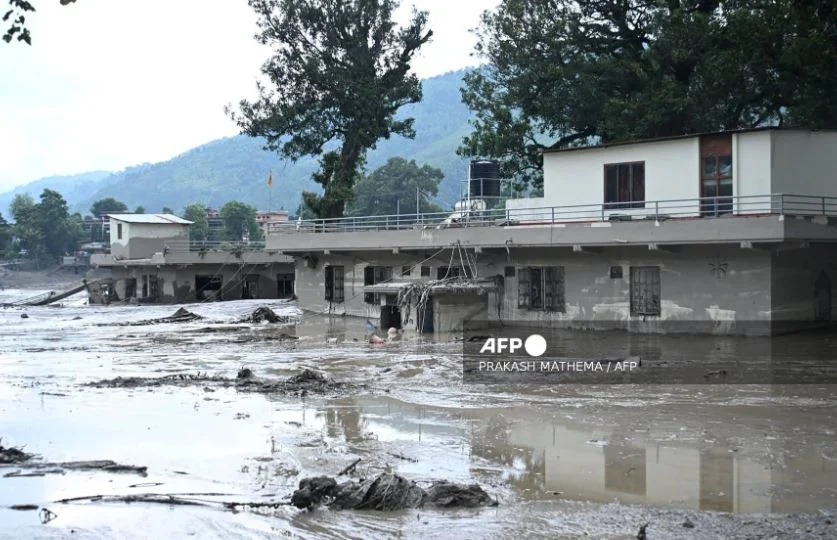
160 dead, 647 missing as floods devastate Nepal, Tibet
August 27, 2026 4:48 am

Credit: AFP
At least 647 people are missing and 160 have died after a catastrophic surge of floodwater, mud and debris swept through Himalayan valleys in Nepal and Tibet, leaving communities devastated on both sides of the China-Nepal border.
The combined figure of missing people comprises 391 reported missing in Nepal, including 291 foreigners and 265 in Tibet, according to Nepali authorities and Chinese state media respectively.
Nepal reported 157 deaths, while Chinese state media said three people had died in Tibet, bringing the reported death toll across the two sides to 160.
The disaster has triggered a large-scale search and rescue operation as authorities race to locate hundreds of people, including foreign tourists, pilgrims, border officials, security personnel and residents caught in the sudden flooding.
The disaster struck a region of profound religious significance, which was crowded with pilgrims and trekkers travelling towards sacred sites in the Himalayas.
The route through Rasuwa is used by pilgrims heading to Mount Kailash and Lake Manasarovar in Tibet, revered by Hindus, Buddhists and Jains, while local Nepali pilgrims were also trekking towards Gosaikunda Lake, a sacred Hindu and Buddhist site, for religious observances.
Many of those caught in the floods were therefore not simply tourists passing through the region but pilgrims undertaking journeys of worship, with hundreds of Kailash-bound travellers reportedly waiting to cross into Tibet when the disaster struck.
More than 100 Indian nationals were among those unaccounted for, alongside visitors from Britain, the United States, Australia, the Netherlands, Malaysia and South Africa.
In Tibet, the Chinese state news agency Xinhua reported 265 people missing after a mudslide struck the Gyirong border port, a key crossing between Tibet and Nepal.
Footage released by Chinese state media showed a torrent of water and mud surging through the port, overwhelming buildings, uprooting trees and cutting off roads.
The disaster also caused extensive damage in Nepal, with at least 19 vehicle bridges and about 40 kilometres of roads swept away.
Schools, hydropower installations and other infrastructure were also damaged as floodwaters tore through riverside settlements.
The scale and suddenness of the flooding initially left authorities struggling to establish what had triggered the disaster.
Nepal’s Foreign Minister, Shisir Khanal, said the government had received preliminary information that an avalanche had occurred in the affected region.
The United States Geological Survey initially detected ground movement equivalent to a 5.2-magnitude earthquake, but later determined that the seismic energy had been generated by a landslide.
Scientists investigating the disaster said their preliminary assessment indicated that an ice avalanche may have triggered the catastrophic flooding.
The apparent absence of heavy rainfall made the flooding particularly unexpected.
“There was no rain in Nepal, so we were not expecting anything like this,” said Narendra Pariyar, the chief district officer of Rasuw, according to a report by The New York Times.
The affected region is a major pilgrimage and trekking corridor, with thousands of visitors travelling through Nepal towards Mount Kailash in Tibet.
Among those missing are Indian pilgrims travelling towards the Tibetan border. The Isha Foundation said 77 people participating in its pilgrimage tours were at an immigration centre near the Nepal-Tibet border when the flooding occurred.
“There has been no official information on the whereabouts of any of the people who were at the immigration office,” the foundation’s leader, Sadhguru, said, adding that efforts were being made with authorities to locate them.
The Nepalese Army is leading rescue efforts, deploying 12 helicopters and establishing a temporary hospital in the affected area.
At least 114 people have been airlifted to safety, while 25 seriously injured people have been evacuated to Kathmandu for medical treatment.
The disaster has also exposed the vulnerability of Himalayan communities and infrastructure to sudden mountain hazards.
Although flash floods are commonly associated with intense rainfall, landslides and the sudden displacement of large volumes of water can generate similar surges. Scientists have increasingly raised concerns about the consequences of a warming climate for the Himalayan region, where accelerating glacier melt can contribute to dangerous flooding.
Nepal has suffered repeated deadly floods and landslides in recent years. Intense rainfall in 2024 killed hundreds and caused widespread destruction, including in and around Kathmandu.
The latest disaster, however, presents an immediate challenge of a different scale, with 647 people now officially reported missing across Nepal and Tibet and large sections of the affected transport network destroyed.
All rights reserved. This material, and other digital content on this website, may not be reproduced, published, broadcast, rewritten or redistributed in whole or in part without prior express written permission from PUNCH.
Contact: [email protected]