


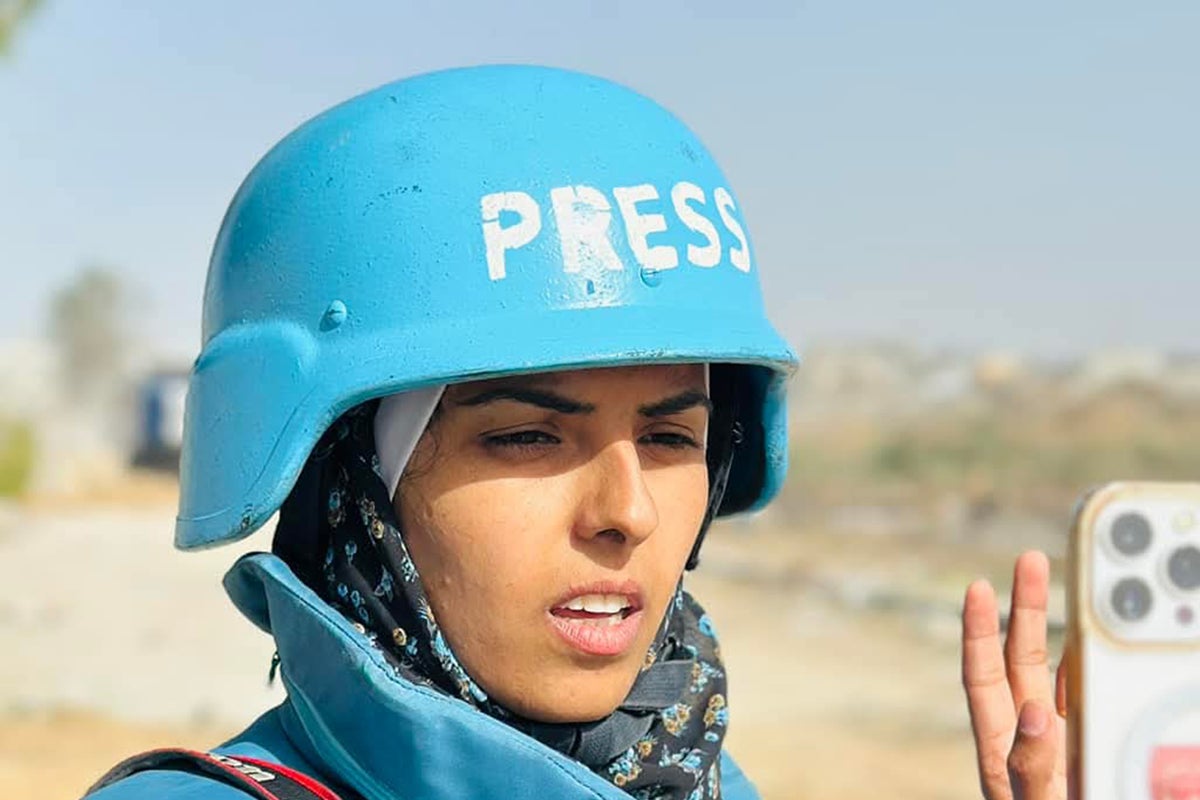
Is it now a year since Mariam Abu Dagga, a Palestinian journalist who worked for Independent Arabia and the Associated Press, was killed by the Israel Defence Forces (IDF) in, of all places, a hospital. That fact is not in doubt.
The story, recounted in moving and forensic detail by the Independent’s Chief International Correspondent Bel Trew, is desperately sad and one of grievous injustice.
Mariam was 33 when she, journalistic colleagues and medical staff were hit by successive rounds of Israeli tank fire, leading to the suspicion that this was a “double tap” attack.
She leaves behind her teenage son, who she sent to the UAE for safety as the conflict intensified.
When Mariam was trying to get the truth about the war in a Gaza out to the wider world, she was also coping with the loss of her mother, who in the middle of the bombings in 2024 died of cancer, in part due to a lack of treatment.
Mariam had donated a kidney to her ailing father. Like almost every family in Gaza, they experienced bereavements and suffered multiple forced relocations. She always knew her own life was in especial danger, and understood the risks.
Her will had already been drawn up, and she was only too well aware of the way the IDF dealt with Palestinian hospitals, and that the one where she was based, the Nasser Medical Centre, would be soon surrounded by IDF armour.
So Mariam Abu Dagga was a selfless person and a devoted journalist who put herself in peril in a way few in the trade could ever hope, or wish, to emulate. She never gave up. Now, neither will friends and colleagues in pursuit of the truth.
Unsurprisingly, she and her family have been denied justice. Even by the standards of this merciless conflict, her death appears at the very least an act of extreme negligence by the IDF, and at worst it may have been something far more sinister.
In any case, the usual conventions of war were violated, as so often has been the case, according to the numerous indictments filed at the International Court.
The Independent has shared all our detailed findings with the Israeli military, and asked for comments on each point. The military declined to respond adding only that “the review is still ongoing under the General Staff Fact-Finding and Assessment Mechanism.”
An independent international inquiry is needed before it is too late to get at the truth.
Mariam was not, by any means, the only brave journalist to lose their life or suffer injury during the Gaza war. At least five journalists were killed in the assault on the Nasser hospital a year ago, and the Committee to Project Journalists (CPJ) says Israel has killed over 200 Palestinian journalists since 2023.
This is more fatalities than any other government has been responsible for since the CPJ began collecting data in 1992. It compares badly with the approximately 230 lost over the entire span of the US-led Iraq war between 2003 and 2011, and the 63 who died during the 20-year quagmire of Vietnam.
It is therefore worth considering whether the extraordinarily mortality rate for journalists in this war is linked to the fact that they are overwhelmingly Palestinians.
The Israeli government often complains that it is held to a higher standard than others. Yet it is precisely because Israel purports to be a free democracy with a responsible military operating within the Geneva conventions that it needs to account for itself, and is under increasing pressure to do so.
It is also, foolishly, resisting this, just as it is refusing to end its aggression in the West Bank and Lebanon, and to support President Trump’s efforts to extricate America from the war in Iran.
The Israelis seem to want to fight on and on and on, and don’t seem overly concerned about their methods or the counter-productive results.
The events since the October 7 massacres by Hamas, which was the worst atrocity of its kind since the Holocaust, have not left the Israeli people more secure.
The conduct of the war in Gaza, as well as the present campaign to drive Palestinians off their land in the West Bank and the destruction of southern Lebanon, is leaving Israel friendless in the world.
It has set back the Abraham Accords process which offered some hope of stability in the region. The future of Palestine remains unsettled, no matter what Benjamin Netanyahu might boast. He has even exasperated the Trump administration.
One step forward, and it is inevitable, is for Israel to allow international journalists access to Gaza. They cannot be excluded forever. What happens there is of global concern.
It is a war zone, but the media has almost always been present in when the bombs are dropping and bullets are flying, and it is a matter for them and individual journalists as to the jeopardy they think is a acceptable.
The more the world sees of the way Israel tries and fails to use military means to resolve a political dispute the more it will leave Israel isolated – and vulnerable. That, presumably, is why the Israeli government resists transparency – and it is not out of some altruistic concern for reporters.
Exposing the truth and telling the story in an unbiased, independent way is one of the reasons why the media is so essential even – especially – on the field of conflict; and no journalist identified as such should be killed just for doing their job.
What happened to Mariam and the others was wrong, and those who did it need to face the consequences.