


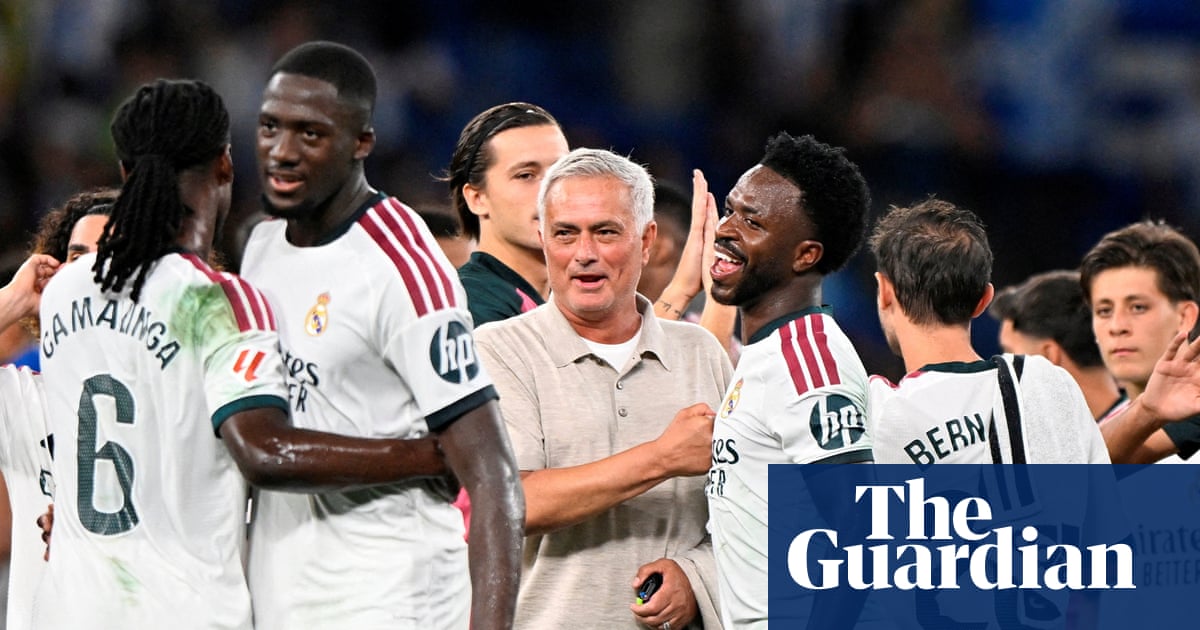
José Mourinho marks Real Madrid return with late drama and touch of humility
The old master is back at Madrid as he begins with celebrations, frustrations and finally relief at Espanyol
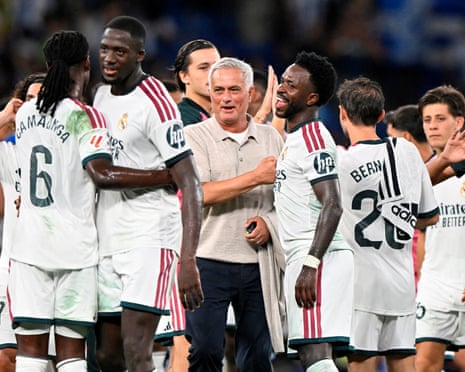
José Mourinho says he is calmer now so when the rest of the bench emptied, sprinting down the touchline to celebrate the 90th-minute goal that finally delivered victory on his first game in charge of Real Madrid in 4,380 days, he didn’t set off with them. Instead, he clenched his fists, got to his feet and walked down the touchline behind the subs, watching them head, shouting, towards Carlos Espí. As they piled on down in the corner, he pulled over his captain Fede Valverde for a word. Which might just have been: phew.
For all those stars; for all that Mourinho’s main task might just have been been to find a way to fit Kylian Mbappé, Vinícius Júnior and Jude Bellingham together; for all that he had introduced Yan Diomande, the most expensive player in the club’s history, it was a 21-year-old, unknown six months ago and unexpectedly signed from Levante, who got the goal that secured victory upon the coach’s second coming.
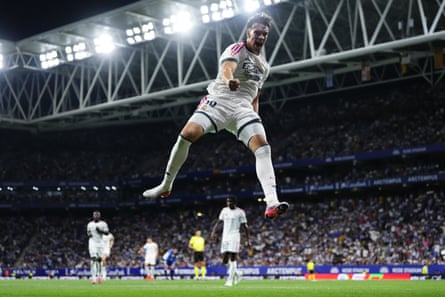
Espí, whose goals had rescued Levante from relegation last season and who is still living at Madrid’s Valdebebas training ground like his coach, the two of them sharing breakfast every morning, was signed for pretty much this: to be a different type of striker, an old-school No 9, with a presence in the area. And when a scrappy, broken-up move ended with Mbappé seeing the ball run away from him in the area, there he was to force it over the line. Perhaps even to pose a question: is his a profile they could do with and not just in reserve? This time, at least, it had worked.
Mourinho’s first game since a 4-2 win over Osasuna in May 2013 began with the photographers abandoning their places behind the goal to surround him on the bench, no doubt what the attraction was; it ended with him hugging the Espanyol coach Manolo González, high-fiving the referee and ducking down the tunnel. In between time, reality was revealed, which he surely always imagined it would be: it is early, solutions are never immediate, and he had said that Espanyol were a good side. At times, they showed it too. Madrid had more chances, but Manolo’s team had largely succeeded in limiting the visitors.
On a night where Madrid exhibited some of the old flaws, there were doubts still – it is the first day after all – but they were at least allayed for a little while. There will be other days, sterner tests of this team; there will also be sterner tests of Mourinho’s temperament, of course.
When Madrid faced Benfica in the spring, Mourinho had described his time there as “three hard, intense, sometimes violent years”. But the thing about nostalgia is that as the bad slips into the distance, only the good remains. Mourinho said that he is “not the kind of man who misses anything”, someone who has “regrets”; plenty though had missed him, the president Florentino Pérez first among them. In his world view, managers are mostly a necessary evil; the Portuguese is virtually the only coach he had ever truly liked.
There are those who had longed for exactly that intensity, violence even: for a hard man to lead them, some kind of iron surgeon to fix them and go to war with their rivals, someone with the personality to impose. For all that by the end they really could not go on, at some level Pérez had always been drawn to Mourinho’s return. He clung to the idea that their success after his departure – six Champions League wins in 11 years – was down to him, that he had made it possible. He had shown the way.
Mourinho told a story on the eve of this game revealing that after every trophy Madrid won he would have got a call from Pérez. “I always said no, no, no, it was nothing to do with me,” he said, which was a neat way of saying it kind of was. This was not a confidence betrayed: Pérez had said much the same. It took the president 13 years to attend to his urge, but now Mourinho was back.
And, perhaps, why not? The last returnees had done rather well, while all the others had failed. There was a moment at the end of that story when Mourinho said the trophies belonged to Zinedine Zidane and Carlo Ancelotti, not him, and innocently checked that they were the only men to have won anything. The diagnosis of their ills, the challenge before them, required his surgery too. Like in 2010, Madrid had fallen behind Barcelona. They have not won a major title in two years, and that was about culture as well as football.
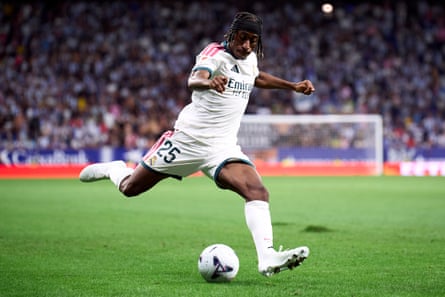
It may not be as simple as effort but that is a start. “We have to try not to negotiate things that are non-negotiable,” Mourinho said. “Commitment can’t be missing.” Mourinho has the authority to change that, or so it goes. He would be afforded it, anyway. That at least is the theory. Habits had been changed, demands made. Sessions had improved, or the attitude towards them. Diomande had said he was ready to “die” for his coach, who insisted that was just a phrase, but he could not help but be pleased with that.
There were other reasons to be optimistic. Vinícius’s future had been resolved at last, no lingering doubts over status or resentment. The World Cup is out the way, no other priority on the horizon. Mourinho noted that Brazil, France and England had found a way to get the best out of Vinícius, Mbappe and Bellingham, but that getting the best of all three is different. “I don’t think they’re incompatible,” he insisted; last year it often looked like they were, Bellingham, admitting that they find themselves occupying the same spaces at times.
Here, they all started. Bellingham was at No 10, Vinícius tight to the touchline. “For me this is his [Jude’s] position: the connection with the forwards, he can score goals. He has to play close to the goal. Playing at 6 or 8 we’re losing his closeness to the goal,” said Mourinho.
after newsletter promotion
Bellingham had an immediate impact, the first goal of this new era coming from a dead ball and after nine minutes. Vinícius was fouled, which was already looking like becoming a pattern – Alex Calatrava had already given him a kick in the back, prompting Mourinho to raise his arms – and from the left, Arda Guler delivered a superb cross. Bellingham leapt highest to head past Marko Dimitrovic.
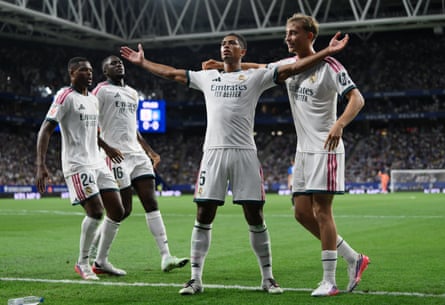
This time, sitting on the left end of the bench, Mourinho barely flinched. He got up, put his hands in his pockets and walked along the touchline to the other end where the rest of his sizeable staff sat in the overspill in the stand beyond the other end. There, he shook hands with Sami Khedira, the in-house assistant Madrid have provided him, and Roberto Merella, the analyst.
And that, it was tempting to assume, was that. The gap between the teams looked insurmountable. Madrid were pressing high, Espanyol barely able to find a way out. Here was a glimpse, they might have hoped, of the future. Instead, the intensity dropped again and that was an invitation for Espanyol.
When Dean Huijsen needed attention for a cut, Madrid’s players came to Mourinho for instructions but the game started to slip from them a little. Espanyol took a step forward and soon had an equaliser. Thibaut Courtois saved from Riedel, Roberto Fernández unable to keep down the follow-up. Then a lovely move concluded with Tuy Dolan and Javi Hernández setting up Calatrava to score. Mourinho sat almost motionless.
Twice Mbappé escaped to force saves from Dimitrovic, one on each side of the area, but it was Espanyol who should have led at the break. Again, the ball was worked into position. From the right, Omar El Hilali provided a superb cross. Dolan couldn’t quite get to it, inside the six-yard box, and Fernández headed it straight at his own feet. Mbappé may wonder how he didn’t put Madrid into the lead just after the break. From Guler’s corner, Bellingham headed against the bar, via Dimitrovic’s hand, and the ball dropped to the Frenchman right by the post. Somehow, it went wide.
Valverde hit the post, Mbappé shot wide, but there was no way through. Mourinho turned to the men behind him – Cucurella, Diomande, Camavinga, Alexander-Arnold, Espí – until, at last, he saw them dash past him, given a reprieve on his return.
“I think we deserved to win, but Espanyol didn’t deserve to lose,” Mourinho said as he ended the night with a touch of humility.
Explore more on these topics