


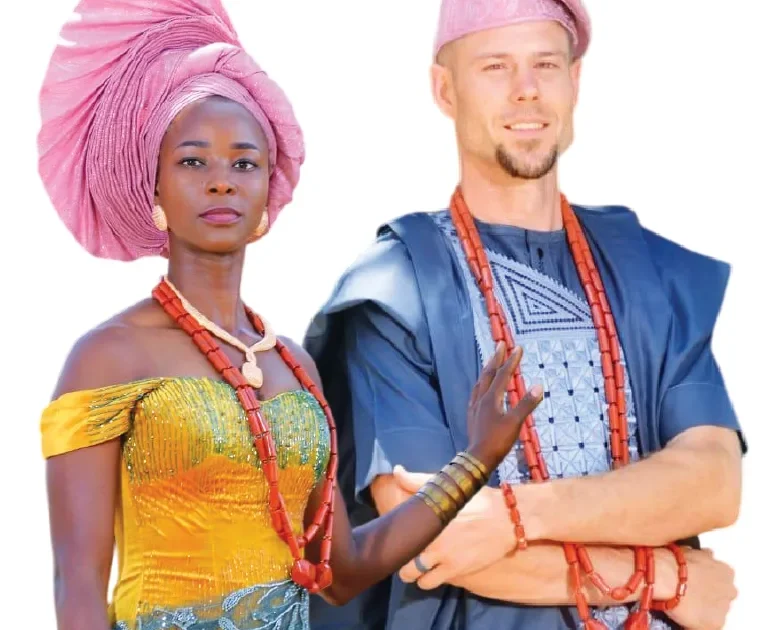
Why we left America for Nigeria with five children — US professor, wife
August 22, 2026 1:00 am

FILE: Pablo Segun and Aanu
Nigeria feels more like home than America — Pablo
A couple; Pablo Segun and Aanu, popularly known on social media as Familia PablAnu, speak with AYOOLA OLASUPO about their love story, their relocation to Nigeria, and how the move has brought them closer to their culture, family, and identity after years of searching for a sustainable life abroad.
Tell us about yourself.
My name is Pablo Segun. I was born and raised in the United States. I studied in Spain and became a professor, teaching Spanish-language linguistics for almost a decade.
What part of Nigeria are you currently based in?
We’re based in Ondo State, South-West Nigeria.
How did you and your wife, Aanu, meet?
When I met Aanu, I was teaching. We have five children together and have experienced a lot in the US, which led us to look for other ways of living and places where our children could thrive. The US was expensive and didn’t seem like a safe or healthy place for us. We wanted a sustainable life with more time for our children.
We didn’t want to only work, work, and work. I also had colleagues from Africa, including Tanzania and Nigeria, who told me that farming was their side job, even after earning PhDs in the US. That aligned with what we wanted, so we looked at East Africa and eventually went to Uganda.
We wanted to settle there, but finding land was difficult. While working on that, we decided to make a film, ‘My Love from Another Land’, our first feature film. We wrote, produced, and acted in it. It was Aanu’s idea, and we connected with a filmmaker in Uganda who helped us develop and produce it.
We later visited Nigeria. For me, it was a great experience finally coming to the continent and trying to assimilate into the culture.
What made you believe that the relationship could become something lasting?
We met in the same university town where Aanu had completed her professional degree. She was working, and I was teaching at the university. We met at a social gathering, and I was a bit shy. I wanted to talk to her but didn’t know how to approach her.
She was with an older woman who called me over and asked who I was. I said, “Yes, ma’am,” because in my culture, when an older person calls you, you come. I sat down and learnt that Aanu was from Nigeria. I asked, “Are you from Lagos?” She smiled, then her face fell when she heard how I pronounced Lagos. She said, “You mean Lagos?” I had never heard it pronounced that way.
I wanted to see her again, but I had to leave for Mexico for the summer. Unfortunately, I forgot to get her number. I spent the whole summer thinking about her and wondering if I would ever see her again. When I returned, I thought she was gone, but she showed up at another gathering.
I tried to play it cool. When she walked in, she lit up the room. It was like a bright light had come in. We started talking again, and I invited her somewhere. She said she couldn’t come because she was slaughtering a rooster for soup.
I thought she was a city girl, very prim and proper, so I was surprised. She even sent me a photograph. I had never talked to my mother about girls before, but when she was visiting, I told her, “Mum, you’ve got to meet this girl. This girl’s amazing.”
As I got to know Aanu, I wanted to do things properly. I knew she was living away from her family, so I asked for her father’s number so I could help her with things like airport rides and be an extra pair of eyes. She was hesitant, so I couldn’t get his number.
As we got closer, I told her I didn’t want to play around. After a few months, I knew she was the one I wanted to be with. I proposed, and we got married about six months later. It was roughly one year from when we first met to our wedding.
How many years have you been married to her?
We’ve been married for almost 10 years, and we now have five children.
What similarities made it easier for you to adapt?
Ugandans, for example, are more laid-back and calm. ‘They no get wahala.’ Time is also relative. If someone gives you a specific time, you might allow another hour or two. Our family has always been like that.
Food was another similarity. We already ate a lot of tropical foods. Growing up in the Midwestern US, getting plantains and other tropical foods wasn’t cheap, but they were already part of our family’s diet.
Uganda was also different from the US in terms of racism. People might call you oyinbo, but it wasn’t intense. You could be any kind of person, and they would simply say, “Oh, okay, interesting.” If you were friendly, they were friendly.
Uganda was calm and relaxing, but Nigeria is where we fit in the most. Nigeria is the first place where I truly feel at home. I think part of that is because my family feels at home. Aanu and the children really enjoy it here. They know the culture, language, and food. When we asked if they wanted to move from Uganda to Nigeria, they said yes immediately and packed their bags.
Before meeting Aanu, what did you imagine your life would look like, and how different is it today?
I was always flexible. I never had a particular picture of what my life would look like. I could go anywhere. I wasn’t planning on staying in the US, but when I met Aanu, I had a stable job and thought maybe this was what I could do for her. I did well as a professor, but it was stressful because the US isn’t an easy place to live. Even saving money is difficult. It’s a very challenging place.
What fears did you have about leaving America and relocating to Africa with your family?
For me, it was almost the opposite. It was my idea to come to Africa. I had wanted to come to Nigeria to teach for about a year and have my family spend that time here. I was more interested in opportunities and how they suited our family.
Our family culture is similar to many African cultures, including those in Uganda and Nigeria. I’ve always been flexible. I’ve studied and worked in different countries, and I enjoy learning languages and cultures, so adapting has never been difficult for me.
You speak Yoruba fluently. How did you learn it?
I wouldn’t say I speak Yoruba fluently, but I try. When Aanu and I started thinking about marriage and children, I knew I needed to learn her language so I could communicate with the children. After we got married, I took Yoruba courses at the university where I worked. I studied for about two semesters, or one year, to get the basics.
After our first child was born, Aanu spoke Yoruba to the children from birth, while I spoke Spanish to them. We’ve followed the “one face, one language” approach. As a linguistics researcher, I know that children can learn five or six languages without being confused. Because of that, I couldn’t use much Yoruba at home because it would break that pattern. The same applied to Aanu and Spanish.
Does your wife also speak Spanish?
She studied Spanish in school for about one or two years. I’m the only person in my immediate family who speaks Spanish. I studied many languages, but Spanish was the first one I learnt and the one I work with most.
In some parts of the US, Spanish is almost necessary for communication. By speaking our languages to the children, Aanu and I also understood each other’s languages, although we didn’t get many opportunities to practise speaking them.
When we first visited Nigeria for Christmas about three years ago, it was the first time I really practised Yoruba. Since moving here permanently a year ago, I’ve had far more opportunities to practise.
For the children, Yoruba is now very strong. I try to keep Spanish strong as well. They understood English from infancy, although we don’t require them to speak it. The older ones started learning it in Uganda because English is widely spoken there. They learnt very quickly.
Your family has attracted a significant audience through Familia PablAnu. Why expose your family life on social media?
We started because we were leaving the country and wanted both families to stay connected with us. We wanted them to know what we were doing step by step without constantly calling or sending videos and photographs. We thought we could monetise it in the future, but the main reason was family connection. When we call them, they already know where we are and what we’re doing.
Since relocating to Nigeria, what has the experience been like?
A lot of Nigerian culture fits with my background in the southern US, where we also place importance on respecting elders. We say, “Yes, sir,” “No, sir,” “Yes, ma’am”, and “No, ma’am.”
In Uganda, people saw me as light-skinned and a foreigner, but they were relaxed about it. Nigeria was different because of the strong colourism. There’s a belief that lighter skin means beauty and goodness. I had never experienced colourism before coming here, so it was new to
I thought there was nothing good left in Nigeria until I returned — Aanu, wife
Pablo spoke about the decision to relocate to Nigeria, but what did you personally feel when the possibility of building a life together became real?
I was so happy that my parents would finally leave me alone because they were hinting that I was getting to that age when I should bring home a prospective suitor. They were even suggesting someone who had a son in the US.
They felt that, as Nigerians, we needed to stick together in the US. So, when I brought Pablo home and they saw that he was cool-headed, I thought, “Finally, they will leave me alone.” We liked each other, and it worked out.
As a mother raising five children who have learnt to speak Spanish, Yoruba, and English across different cultures, what parts of your Nigerian and American heritage are you determined to preserve in them?
Even I am a Nigerian-American, and sometimes I still struggle with an identity crisis. I’m not Nigerian enough for Nigerians here because I’ve lived away for so long. In the US, too, I’m not American enough because my accent sometimes gives me away. I feel like I don’t quite belong in one category, and that’s okay. That’s going to be the same situation for our children.
They won’t fit into a specific box. We want to preserve everything we can—keep the good and leave the bad. They will retain the languages so that if they decide to go to South America, the US, Africa, or anywhere else, they will have the tools to excel. We want to preserve all aspects of who they are because that’s their identity.
Your husband mentioned the high level of racism in the United States. As a Black woman, did you have any experiences with racism and discrimination there?
There were many experiences, even before meeting Pablo. When I met him, I started telling him about them. He was oblivious. He didn’t know a lot of these things, and I had to say, “Did you know that’s racism right there?” Then he would say, “Wow.” He never had to leave the house and think about these things because he had that privilege.
When I was an undergraduate, I was friends with international groups because people from different places had shared experiences. I tried to make friends with my classmates, and one guy told me, “It’s not you; it’s just that your skin tone is too dark for me.” I was like, “How did we get here? What do you mean my skin is too dark?”
Later, I went to graduate school in Indiana. I would ride the bus to campus and, as soon as I was seated and more people entered, if they saw me sitting there, they wouldn’t want to sit next to me. Sometimes, all the seats would be taken except the one beside me. I had already moved my bag away, thinking, “Come on, there’s a seat right there.”
But they would rather stand than sit beside me. Even when they sat next to me, they made sure their bodies didn’t touch mine. They acted as if I was disgusting, like a piece of dirt. You could tell from the way they looked at you that they were looking down on you.
After we got married, I also got many stares from older men and women. They would look at us and look at Pablo as if he was doing something wrong by being with me. There was a particular time Pablo was not there. I took three of our children to pick chestnuts. We lived in a small town with mostly white people.
I had asked the owner of the property for permission to gather them because they were simply wasting away on the ground. He said yes. All of a sudden, I saw the police show up. I thought, “Oh, somebody called the police on me; for what?” They were looking in my direction and were about to come towards me.
How were you able to get off the hook?
I called Pablo and told him what was happening. He said, “Just stay calm. If they come to ask you questions, put me on the phone.”
I hadn’t done anything wrong. I was simply picking chestnuts with my children. But anyone with my skin tone walking there, even though I lived in the neighbourhood, could be seen as homeless or as someone who didn’t belong. I stayed on the phone, picked what I needed, and told the kids, “Let’s go.”
After that, I usually didn’t go there unless Pablo was with me. There were many more experiences like that. You just know you’re not safe because anything can go wrong. I’m a woman, which is probably less threatening to them. If my skin is this dark and I were a man, forget it. I would have been shot dead long ago. Even in supermarkets, people would look at my children and say, “Oh, what a pity.”
As if, by having me as their mother, I had ruined their lives. Here, people are always happy to see our children. Over there, it was like, “Why would you bring them into this world? It’s going to be difficult for these children.” I was like, “Are you kidding me?”
I also worked in a doctor’s office. Sometimes, when I went to attend to patients or draw blood, they would say, “No, I want someone else.” As soon as they saw me, you could tell they didn’t want to deal with me. I would tell a colleague, “Do you want to take this patient? They don’t want me to attend to them.” Many experiences like that left me frustrated and depressed. It was awful.
With those experiences, when your husband suggested moving to Nigeria, why did you kick against it?
My parents live in the US, and they believe it is a land of opportunity, but everything I saw was contrary to that. You work endlessly. When we got married, we had four children, and Pablo said, “Why don’t we move to West Africa, maybe Togo or somewhere?” I was like, “Why would you go back to that country? At this point, there’s nothing good about Nigeria in my head.”
Even though I was facing discrimination and racism in the US, something in my mindset had shifted since I left Nigeria. I loved the food and music, but I believed Nigeria had insecurity and too many problems. Even my parents said they would never want to come and live here.
So, when Pablo said, “Let’s go and live there,” I was like, “Are you kidding me? Don’t you hear the news? Why would you put us in that situation?” I never told him anything positive about Nigeria because it wasn’t even in my thoughts. When I refused West Africa, we started looking elsewhere.
Then he said, “How about Uganda?” I didn’t even know where Uganda was on the map. I was like, “Let’s go. It’s Africa, right? As long as it’s not West Africa or Nigeria, I’m fine.” That’s how we ended up in Uganda.
When we told my parents we were leaving the US for Africa, they were like, “Are you crazy? You’re leaving this opportunity.” I said, “What opportunity? We’re struggling. Everyone there is struggling.” They almost disowned me, but this was what we wanted for our family. We tried Uganda but eventually realised it wasn’t working.
When my parents saw our situation, they said Nigeria might actually be better. That changed their perspective. We then started thinking about Nigeria. Here, you can farm and grow food. The children can eat tropical foods, speak the language, and connect with their roots. So, we eventually relocated to Nigeria.
Are you originally from Ondo State?
Yes, both my parents are from Ondo State, but I grew up in Ogun State.
What is the biggest misconception you wish people would stop making about moving to Africa?
A lot of people think we came here because we failed abroad or did something wrong. That’s not true. It’s a shame that some people see returning to your home country as a failure. Some still believe America or other foreign countries are lands flowing with milk and honey, even when people are working three or four jobs. We found that Nigeria works better for our family than Uganda, and we didn’t know that before coming here.
Ayoola Olasupo is a journalist at Punch Newspapers with six years of experience reporting on metro, crime, human-interest interviews, politics, and feature stories. He focuses on amplifying underrepresented voices and producing stories that promote justice, empathy, and informed public dialogue. Ayoola’s reporting reflects practical newsroom experience, editorial insight, and a dedication to accurate, impactful, and socially conscious journalism.
All rights reserved. This material, and other digital content on this website, may not be reproduced, published, broadcast, rewritten or redistributed in whole or in part without prior express written permission from PUNCH.
Contact: [email protected]