


Marco Rubio has unique power to promote peace in the world. Why isn’t he doing his job?

As chief US diplomat, Rubio could do great good – but he hasn’t yet. His pandering and neglect are a disgrace we shouldn’t ignore
Viewed from the state department in Washington DC, the world is on fire – but record heatwaves are not to blame. The unresolved Iran war has badly burned Donald Trump. His military campaign conclusively failed, energy and food prices are still rising, and a Republican rout in November’s midterm elections looms. Humiliatingly, Israel this week flatly rejected his latest Gaza peace proposals, days after Trump congratulated himself on a “historic breakthrough”. In Europe, Russia’s attacks on Nato allies grow increasingly brazen, threatening a wider escalation. The Ukraine war, which Trump vowed to end, is now well into its fifth year, with civilians on both sides caught in the killing fields. And these are just the bigger firestorms. There are plenty more.
Rarely has the need for effective, professional diplomacy been more pressing. So step forward Marco Rubio, US secretary of state and chief American diplomat. These are challenges that, if successfully tackled, could propel the 55-year-old son of Cuban immigrants and the former US senator for Florida into pole position in the 2028 Republican presidential nomination race. Here is a chance for Rubio to defy critics who dismiss him as a lickspittle and Trump dogsbody, and transform himself into respected global statesman. His boss mocked him as “little Marco” and a “loser” when they were election rivals in 2016. (Rubio called him a conman.) Now is Rubio’s opportunity to go big, be brave and prove he’s a winner.
Or maybe not.
Rubio is unlike recent US secretaries of state – heavyweights such as Hillary Clinton and Antony Blinken, or John Kerry, famed for his high-energy shuttle diplomacy. Rubio has little time for “peace processes”. Instead, he projects brute US power to impose take-it-or-leave-it “solutions” that advance US interests, as defined by Trump. It’s a modern form of imperialism. Target countries have a choice: become client states, like Venezuela and, prospectively, Cuba and Greenland, or be crushed. In Iran, the policy is not regime change, let alone democratic renewal. It’s regime compliance. Rubio behaves less like a peace-broker, more like a pith-helmeted colonial viceroy demanding fealty from obsequious satraps.
Speaking in Munich in February, Rubio aired his hawkishly retro doctrine of US primacy. He lamented the decline of “the great western empires … accelerated by godless communist revolutions and anti-colonial uprisings” and warned Europe faced “civilisational erasure”. The US didn’t want milksop allies “shackled by guilt and shame” about their imperial past, he said. “We want allies who are proud of their culture and heritage … and who, together with us, are willing and able to defend it.” Here was a familiar assertion of US hegemony, but one stripped of bogus altruism and pretence. It sounded a death knell for diplomacy. Trump has attacked eight countries in the past year. Cuba, Rubio’s obsession, could be next.
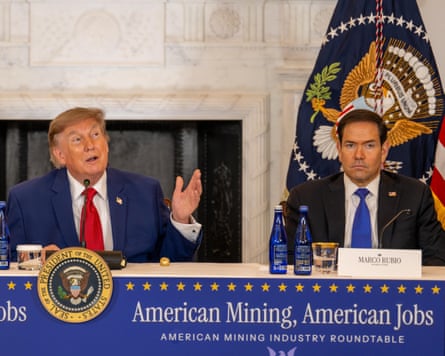
Rubio’s reluctance to get personally involved in peacemaking may be partly explained by his other, contradictory role, as Trump’s national security adviser. He has accepted the White House’s outsourcing of negotiations over Ukraine and Palestine to amateur envoys of limited ability – namely Trump’s son-in-law, Jared Kushner, and business crony Steve Witkoff. Broadly speaking, Rubio has steered clear of direct involvement in the Iran talks, too, leaving JD Vance, the vice-president and his main potential rival in 2028, to take the flak. Rubio’s arm’s length approach smacks of calculation. Or maybe he’s just out of his depth. Maybe he has no clear idea what he, Marco, really thinks about any of these issues and simply does Trump’s erratic bidding.
This perception of a political chameleon lacking firm principles, consistent opinions and a strong moral compass is reinforced by his record. His biographer, Manuel Roig-Franzia, believes Rubio’s personal and political slipperiness – he once became a Mormon, then reverted to Catholicism – is rooted in a childhood need to belong, to be on the winning side, no matter the price. Senator Rubio was a China hawk. Now he toes Trump’s ingratiating line on Beijing. He used to castigate Russia; now he’s an appeaser. He championed overseas assistance but, in office, has gutted USAID and seeks to dismantle the international criminal court, a keystone of global order. He blasted Barack Obama’s Iran nuclear deal. Now he backs an accord that would offer additional concessions to Tehran. Accused by the Vatican of waging an immoral, unjust war, he travelled to Rome and set the pope straight.
The irony, or tragedy, of the Rubio conundrum is he has the power to do great good, if only he would stand up and be counted. Russia’s Vladimir Putin, losing on the battlefield and at home, is weaker than at any time since 2022. Ukraine’s Volodymyr Zelenskyy is short of missile interceptors, soldiers and political support. A ceasefire deal freezing the conflict is there for the making by the only country – the US – that can meaningfully squeeze both sides. Likewise, in Israel, the architect of the Gaza genocide and disastrous wars with Hamas, Iran and Hezbollah – Benjamin Netanyahu – faces defeat in October’s elections. Here’s a rare opportunity to quietly shelve Trump’s Board of Peace idiocies, halt Jewish settler violence in the West Bank and make a fresh, inclusive start based on UN resolutions.
after newsletter promotion
Rubio could also do the Middle East, the global economy, American consumers and himself a power of good by taking charge of moribund peace talks with Iran and resuscitating the June memorandum of understanding that Tehran insists is the only route out of the strait of Hormuz logjam. In doing so, Rubio would have the enthusiastic backing of most Americans, European and Gulf state governments, energy producers and businesses, and Maga supporters who rightly fear Trump has dragged the US into another forever war. Even Trump may be grateful. He knows he’s in a hole. He needs someone to dig him out.
The fact that Rubio, despite his ostensibly uniquely powerful position, is unlikely to do any of the above marks him out as the most dangerous man in the US administration after Trump himself. He is dangerous because he enables and facilitates Trump’s worst instincts – and neglects his duty. He is dangerous because he provides pseudo-intellectual respectability to far-right fantasies about unfettered US supremacy. More so than the impetuous Vance, indulging in puerile name-calling on social media, and the “secretary of war” Pete Hegseth, a ranting ultra-nationalist, Rubio is dangerous because he can look and sound reasonable. He stands a fair chance of becoming Trump’s chosen successor and heir to the Maga brand.
Maybe, before that happens, he will change again. Maybe he will rediscover a few principles, find a diplomatic backbone, extinguish a few fires. He has shown repeatedly that his views are infinitely fungible. Rubio could yet do great things. Or he could become a problem as great or greater than Trump.
-
Simon Tisdall is a Guardian foreign affairs commentator
Explore more on these topics